Barnes Mallory L, Breshears David D, Law Darin J, van Leeuwen Willem J D, Monson Russell K, Fojtik Alec C, Barron-Gafford Greg A, Moore David J P
School of Natural Resources and the Environment, University of Arizona, Tucson, Arizona, United States of America.
Department of Ecology and Evolutionary Biology, University of Arizona, Tucson, Arizona, United States of America.
PLoS One. 2017 Dec 27;12(12):e0189539. doi: 10.1371/journal.pone.0189539. eCollection 2017.
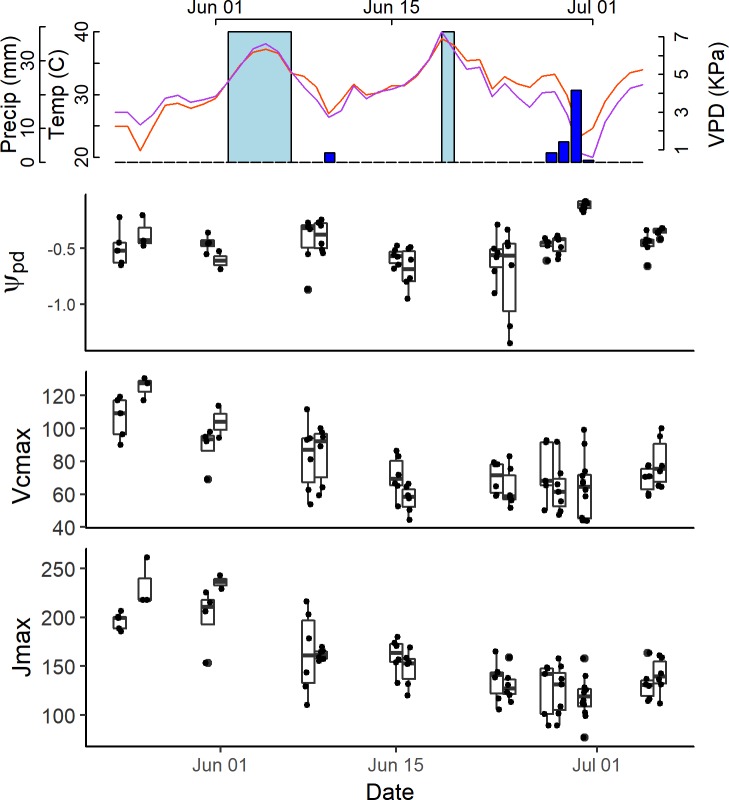
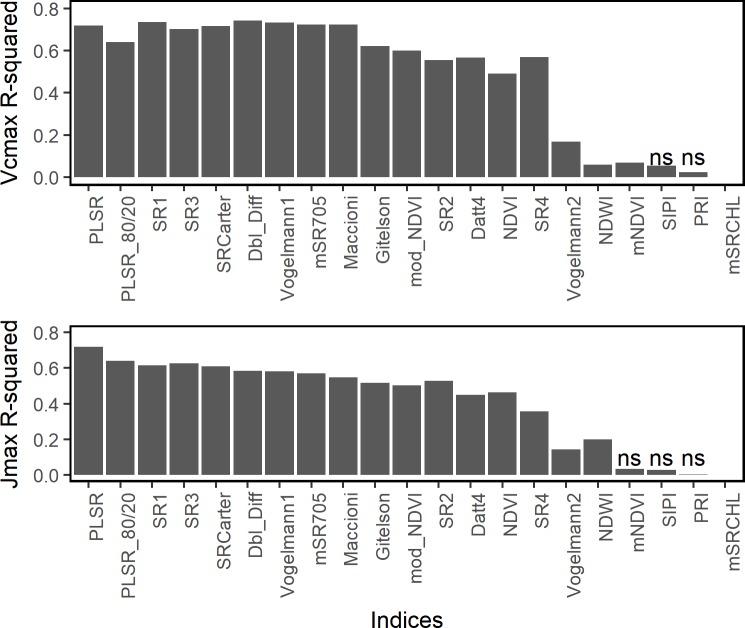
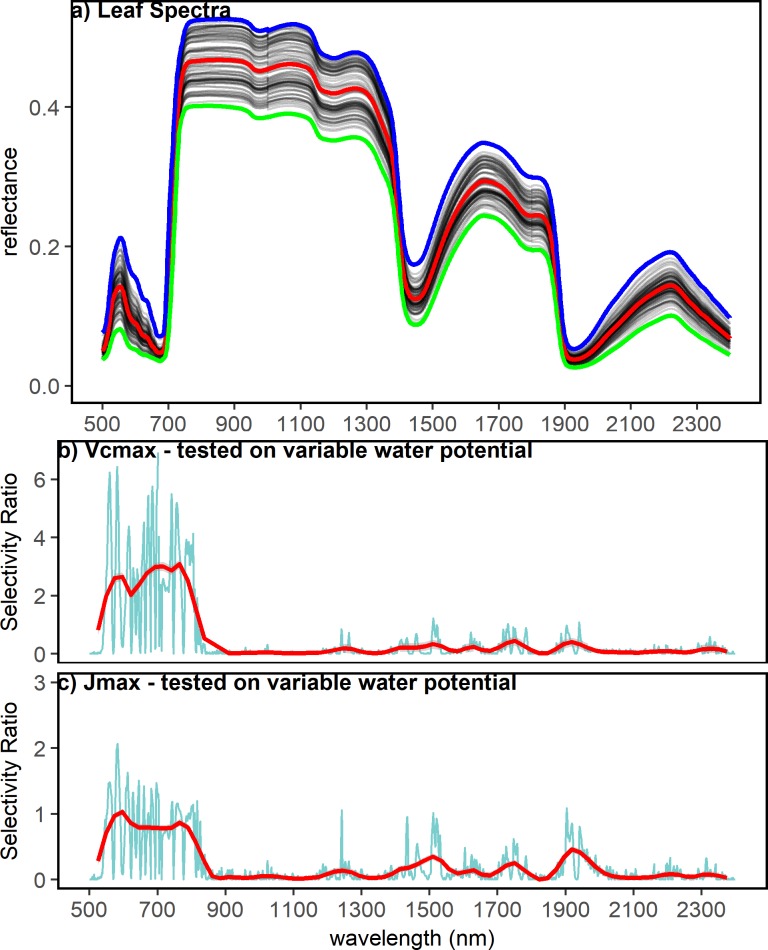
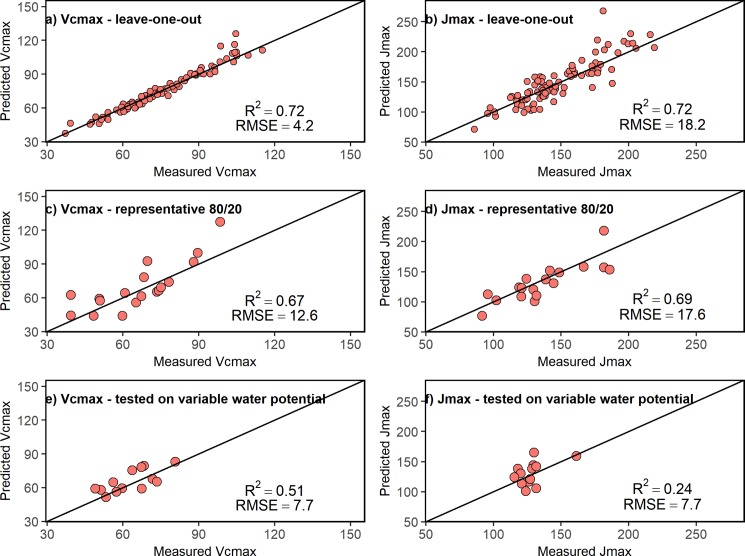
Earth's future carbon balance and regional carbon exchange dynamics are inextricably linked to plant photosynthesis. Spectral vegetation indices are widely used as proxies for vegetation greenness and to estimate state variables such as vegetation cover and leaf area index. However, the capacity of green leaves to take up carbon can change throughout the season. We quantify photosynthetic capacity as the maximum rate of RuBP carboxylation (Vcmax) and regeneration (Jmax). Vcmax and Jmax vary within-season due to interactions between ontogenetic processes and meteorological variables. Remote sensing-based estimation of Vcmax and Jmax using leaf reflectance spectra is promising, but temporal variation in relationships between these key determinants of photosynthetic capacity, leaf reflectance spectra, and the models that link these variables has not been evaluated. To address this issue, we studied hybrid poplar (Populus spp.) during a 7-week mid-summer period to quantify seasonally-dynamic relationships between Vcmax, Jmax, and leaf spectra. We compared in situ estimates of Vcmax and Jmax from gas exchange measurements to estimates of Vcmax and Jmax derived from partial least squares regression (PLSR) and fresh-leaf reflectance spectroscopy. PLSR models were robust despite dynamic temporal variation in Vcmax and Jmax throughout the study period. Within-population variation in plant stress modestly reduced PLSR model predictive capacity. Hyperspectral vegetation indices were well-correlated to Vcmax and Jmax, including the widely-used Normalized Difference Vegetation Index. Our results show that hyperspectral estimation of plant physiological traits using PLSR may be robust to temporal variation. Additionally, hyperspectral vegetation indices may be sufficient to detect temporal changes in photosynthetic capacity in contexts similar to those studied here. Overall, our results highlight the potential for hyperspectral remote sensing to estimate determinants of photosynthetic capacity during periods with dynamic temporal variations related to seasonality and plant stress, thereby improving estimates of plant productivity and characterization of the associated carbon budget.
地球未来的碳平衡和区域碳交换动态与植物光合作用有着千丝万缕的联系。光谱植被指数被广泛用作植被绿度的代理指标,并用于估算诸如植被覆盖度和叶面积指数等状态变量。然而,绿叶吸收碳的能力在整个季节中会发生变化。我们将光合能力量化为核酮糖-1,5-二磷酸羧化酶(Vcmax)的最大速率和再生(Jmax)。由于个体发育过程与气象变量之间的相互作用,Vcmax和Jmax在季节内会有所变化。利用叶片反射光谱基于遥感估算Vcmax和Jmax很有前景,但这些光合能力的关键决定因素、叶片反射光谱以及连接这些变量的模型之间关系的时间变化尚未得到评估。为了解决这个问题,我们在仲夏的7周时间里对杂交杨树(Populus spp.)进行了研究,以量化Vcmax、Jmax和叶片光谱之间的季节性动态关系。我们将通过气体交换测量得到的Vcmax和Jmax的原位估计值与通过偏最小二乘回归(PLSR)和鲜叶反射光谱法得到的Vcmax和Jmax估计值进行了比较。尽管在整个研究期间Vcmax和Jmax存在动态时间变化,但PLSR模型仍然稳健。植物胁迫的种群内变异适度降低了PLSR模型的预测能力。高光谱植被指数与Vcmax和Jmax高度相关,包括广泛使用的归一化植被指数。我们的结果表明,使用PLSR对植物生理性状进行高光谱估计可能对时间变化具有稳健性。此外,在类似于本文所研究的环境中,高光谱植被指数可能足以检测光合能力的时间变化。总体而言,我们的结果突出了高光谱遥感在估算与季节性和植物胁迫相关的动态时间变化期间光合能力决定因素方面的潜力,从而改进对植物生产力的估计以及相关碳预算的表征。