Division of Medical Oncology, Department of Internal Medicine, Yonsei Cancer Center, Yonsei University College of Medicine, Seoul, Korea.
College of Medicine, Yonsei University Graduate School, Seoul, Korea.
Cancer Res Treat. 2018 Oct;50(4):1238-1251. doi: 10.4143/crt.2017.534. Epub 2017 Dec 28.
Uveal melanoma has a very poor prognosis despite successful local primary tumor treatment. In this study, we investigated prognostic factors that more accurately reflected the likelihood ofrecurrence and survival and delineated a prognostic model that could effectively identify different risk groups based on initial clinical parameters.
Prognostic factors associated with distant recurrence, recurrence-free survival (RFS), progression-free survival, and overall survival from distant recurrence to death (OS2) were analyzed in 226 patients with stage I-III uveal melanoma who underwent primary local therapy.
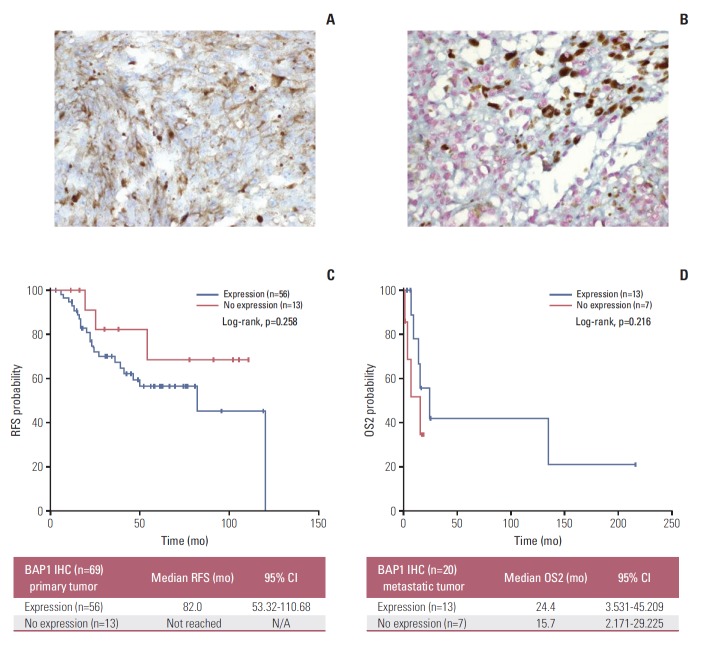
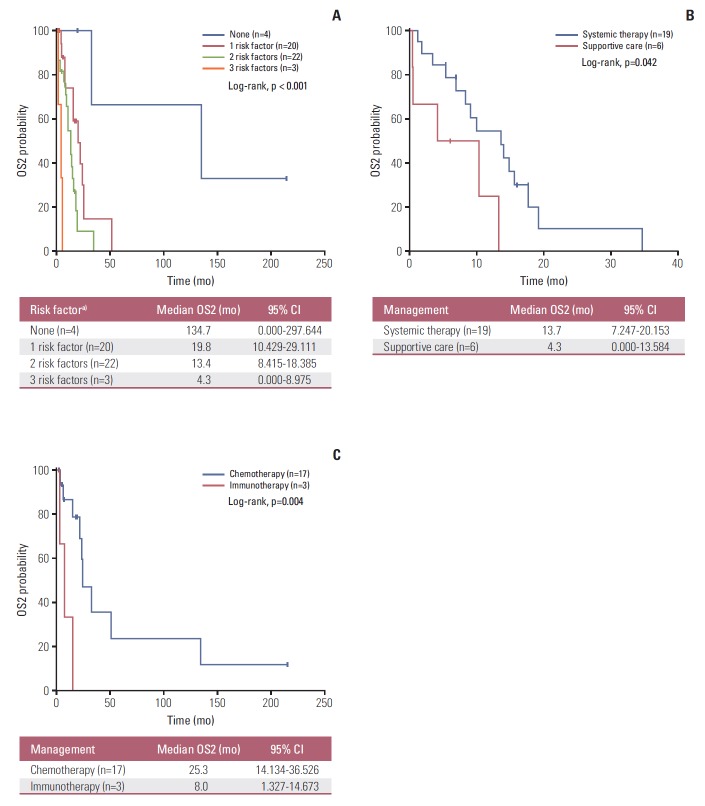
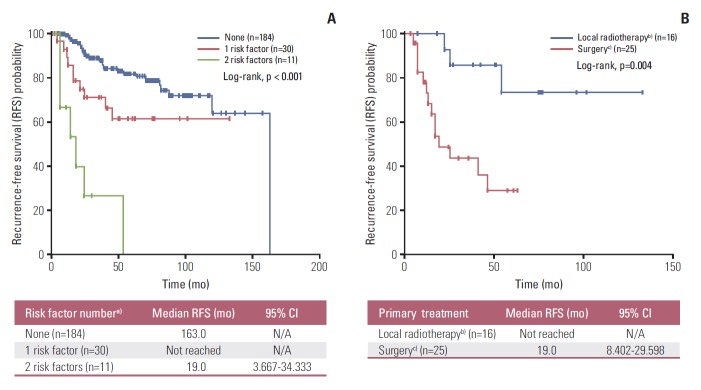
Forty-nine patients (21.7%) had distant recurrences, which occurred most frequently in the liver (87.7%). In a multivariate analysis, local radiotherapy improved RFS among patients with multiple recurrence risk factors relative to excision (not reached vs. 19.0 months, p=0.004). Patients with BRCA1-associated protein-1 (BAP1)‒negative primary tumors showed a longer RFS duration after primary treatments, while those with BAP1-negative metastatic tissues had a shorter OS2 compared to those with BAP1-positive tumors, both not statistically insignificance (RFS: not reached vs. 82.0 months, p=0.258; OS2: 15.7 vs. 24.4 months, p=0.216). Male sex (hazard ratio [HR], 3.79; p=0.012), a short RFS (HR, 4.89; p=0.014), and a largest metastatic tumor linear diameter ≥ 45 mm (HR, 5.48; p=0.017) were found to correlate with worse post-recurrence survival.
Risk factors could be used to classify uveal melanoma cases and subsequently direct individual treatment strategies. Furthermore, metastasectomy appears to contribute to improved survival outcomes.
尽管局部原发性肿瘤治疗成功,葡萄膜黑色素瘤的预后仍非常差。在本研究中,我们研究了更能准确反映复发和生存可能性的预后因素,并制定了一种预后模型,该模型可以根据初始临床参数有效地识别不同的风险组。
分析了 226 例接受局部初始治疗的 I-III 期葡萄膜黑色素瘤患者中与远处复发、无复发生存(RFS)、无进展生存(PFS)和远处复发至死亡的总生存(OS2)相关的预后因素。
49 例(21.7%)患者发生远处复发,最常发生于肝脏(87.7%)。多因素分析显示,与切除术相比,局部放射治疗改善了具有多种复发危险因素患者的 RFS(未达到 vs. 19.0 个月,p=0.004)。原发肿瘤为 BRCA1 相关蛋白 1(BAP1)阴性的患者在接受原发治疗后 RFS 持续时间较长,而转移组织为 BAP1 阴性的患者与 BAP1 阳性肿瘤相比,OS2 更短,均无统计学意义(RFS:未达到 vs. 82.0 个月,p=0.258;OS2:15.7 vs. 24.4 个月,p=0.216)。男性(危险比 [HR],3.79;p=0.012)、RFS 较短(HR,4.89;p=0.014)和最大转移瘤线性直径≥45 mm(HR,5.48;p=0.017)与复发后生存较差相关。
风险因素可用于对葡萄膜黑色素瘤病例进行分类,从而指导个体化治疗策略。此外,转移瘤切除术似乎可改善生存结局。