Department of Bioinformatics, Wissenschaftszentrum Weihenstephan, Technische Universität München, Freising, 85354, Germany.
Medigene Immunotherapies GmbH, a subsidiary of Medigene AG, Planegg, 82152, Germany.
BMC Cancer. 2017 Dec 28;17(1):892. doi: 10.1186/s12885-017-3854-8.
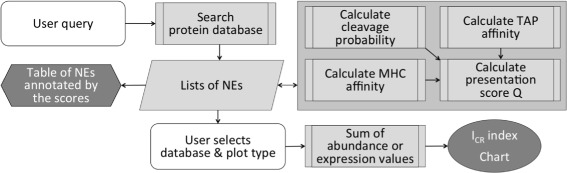
Adoptive immunotherapy offers great potential for treating many types of cancer but its clinical application is hampered by cross-reactive T cell responses in healthy human tissues, representing serious safety risks for patients. We previously developed a computational tool called Expitope for assessing cross-reactivity (CR) of antigens based on tissue-specific gene expression. However, transcript abundance only indirectly indicates protein expression. The recent availability of proteome-wide human protein abundance information now facilitates a more direct approach for CR prediction. Here we present a new version 2.0 of Expitope, which computes all naturally possible epitopes of a peptide sequence and the corresponding CR indices using both protein and transcript abundance levels weighted by a proposed hierarchy of importance of various human tissues.
We tested the tool in two case studies: The first study quantitatively assessed the potential CR of the epitopes used for cancer immunotherapy. The second study evaluated HLA-A*02:01-restricted epitopes obtained from the Immune Epitope Database for different disease groups and demonstrated for the first time that there is a high variation in the background CR depending on the disease state of the host: compared to a healthy individual the CR index is on average two-fold higher for the autoimmune state, and five-fold higher for the cancer state.
The ability to predict potential side effects in normal tissues helps in the development and selection of safer antigens, enabling more successful immunotherapy of cancer and other diseases.
过继性免疫疗法为治疗多种类型的癌症提供了巨大的潜力,但由于健康人体组织中存在交叉反应性 T 细胞反应,其临床应用受到阻碍,这对患者构成了严重的安全风险。我们之前开发了一种名为 Expitope 的计算工具,用于根据组织特异性基因表达评估抗原的交叉反应性 (CR)。然而,转录丰度仅间接表明蛋白质表达。最近获得的人类蛋白质丰度信息的全谱现在为 CR 预测提供了一种更直接的方法。在这里,我们提出了 Expitope 的新版本 2.0,它使用蛋白质和转录丰度水平以及我们提出的各种人体组织重要性层次结构对其进行加权,计算肽序列的所有自然可能表位及其相应的 CR 指数。
我们在两个案例研究中测试了该工具:第一项研究定量评估了用于癌症免疫疗法的表位的潜在 CR。第二项研究评估了来自免疫表位数据库的针对不同疾病组的 HLA-A*02:01 限制性表位,并首次证明,根据宿主的疾病状态,背景 CR 存在很大差异:与健康个体相比,自身免疫状态下的 CR 指数平均高两倍,癌症状态下高五倍。
预测正常组织中潜在副作用的能力有助于开发和选择更安全的抗原,从而更成功地进行癌症和其他疾病的免疫治疗。