Li Fangzhou, Takechi Hajime, Kokuryu Atsuko, Takahashi Ryosuke
Department of Neurology, Kyoto University Graduate School of Medicine, Kyoto, Japan.
Department of Geriatrics and Cognitive Disorders, Fujita Health University School of Medicine, Toyoake, Japan.
Dement Geriatr Cogn Dis Extra. 2017 Nov 8;7(3):366-373. doi: 10.1159/000481910. eCollection 2017 Sep-Dec.
Neuropsychological tests that can track changes in cognitive functions after diagnosis of Alzheimer disease (AD) and mild cognitive impairment (MCI), including episodic memory, should be further developed.
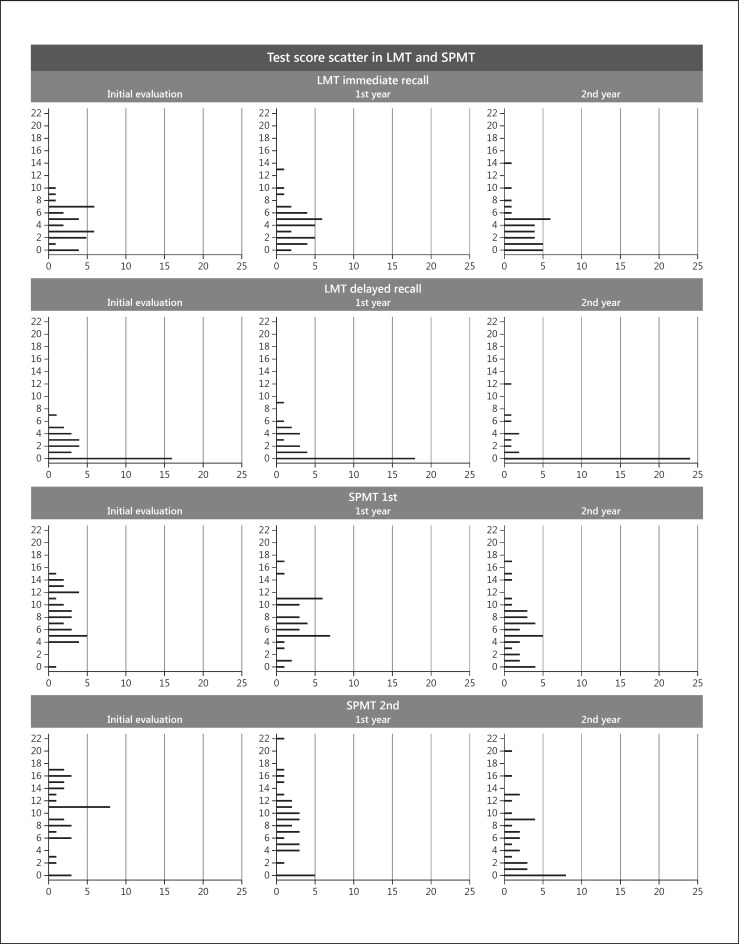
The participants of our study consisted of 22 mild AD patients and 11 MCI patients. They were followed up for 2 years. Brief cognitive screening tests were administered to the participants. Longitudinal changes in test performance were evaluated and analyzed.
In this longitudinal study, the Scenery Picture Memory Test (SPMT) showed significant changes over 2 years in both MCI and AD participants. The Mini-Mental State Examination (MMSE) and Word Fluency Test-vegetable showed significant changes only in AD participants. Other tests all showed little or no decline in results.
The SPMT can be a useful tool for effectively observing changes during follow-up of MCI and AD patients.
能够追踪阿尔茨海默病(AD)和轻度认知障碍(MCI)诊断后认知功能变化的神经心理学测试,包括情景记忆测试,应进一步开发。
我们研究的参与者包括22名轻度AD患者和11名MCI患者。他们接受了2年的随访。对参与者进行了简短的认知筛查测试。对测试表现的纵向变化进行了评估和分析。
在这项纵向研究中,风景图片记忆测试(SPMT)在MCI和AD参与者中均显示出2年内的显著变化。简易精神状态检查表(MMSE)和蔬菜词流畅性测试仅在AD参与者中显示出显著变化。其他测试结果均显示几乎没有下降或没有下降。
SPMT可以成为有效观察MCI和AD患者随访期间变化的有用工具。