Department of Gerontology, Shanghai Jiao Tong University Affiliated Sixth People's Hospital, No. 600, Yi Shan Road, Shanghai, P. R. China.
Department of Neurology and Institute of Neurology, Huashan Hospital, Shanghai Medical College, Fudan University, Shanghai, China.
BMC Neurol. 2020 Mar 5;20(1):78. doi: 10.1186/s12883-020-01657-9.
Subtle cognitive decline (SCD) may represent a very early stage of objective cognitive impairment before mild cognitive impairment (MCI), with less neuronal damage and more functional reservation. Detecting individuals with SCD is imperative for dementia prevention and treatment. In this study, we aimed to compare the validations of three cognitive screening tests, Mini-Mental State Examination (MMSE), Montreal Cognitive Assessment-Chinese Version (MoCA-CV), and Memory and Executive Screening (MES), in identifying subtle cognitive decline.
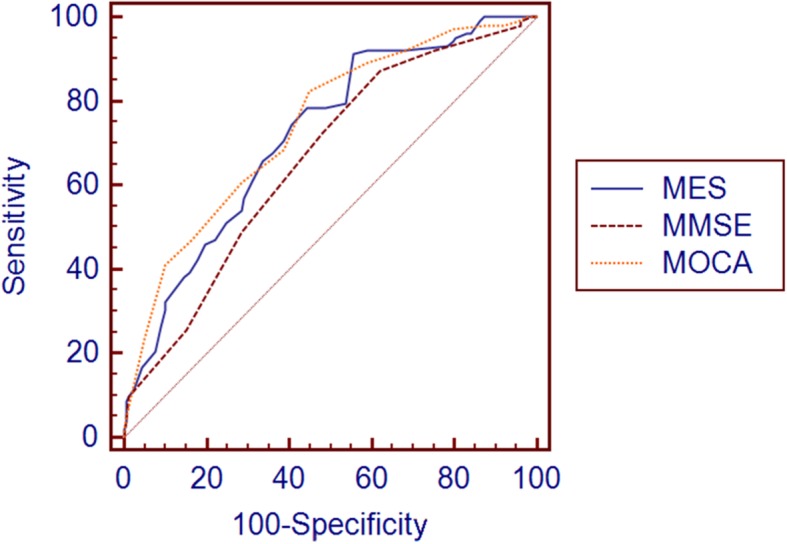
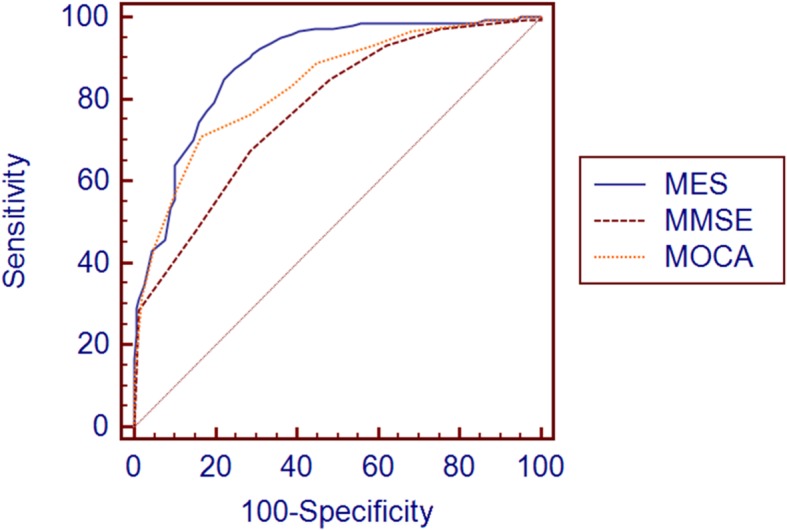
A total of 407 individuals were recruited, including 147 cognitively normal controls (NC), 102 individuals with subtle cognitive decline (SCD) and 158 individuals with mild cognitive impairment (MCI) according to the operational neuropsychological criteria proposed by Jak and Bondi's. All participants underwent standardized comprehensive neuropsychological tests and the three cognitive screening tests. Chi-square analysis was used to compare the cognitive performance among the groups of NC, SCD and MCI. Receiver operating characteristic (ROC) curves were used to evaluate the abilities of MMSE, MoCA-CV and MES in discriminating NC, SCD and MCI.
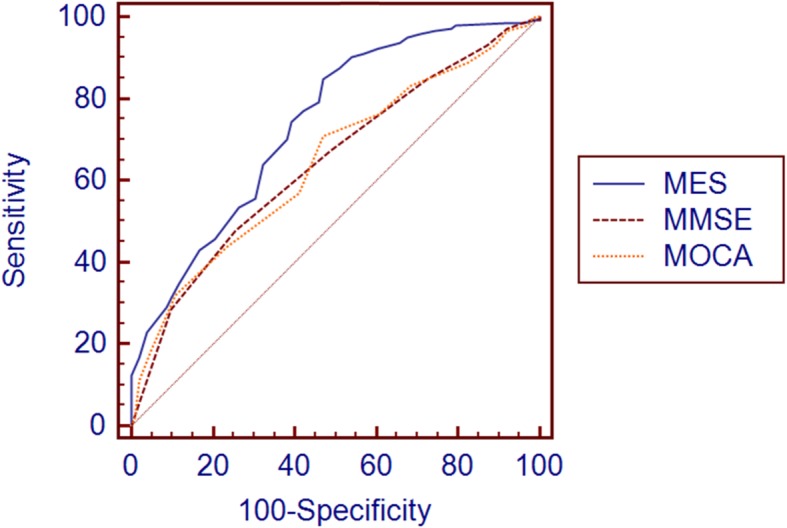
Compared with NC, SCD showed a significant decline only in the tests of memory, such as Auditory Verbal Learning Test (AVLT), Rey-Osterrieth Complex Figure Test (CFT) and Prospective Memory Test (PrM) (P < 0.01). However, MCI showed significant decline in all cognitive performances (P < 0.01). The scores of MMSE, MoCA-CV and MES all showed a progressive downward trend within the groups of NC, SCD and MCI (P < 0.001). In ROC Analyses for discriminating individuals with SCD from NC, the most appropriate MES cutoff was 84, with a sensitivity of 74.3%, a specificity of 60.8% and 0.738 for AUC (95%CI, 0.675-0.801). By contrast, MMSE and MOCA-CV had poor sensitivity (67.4 and 70.8%, respectively) and specificity (51.0 and 52.9%, respectively), and smaller AUCs (0.643 and 0.644, respectively) than the MES.
As a screening test, MES is more efficacious in identifying SCD from normal controls than MMSE and MoCA-CV.
认知功能轻度下降(MCI)之前可能存在细微认知减退(SCD),这是一种更早期的客观认知障碍,神经元损伤更少,功能储备更多。检测 SCD 患者对于痴呆症的预防和治疗至关重要。本研究旨在比较三种认知筛查测试,即简易精神状态检查(MMSE)、蒙特利尔认知评估-中文版(MoCA-CV)和记忆与执行筛查(MES),在识别细微认知减退方面的有效性。
根据 Jak 和 Bondi 的操作性神经心理学标准,共招募了 407 名参与者,包括 147 名认知正常对照(NC)、102 名细微认知减退(SCD)患者和 158 名轻度认知障碍(MCI)患者。所有参与者均接受了标准化的全面神经心理学测试和三种认知筛查测试。卡方检验用于比较 NC、SCD 和 MCI 三组的认知表现。受试者工作特征(ROC)曲线用于评估 MMSE、MoCA-CV 和 MES 区分 NC、SCD 和 MCI 的能力。
与 NC 组相比,SCD 组仅在记忆测试中表现出明显下降,如听觉词语学习测试(AVLT)、 Rey-Osterrieth 复杂图形测试(CFT)和前瞻性记忆测试(PrM)(P<0.01)。然而,MCI 组在所有认知表现上均表现出显著下降(P<0.01)。MMSE、MoCA-CV 和 MES 的评分在 NC、SCD 和 MCI 组内均呈逐渐下降趋势(P<0.001)。在 ROC 分析中,用于区分 SCD 患者与 NC 患者的最佳 MES 截断值为 84,其灵敏度为 74.3%,特异性为 60.8%,AUC 为 0.738(95%CI,0.675-0.801)。相比之下,MMSE 和 MoCA-CV 的灵敏度(分别为 67.4%和 70.8%)和特异性(分别为 51.0%和 52.9%)较低,AUC 也较小(分别为 0.643 和 0.644)。
作为一种筛查测试,MES 在识别 SCD 患者与正常对照方面比 MMSE 和 MoCA-CV 更有效。