Institute of Neuroscience, Newcastle University Institute for Ageing, Clinical Ageing Research Unit, Campus for Ageing and Vitality, Newcastle University, Newcastle upon Tyne, NE4 5PL, UK.
Institute of Neuroscience (Stroke Research Group), Newcastle University, 3-4 Claremont Terrace, Newcastle upon Tyne, NE2 4AE, UK.
J Neuroeng Rehabil. 2017 Dec 29;14(1):130. doi: 10.1186/s12984-017-0341-z.
Application of objective measurement of stroke gait with accelerometer-based wearable technology and associated algorithms is increasing, despite reports questioning the accuracy of this technique in quantifying specific stroke-related gait impairments. The aim of this study is to determine the feasibility, validity and reliability of a low-cost open-source system incorporating algorithms and a single tri-axial accelerometer-based wearable to quantify gait characteristics in the laboratory and community post-stroke.
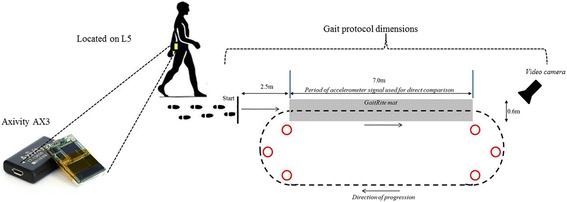
Twenty-five participants with stroke wore the wearable (AX3, Axivity) on the lower back during a laboratory 2 minute continuous walk (preferred pace) on two occasions a week apart and continuously in the community for two consecutive 7 day periods. Video, instrumented walkway (GaitRite) and an OPAL accelerometer-based wearable were used as laboratory references.
Feasibility of the proposed system was good. The system was valid for measuring step count (ICC 0.899). Inherent differences in gait quantification between algorithm and GaitRite resulted in difficulties comparing agreement between the different systems. Agreement was moderate-excellent (ICC 0.503-0.936) for mean and variability gait characteristics vs. OPAL. Agreement was moderate-poor between the system and OPAL for asymmetry characteristics. Moderate-excellent reliability (ICC 0.534-0.857) was demonstrated for 11/14 laboratory measured gait characteristics. Community test-retest reliability was good-excellent (ICC 0.867-0.983) for all except one (ICC 0.699) of the 19 gait characteristics.
The proposed system is a low-cost, reliable tool for quantifying gait post-stroke with multiple potential applications. Further refinement to optimise gait quantification algorithms for certain gait characteristics including gait asymmetry is required.
尽管有报道质疑该技术在量化特定与中风相关的步态障碍方面的准确性,但使用基于加速度计的可穿戴技术和相关算法来客观测量中风步态的应用正在增加。本研究旨在确定一种包含算法和单个三轴加速度计的低成本开源系统在中风后实验室和社区中量化步态特征的可行性、有效性和可靠性。
25 名中风患者在实验室中两次间隔一周的时间里,在背部佩戴可穿戴设备(AX3、Axivity),以自己的舒适速度连续行走 2 分钟;并在社区中连续佩戴两个连续的 7 天。使用视频、仪器化步态分析系统(GaitRite)和基于 OPAL 加速度计的可穿戴设备作为实验室参考。
提出的系统具有良好的可行性。该系统在测量步数方面是有效的(ICC 0.899)。由于算法和 GaitRite 之间在步态量化方面存在固有差异,因此比较不同系统之间的一致性存在困难。与 OPAL 相比,系统与仪器化步态分析系统和 OPAL 之间的平均和变异性步态特征的一致性为中等-极好(ICC 0.503-0.936)。系统与 OPAL 之间的对称性特征的一致性为中等-较差(ICC 0.534-0.857)。11/14 种实验室测量的步态特征具有良好-极好的可靠性(ICC 0.534-0.857)。19 种步态特征中除了一种(ICC 0.699)之外,其余所有特征在社区中测试-重测的可靠性都很好-极好(ICC 0.867-0.983)。
该系统是一种低成本、可靠的工具,可用于量化中风后的步态,具有多种潜在应用。需要进一步改进步态量化算法,以优化某些步态特征(包括步态不对称性)的量化。