
肿瘤坏死因子-α与溶质载体家族 26 成员 3(腺瘤中下调)相互作用,降低其表达,导致肠道炎症。
Tumor necrosis factor-α acts reciprocally with solute carrier family 26, member 3, (downregulated-in-adenoma) and reduces its expression, leading to intestinal inflammation.
机构信息
Department of Gastroenterology, Tongji Hospital, Huazhong University of Science and Technology, Wuhan, Hubei 430030, P.R. China.
Department of Pediatrics, BC Children's Hospital and The University of British Columbia, Vancouver, BC V6T 1Z4, Canada.
出版信息
Int J Mol Med. 2018 Mar;41(3):1224-1232. doi: 10.3892/ijmm.2017.3347. Epub 2017 Dec 22.
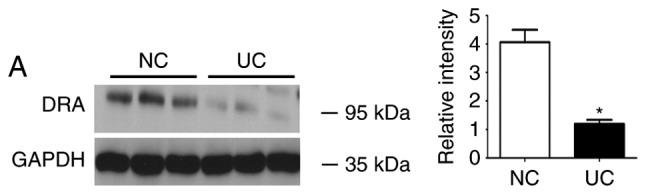
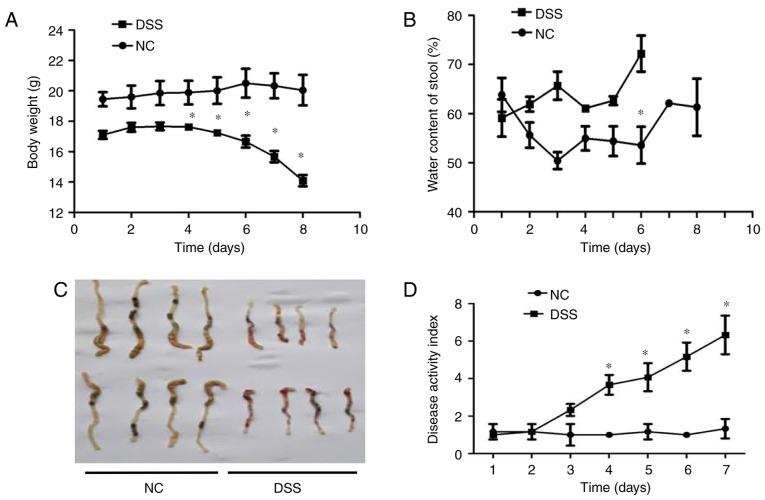
Solute carrier family 26, member 3 (Slc26a3), also termed downregulated-in-adenoma (DRA) is a member of the Slc26 family of anion transporters and is mutated in congenital chloride diarrhea. Our previous study demonstrated that DRA deficiency is associated with severely reduced colonic HCO3‑ secretion, a loss of colonic fluid absorption, a lack of a firmly adherent mucus layer and a severely reduced colonic mucosal resistance to dextran sodium sulfate (DSS) damage. However, the direct effect of mediators that trigger intestinal inflammatory factors on DRA has not been fully investigated. Tumor necrosis factor (TNF)‑α is a central mediator of intestinal inflammation in inflammatory bowel disease (IBD), including ulcerative colitis (UC) and Crohn's disease. However, to the best of our knowledge, whether TNF‑α acts reciprocally with DRA leading to the development of gut inflammation in IBD has not been reported. The present study identified that the expression level of DRA was reduced in active UC patients and DSS‑induced colitis mice with high expression levels of TNF‑α identified in the peripheral blood serum. In addition, TNF‑α may affect the expression level of DRA in human colonic Caco2BBE cells in a dose‑dependent manner, including in DRA overexpressed Caco2BBE cells. Furthermore, knockdown of TNF‑α in Caco2BBE cells led to a higher expression level of DRA and a markedly reduced secretion of TNF‑α in the culture media. In addition, knockdown of DRA in Caco2BBE cells led to a higher secretion of TNF‑α in the culture media compared with the control cells, which could be reversed by overexpression of DRA. Overall, these results indicate that TNF‑α may act reciprocally with DRA, leading to the development of intestinal inflammation. Based on the pivotal position of TNF‑α in IBD, DRA is hypothesized to have therapeutic potential against colitis serving as an important target.
溶质载体家族 26,成员 3(Slc26a3),也称为腺瘤下调物(DRA),是阴离子转运体 Slc26 家族的成员,在先天性氯性腹泻中发生突变。我们之前的研究表明,DRA 缺乏与结肠 HCO3-分泌严重减少、结肠液体吸收丧失、缺乏牢固附着的黏液层以及结肠黏膜对葡聚糖硫酸钠(DSS)损伤的抵抗力严重降低有关。然而,触发肠道炎症因子的介质对 DRA 的直接影响尚未得到充分研究。肿瘤坏死因子(TNF)-α 是炎症性肠病(IBD)中肠道炎症的中心介质,包括溃疡性结肠炎(UC)和克罗恩病。然而,据我们所知,TNF-α 是否与 DRA 相互作用导致 IBD 中肠道炎症的发展尚未报道。本研究发现,在活性 UC 患者和 DSS 诱导的结肠炎小鼠中,DRA 的表达水平降低,在外周血清中鉴定出 TNF-α 的高表达水平。此外,TNF-α 可能以剂量依赖的方式影响人结肠 Caco2BBE 细胞中 DRA 的表达水平,包括在 DRA 过表达的 Caco2BBE 细胞中。此外,Caco2BBE 细胞中 TNF-α 的敲低导致 DRA 的表达水平更高,并且培养基中 TNF-α 的分泌明显减少。此外,与对照细胞相比,Caco2BBE 细胞中 DRA 的敲低导致培养基中 TNF-α 的分泌更高,而过表达 DRA 可逆转这种情况。总之,这些结果表明 TNF-α 可能与 DRA 相互作用,导致肠道炎症的发展。基于 TNF-α 在 IBD 中的关键地位,假设 DRA 具有治疗结肠炎的潜力,可作为一个重要的靶点。



 Zotero 插件