Department of Chemistry, Fu Jen Catholic University, New Taipei City 242, Taiwan.
Graduate Institute of Biomedical and Pharmaceutical Science, Fu Jen Catholic University, New Taipei City 242, Taiwan.
Int J Mol Sci. 2017 Dec 29;19(1):103. doi: 10.3390/ijms19010103.
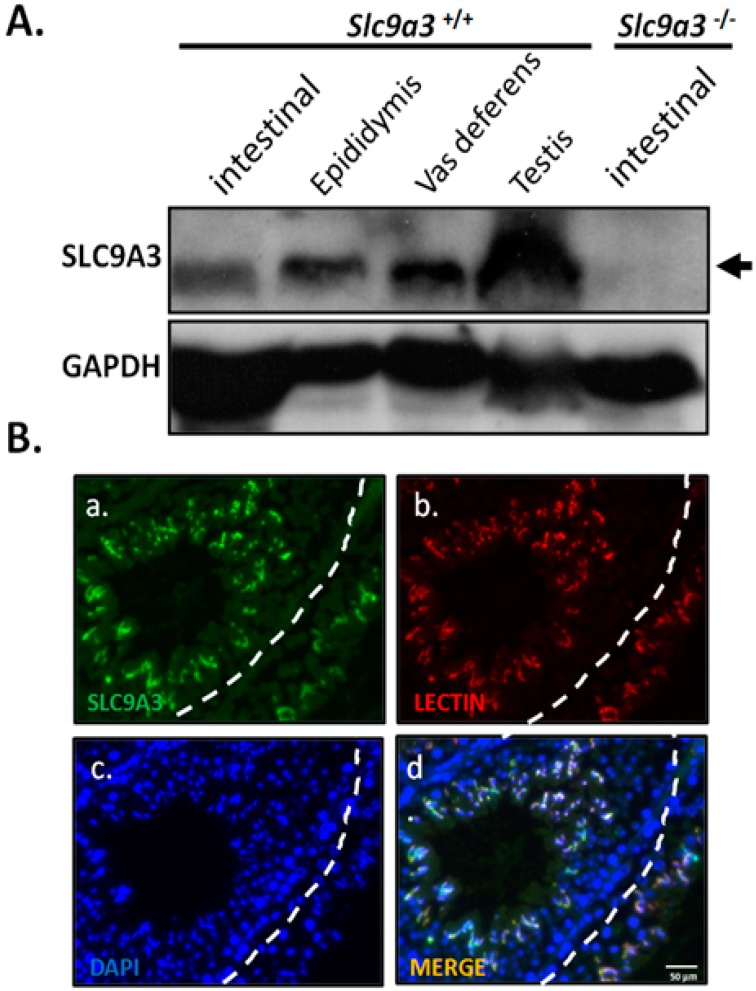
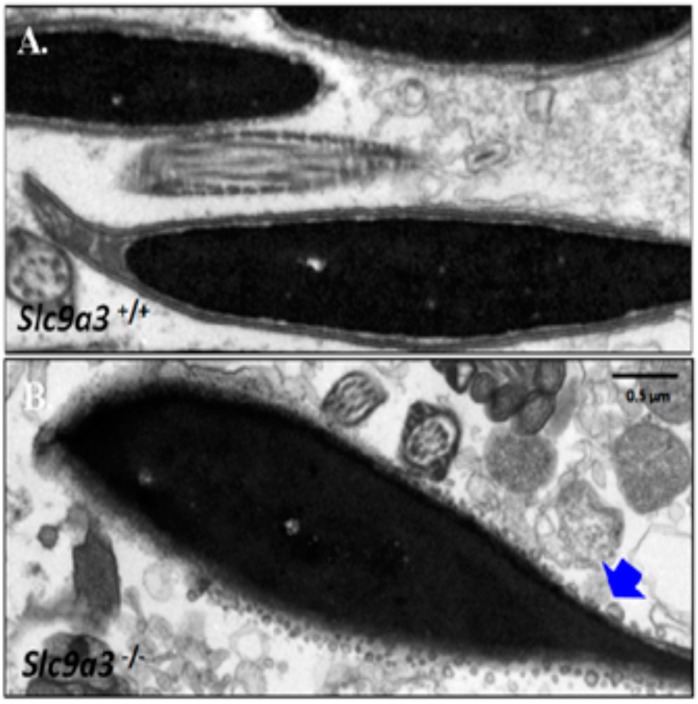
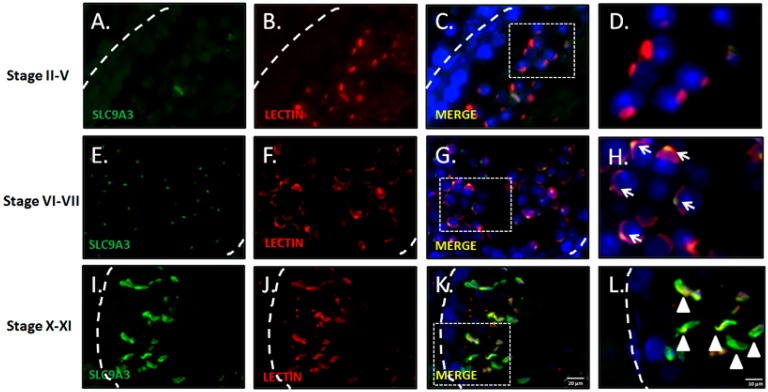
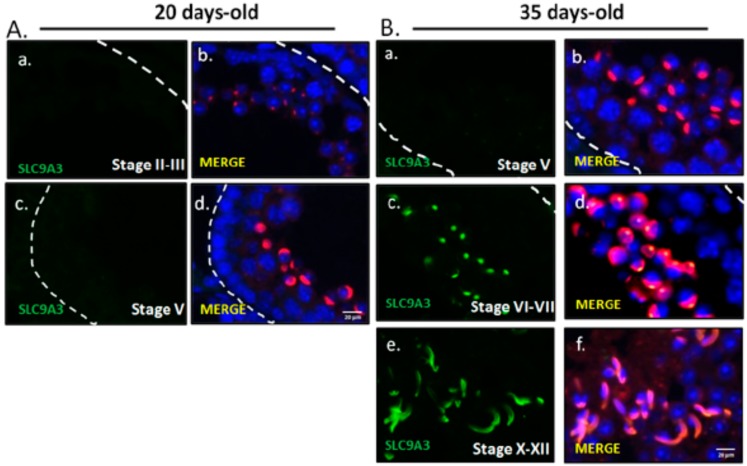
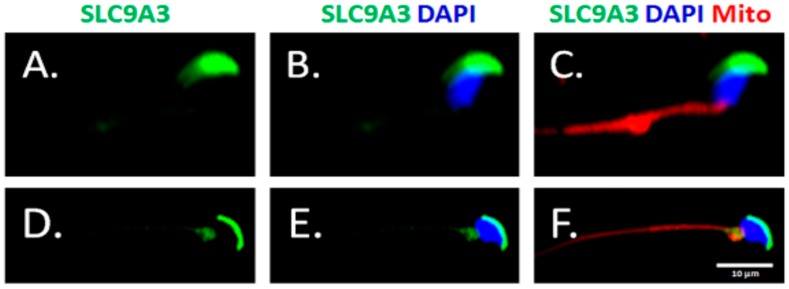
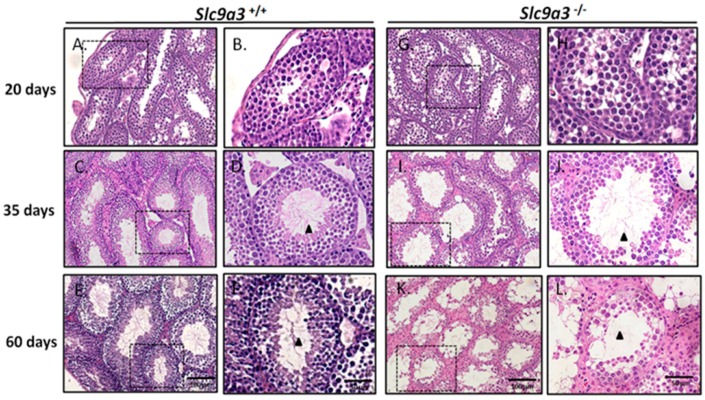
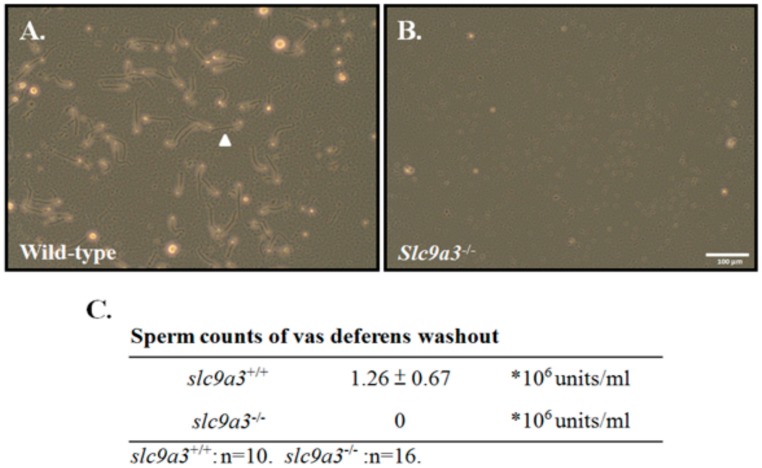
Solute carrier family 9 isoform 3 (SLC9A3), a Na⁺/H⁺ exchanger, regulates the transepithelial absorption of Na⁺ and water and is primarily expressed on the apical membranes of the intestinal epithelium, renal proximal tubule, epididymis, and vas deferens. Loss of the allele in mice enhances intestinal fluid and causes diarrhoea as a consequence of diminished Na⁺ and HCO₃ absorption. Hence, the loss also causes male infertility and reveals the abnormal dilated lumen of the rete testis and calcification in efferent ductules. However, whether loss of alleles also disrupts mammalian spermatogenesis remains unknown. First, through immunoblotting, we determined that SLC9A3 is highly expressed in the murine testis compared with the small intestine, epididymis, and vas deferens. During murine spermatogenesis, SLC9A3 is specifically expressed in the acrosome region of round, elongating, and elongated spermatids through immunostaining. Furthermore, SLC9A3 signals are enriched in the acrosome of mature sperm isolated from the vas deferens. In knockout (KO) mice, compared with the same-aged controls, the number of spermatids on the testicular section of the mice progressively worsened in mice aged 20, 35, and 60 days. Sperm isolated from the epididymis of KO mice revealed severe acrosomal defects. Our data indicated that SLC9A3 has a vital role in acrosomal formation during spermiogenesis.
溶质载体家族 9 成员 3(SLC9A3)是一种 Na⁺/H⁺交换体,调节 Na⁺和水的跨上皮吸收,主要表达于肠道上皮细胞、肾近端小管、附睾和输精管的顶膜上。小鼠中 等位基因的缺失增强了肠道液体分泌,并导致 Na⁺和 HCO₃吸收减少,从而引发腹泻。因此,该缺失还导致雄性不育,并揭示了睾丸网管腔的异常扩张和输出小管的钙化。然而, 等位基因的缺失是否也会破坏哺乳动物的精子发生仍不清楚。首先,通过免疫印迹,我们发现与小肠、附睾和输精管相比,SLC9A3 在小鼠睾丸中高度表达。通过免疫染色,在小鼠精子发生过程中,SLC9A3 特异性表达于圆形、伸长和伸长精子的顶体区域。此外,SLC9A3 信号在从输精管中分离的成熟精子的顶体中富集。在 敲除(KO)小鼠中,与同龄对照相比,在 20、35 和 60 天大的小鼠睾丸切片上,精子细胞的数量逐渐恶化。从 KO 小鼠的附睾中分离出的精子显示出严重的顶体缺陷。我们的数据表明,SLC9A3 在精子发生过程中的顶体形成中起着至关重要的作用。