Department of Materials Science and Engineering, University of Wisconsin-Madison, Madison, WI 53715, USA; Wisconsin Institute for Discovery, Department of Biomedical Engineering, University of Wisconsin-Madison, Madison, WI 53715, USA.
Wisconsin Institute for Discovery, Department of Biomedical Engineering, University of Wisconsin-Madison, Madison, WI 53715, USA; Department of Hepatobiliary Surgery, Xijing Hospital, Fourth Military Medical University, Xi'an, Shaanxi Province 710032, China.
J Control Release. 2018 Jul 28;282:148-155. doi: 10.1016/j.jconrel.2017.12.028. Epub 2017 Dec 27.
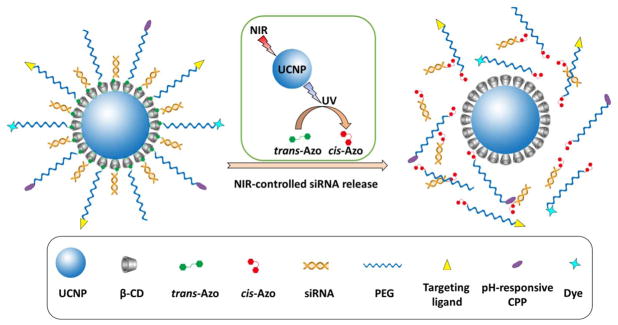
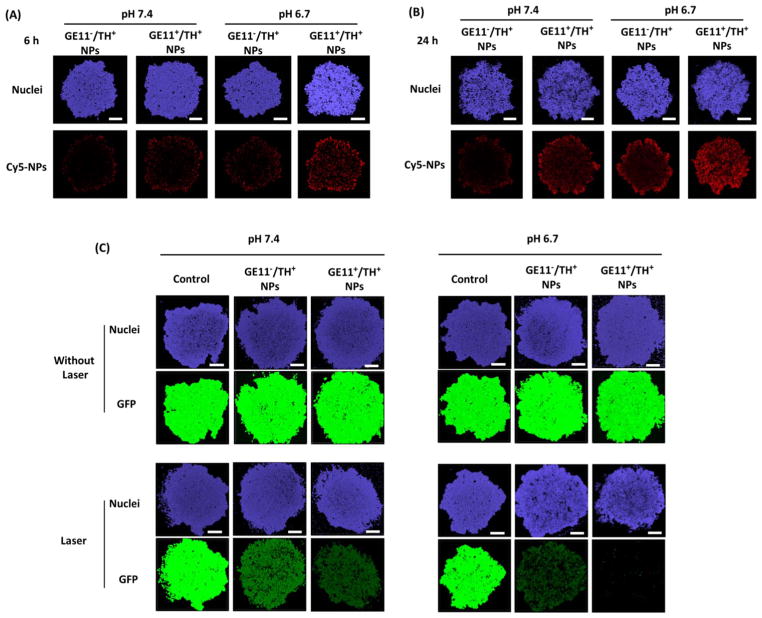
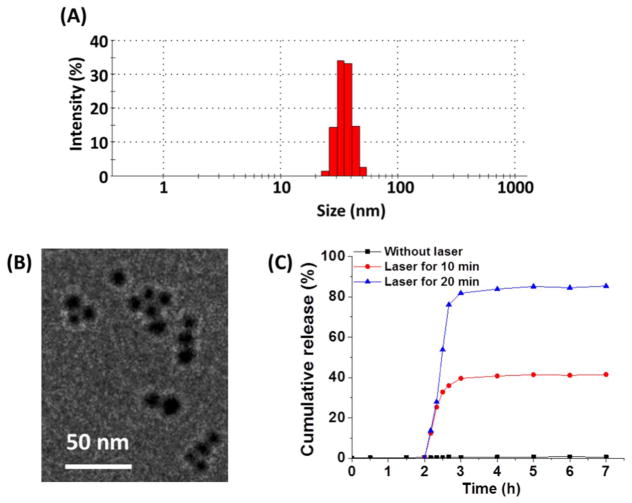
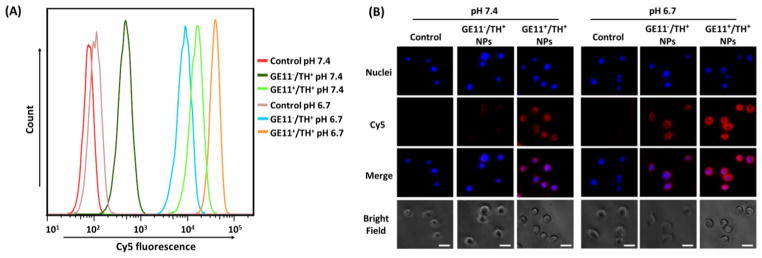
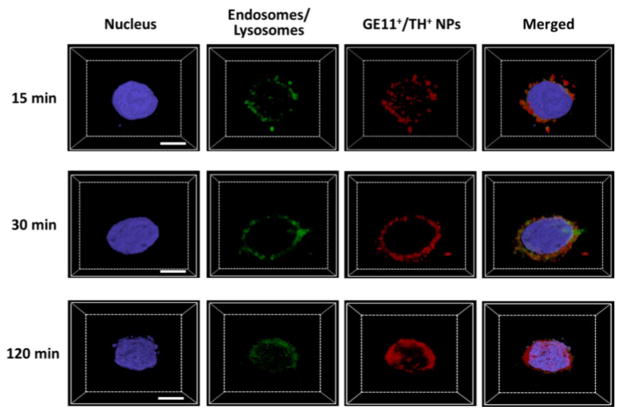
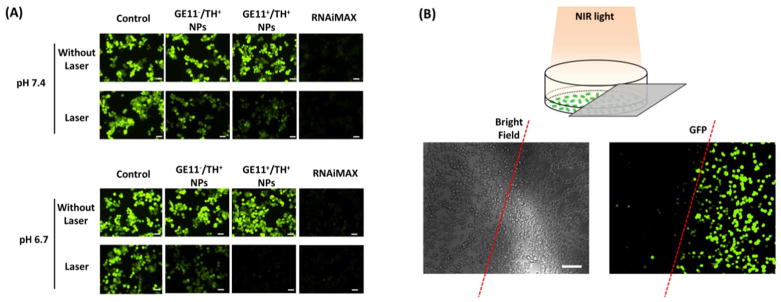
Spatiotemporal control over the release or activation of biomacromolecules such as siRNA remains a significant challenge. Light-controlled release has gained popularity in recent years; however, a major limitation is that most photoactivable compounds/systems respond only to UV irradiation, but not near-infrared (NIR) light that offers a deeper tissue penetration depth and better biocompatibility. This paper reports a simple NIR-to-UV upconversion nanoparticle (UCNP)-based siRNA nanocarrier for NIR-controlled gene silencing. siRNA is complexed onto a NaYF:Yb/Tm/Er UCNP through an azobenzene (Azo)-cyclodextrin (CD) host-guest interaction. The UV emission generated by the NIR-activated UCNP effectively triggers the trans-to-cis photoisomerization of azobenzene, thus leading to the release of siRNA due to unmatched host-guest pairs. The UCNP-siRNA complexes are also functionalized with PEG (i.e., UCNP-(CD/Azo)-siRNA/PEG NPs), targeting ligands (i.e., EGFR-specific GE11 peptide), acid-activatable cell-penetrating peptides (i.e., TH peptide), and imaging probes (i.e., Cy5 fluorophore). The UCNP-(CD/Azo)-siRNA/PEG NPs with both GE11 and TH peptides display a high level of cellular uptake and an excellent endosomal/lysosomal escape capability. More importantly, NIR-controlled spatiotemporal knockdown of GFP expression is successfully achieved in both a 2D monolayer cell model and a 3D multicellular tumor spheroid model. Thus, this simple and versatile nanoplatform has great potential for the selective activation or release of various biomacromolecules.
时空控制生物大分子如 siRNA 的释放或激活仍然是一个重大挑战。近年来,光控释放受到了广泛关注;然而,一个主要的限制是,大多数光激活化合物/系统仅对紫外光(UV)照射有响应,而不能对近红外光(NIR)有响应,近红外光具有更深的组织穿透深度和更好的生物相容性。本文报道了一种简单的基于上转换纳米粒子(UCNP)的 siRNA 纳米载体,用于近红外控制基因沉默。siRNA 通过偶氮苯(Azo)-环糊精(CD)主客体相互作用复合到 NaYF:Yb/Tm/Er UCNP 上。由近红外激活的 UCNP 产生的紫外发射有效地触发偶氮苯的顺反光异构化,从而由于不匹配的主客体对导致 siRNA 的释放。UCNP-siRNA 复合物还通过聚乙二醇(PEG,即 UCNP-(CD/Azo)-siRNA/PEG NPs)、靶向配体(即 EGFR 特异性 GE11 肽)、酸激活的细胞穿透肽(即 TH 肽)和成像探针(即 Cy5 荧光团)进行功能化。具有 GE11 和 TH 肽的 UCNP-(CD/Azo)-siRNA/PEG NPs 显示出高水平的细胞摄取和出色的内体/溶酶体逃逸能力。更重要的是,在二维单层细胞模型和三维多细胞肿瘤球体模型中,成功实现了 GFP 表达的近红外时空特异性敲低。因此,这种简单而多功能的纳米平台具有选择性激活或释放各种生物大分子的巨大潜力。