Murphy Adrian G, Foley Kelly, Rucki Agnieszka A, Xia Tao, Jaffee Elizabeth M, Huang Chiung-Yu, Zheng Lei
The Sidney Kimmel Comprehensive Cancer Center, Johns Hopkins University School of Medicine, Baltimore, Maryland, USA.
Department of Oncology, Johns Hopkins University School of Medicine, Baltimore, Maryland, USA.
Oncotarget. 2017 Nov 15;8(63):106405-106414. doi: 10.18632/oncotarget.22433. eCollection 2017 Dec 5.
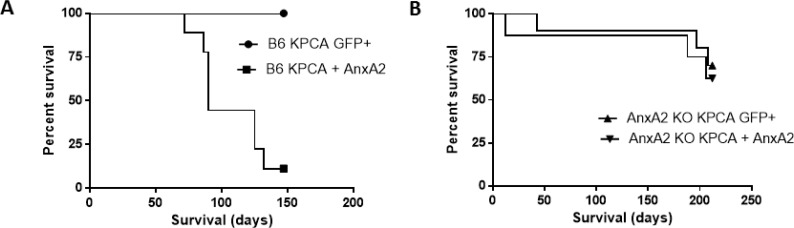
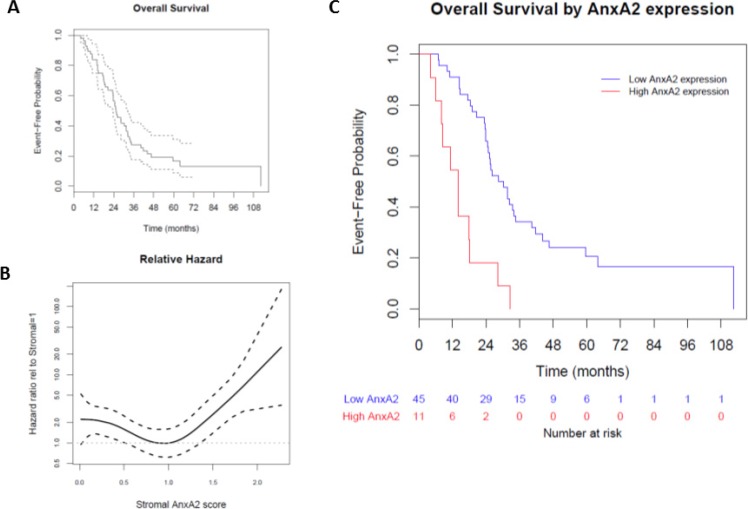
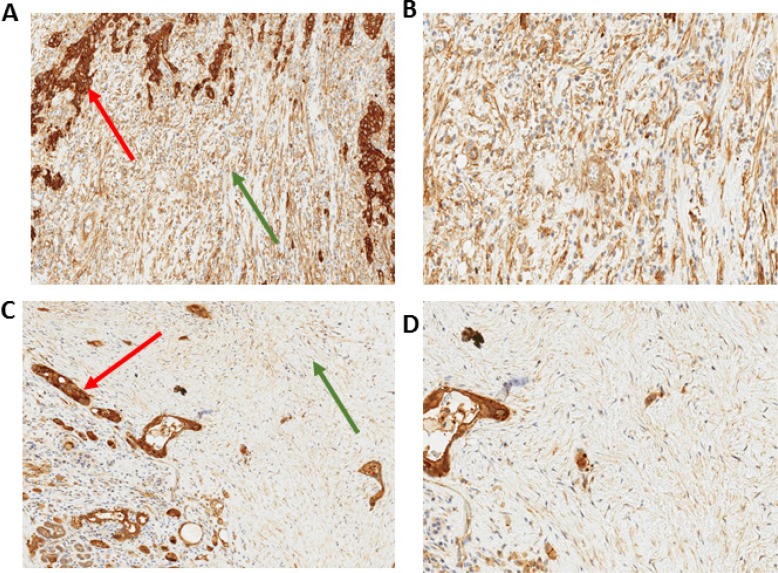
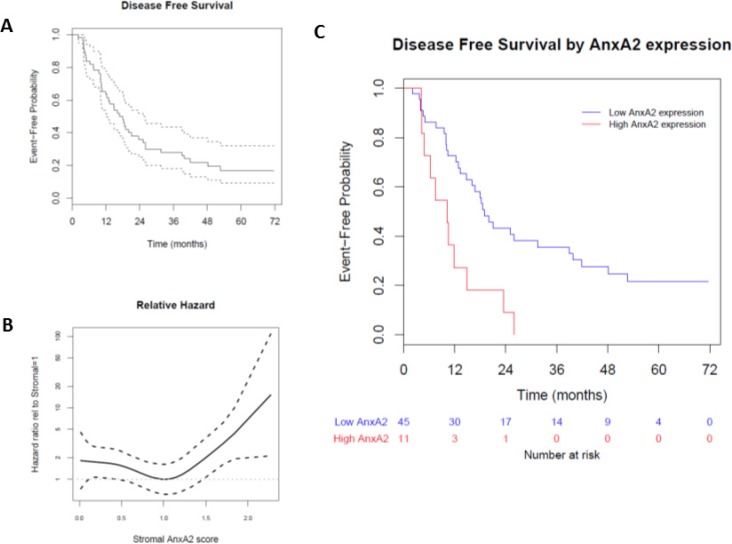
Pancreatic ductal adenocarcinoma (PDA) is renowned for high rates of metastasis and poor survival. Its notoriously dense fibrotic stroma contributes to chemoresistance. Stromal signaling in PDA is recognized for its multiple roles in regulating tumor invasion and metastasis. However, no stromal biomarker which can predict survival in PDA exists. Annexin A2 (AnxA2) was formerly identified as a metastasis-associated protein in PDA and tumoral overexpression is associated with poor survival. In this study, we examined AnxA2 expression in the tumor microenvironment in a preclinical model of PDA which suggests its role in tumor colonization. We injected wild-type (KPC) and AnxA2 knockout (KPCA) pancreatic cells into C57BL/GJ (B6) and AnxA2 knockout (KO) mice using the hemi-spleen model and observed their survival. We performed quantitative immunohistochemistry examining stromal AnxA2 expression in 56 patients who had surgically resected PDA and correlated expression with clinical outcomes. B6 mice injected with KPC cells demonstrated decreased median survival compared to those injected with KPCA cells (90 days vs. not reached, < 0.0001) whereas there was no survival difference in the AnxA2 KO mice ( = 0.63). In patient specimens, we found that high stromal AnxA2 expression (≥80th percentile) was associated with significantly reduced disease-free survival ( = 0.002) and overall survival ( < 0.001). Using multivariate Cox models, there were no significant associations between other clinical covariates apart from high stromal AnxA2 expression. This study highlights the role that stromal AnxA2 expression plays as a prognostic marker in PDA and its potential as a predictive biomarker for survival outcomes in PDA.
胰腺导管腺癌(PDA)以高转移率和低生存率而闻名。其致密的纤维化基质导致化疗耐药。PDA中的基质信号传导在调节肿瘤侵袭和转移方面具有多种作用。然而,目前尚无能够预测PDA患者生存情况的基质生物标志物。膜联蛋白A2(AnxA2)先前被确定为PDA中的一种转移相关蛋白,肿瘤过表达与不良生存相关。在本研究中,我们在PDA临床前模型中检测了肿瘤微环境中AnxA2的表达,提示其在肿瘤定植中的作用。我们使用半脾模型将野生型(KPC)和AnxA2基因敲除(KPCA)的胰腺细胞注射到C57BL/GJ(B6)和AnxA2基因敲除(KO)小鼠体内,并观察它们的生存情况。我们对56例接受手术切除的PDA患者进行了定量免疫组化,检测基质AnxA2的表达,并将其与临床结果进行关联分析。注射KPC细胞的B6小鼠的中位生存期低于注射KPCA细胞的小鼠(90天对未达到,<0.0001),而在AnxA2基因敲除小鼠中没有生存差异(=0.63)。在患者标本中,我们发现基质AnxA2高表达(≥第80百分位数)与无病生存期显著缩短(=0.002)和总生存期缩短(<0.001)相关。使用多变量Cox模型,除基质AnxA2高表达外,其他临床协变量之间无显著关联。本研究强调了基质AnxA2表达作为PDA预后标志物的作用及其作为PDA生存结果预测生物标志物的潜力。