Department of Chemistry, Emory University, 201 Dowman Drive, Atlanta, GA 30322, United States.
Department of Chemistry, Emory University, 201 Dowman Drive, Atlanta, GA 30322, United States; Department of Chemistry, University of Illinois at Urbana-Champaign, Urbana, IL 61801, United States; Department of Physics, University of Illinois at Urbana-Champaign, Urbana, IL 61801, United States.
Biochim Biophys Acta Biomembr. 2018 Mar;1860(3):792-800. doi: 10.1016/j.bbamem.2017.12.019. Epub 2017 Dec 30.
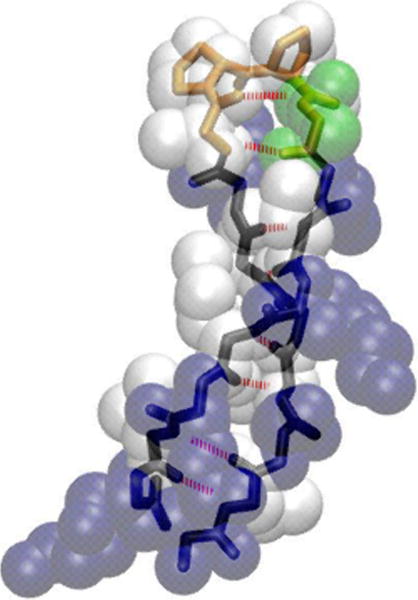
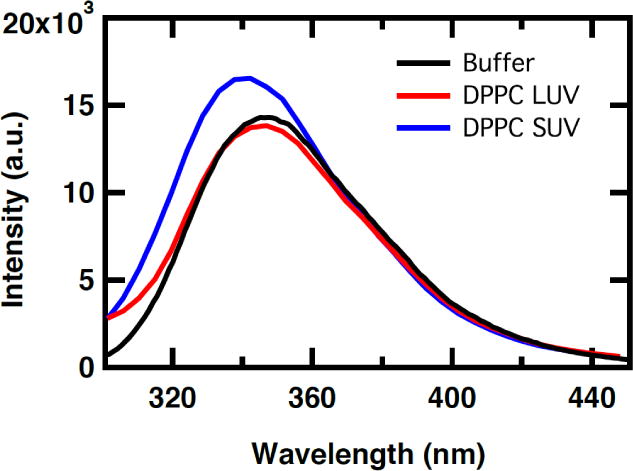
Antimicrobial peptides (AMPs) act as host defenses against microbial pathogens. Here we investigate the interactions of SVS-1 (KVKVKVKVPPTKVKVKVK), an engineered AMP and anti-cancer β-hairpin peptide, with lipid bilayers using spectroscopic studies and atomistic molecular dynamics simulations. In agreement with literature reports, simulation and experiment show preferential binding of SVS-1 peptides to anionic over neutral bilayers. Fluorescence and circular dichroism studies of a Trp-substituted SVS-1 analogue indicate, however, that it will bind to a zwitterionic DPPC bilayer under high-curvature conditions and folds into a hairpin. In bilayers formed from a 1:1 mixture of DPPC and anionic DPPG lipids, curvature and lipid fluidity are also observed to promote deeper insertion of the fluorescent peptide. Simulations using the CHARMM C36m force field offer complementary insight into timescales and mechanisms of folding and insertion. SVS-1 simulated at an anionic mixed POPC/POPG bilayer folded into a hairpin over a microsecond, the final stage in folding coinciding with the establishment of contact between the peptide's valine sidechains and the lipid tails through a "flip and dip" mechanism. Partial, transient folding and superficial bilayer contact are seen in simulation of the peptide at a zwitterionic POPC bilayer. Only when external surface tension is applied does the peptide establish lasting contact with the POPC bilayer. Our findings reveal the influence of disruption to lipid headgroup packing (via curvature or surface tension) on the pathway of binding and insertion, highlighting the collaborative effort of electrostatic and hydrophobic interactions on interaction of SVS-1 with lipid bilayers.
抗菌肽 (AMPs) 是宿主防御微生物病原体的第一道防线。在这里,我们使用光谱研究和原子分子动力学模拟研究了工程化 AMP 和抗癌 β-发夹肽 SVS-1(KVKVKVKVPPTKVKVKVK)与脂质双层的相互作用。与文献报道一致,模拟和实验都表明 SVS-1 肽优先与阴离子双层而不是中性双层结合。然而,对一个色氨酸取代的 SVS-1 类似物的荧光和圆二色性研究表明,它将在高曲率条件下与两性 DPPC 双层结合并折叠成发夹。在由 DPPC 和阴离子 DPPG 脂质 1:1 混合物形成的双层中,曲率和脂质流动性也被观察到促进荧光肽更深地插入。使用 CHARMM C36m 力场的模拟提供了对折叠和插入的时间尺度和机制的补充见解。在阴离子混合 POPC/POPG 双层中模拟的 SVS-1 在微秒内折叠成发夹,折叠的最后阶段与肽的缬氨酸侧链与脂质尾部通过“翻转和浸入”机制建立接触同时发生。在模拟两性 DPPC 双层中的肽时,会看到部分、瞬时折叠和浅层双层接触。只有当施加外部表面张力时,肽才会与 POPC 双层建立持久接触。我们的研究结果揭示了破坏脂质头基堆积(通过曲率或表面张力)对结合和插入途径的影响,强调了静电和疏水力在 SVS-1 与脂质双层相互作用中的协同作用。