Department of Biochemistry, University of Lausanne, Epalinges, Lausanne, Switzerland.
Int Immunol. 2018 Mar 10;30(3):103-111. doi: 10.1093/intimm/dxx075.
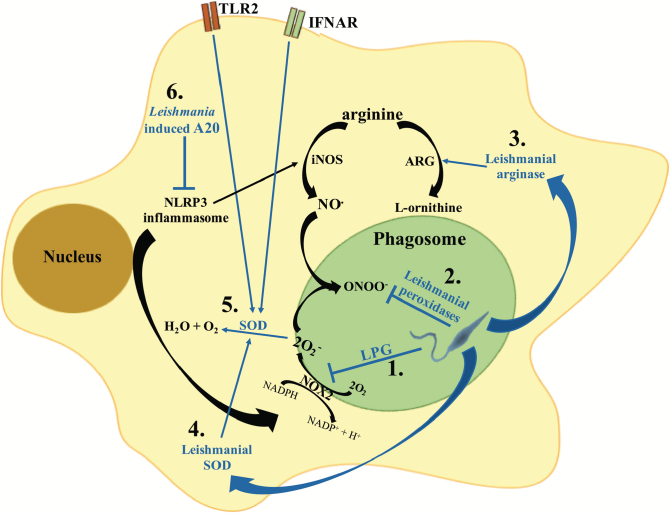
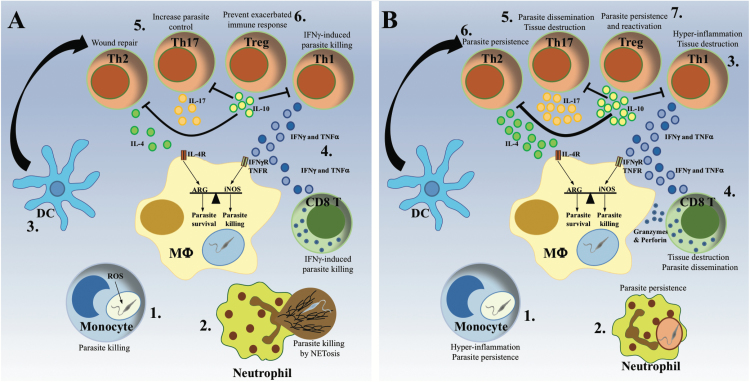
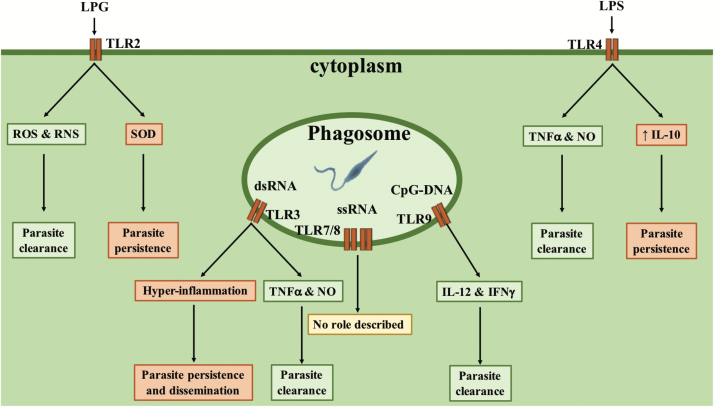
Infection by protozoan parasites of the genus Leishmania results in the development of leishmaniasis, an increasingly prevalent group of diseases affecting over 12 million people worldwide. Leishmaniasis can have very different outcomes ranging from cutaneous lesions, mucosal lesions to visceralization depending on the species of the infecting parasite and on the immune response developed by the host. As an obligate intracellular parasite, residing within macrophages, Leishmania evolved in strict contact with the host immune system, developing different mechanisms to evade or modulate the immune response. Various types of immune responses are observed during different Leishmania spp. infections, resulting in parasite clearance but also contributing to the pathogenesis, thus increasing the complexity of the course of the disease. Interestingly, depending on the type of leishmaniasis developed, opposite treatment strategies, which either boost or inhibit the inflammatory response, have shown efficacy. In this review, we summarize the contribution of different immune cell types to the development of the anti-leishmanial immune response and the parasite strategies to evade and modulate host immunity. Further, we discuss the involvement of co-infecting pathogens in the determination of the outcome of leishmaniasis and on the effectiveness of treatment and the implication of the immune response for treatment and vaccine development.
原生动物寄生虫利什曼原虫的感染会导致利什曼病的发生,这是一组日益流行的疾病,影响着全球超过 1200 万人。利什曼病的结果可能非常不同,从皮肤损伤、粘膜损伤到内脏化,这取决于感染寄生虫的物种和宿主产生的免疫反应。作为一种专性细胞内寄生虫,利什曼原虫存在于巨噬细胞内,与宿主免疫系统密切接触,发展出不同的机制来逃避或调节免疫反应。在不同的利什曼原虫感染中观察到各种类型的免疫反应,导致寄生虫清除,但也有助于发病机制,从而增加疾病过程的复杂性。有趣的是,根据所发生的利什曼病的类型,不同的治疗策略,无论是增强还是抑制炎症反应,都显示出了疗效。在这篇综述中,我们总结了不同免疫细胞类型对抗利什曼原虫免疫反应的发展以及寄生虫逃避和调节宿主免疫的策略的贡献。此外,我们还讨论了共感染病原体在决定利什曼病的结果以及治疗效果和免疫反应对治疗和疫苗开发的影响。