Department of Pathology, School of Dental Medicine, University of Pennsylvania, 240 South 40th Street, Philadelphia, PA, 19104-6030, USA.
Department of Oral Medicine, School of Dental Medicine, University of Pennsylvania, Philadelphia, PA, USA.
Respir Res. 2018 Jan 3;19(1):1. doi: 10.1186/s12931-017-0698-3.
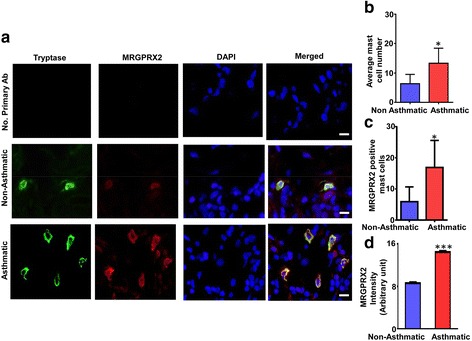
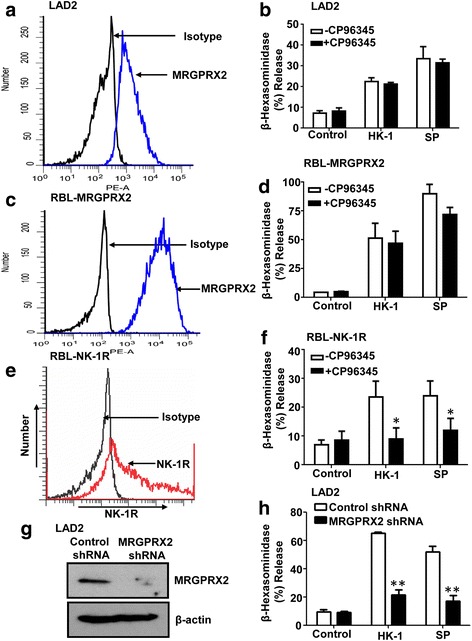
Hemokinin-1 (HK-1) is a novel neuropeptide produced by human bronchial cells and macrophages and causes contraction of human bronchi ex vivo. It is also generated by antigen/IgE-activated murine mast cells (MCs) and contributes to experimental chronic allergic airway inflammation via the activation of the neurokinin receptor-1 (NK-1R) expressed on murine MCs. We found elevated MC numbers in the lungs of individuals who died from asthma (asthma) when compared to lungs of individuals who died from other causes (non-asthma). Mas-related G Protein coupled receptor X2 (MRGPRX2) is a novel G-protein coupled receptor (GPCR) that is expressed predominantly on human MCs. We detected low level of MRGPRX2 in non-asthma lung MCs but its expression was significantly upregulated in asthma lung MCs. HK-1 caused degranulation in a human MC line (LAD2) and RBL-2H3 cells stably expressing MRGPRX2 and this response was resistant to inhibition by an NK-1R antagonist. However, knockdown of MRGPRX2 in LAD2 cells resulted in substantial inhibition of HK-1-induced degranulation. These findings suggest that while HK-1 contributes to the development of experimental asthma in mice via NK-1R on murine MCs the effect of this neuropeptide on human bronchoconstriction likely reflects the activation of MRGPRX2 on lung MCs. Thus, development of selective MRGPRX2 antagonists could serve as novel target for the modulation of asthma.
血红蛋白激酶-1(HK-1)是一种新型的神经肽,由人支气管细胞和巨噬细胞产生,可引起人体支气管的体外收缩。它也由抗原/IgE 激活的鼠肥大细胞(MC)产生,并通过激活表达在鼠 MC 上的神经激肽受体-1(NK-1R),促进实验性慢性变应性气道炎症。与死于其他原因的个体(非哮喘)的肺相比,死于哮喘的个体的肺中 MC 数量升高。Mas 相关 G 蛋白偶联受体 X2(MRGPRX2)是一种新型的 G 蛋白偶联受体(GPCR),主要表达在人 MC 上。我们在非哮喘肺 MC 中检测到低水平的 MRGPRX2,但在哮喘肺 MC 中其表达明显上调。HK-1 可引起人 MC 系(LAD2)和稳定表达 MRGPRX2 的 RBL-2H3 细胞脱颗粒,该反应对 NK-1R 拮抗剂的抑制作用具有抗性。然而,在 LAD2 细胞中敲低 MRGPRX2 可导致 HK-1 诱导的脱颗粒显著抑制。这些发现表明,尽管 HK-1 通过鼠 MC 上的 NK-1R 促进实验性哮喘的发展,但该神经肽对人体支气管收缩的影响可能反映了肺 MC 上 MRGPRX2 的激活。因此,开发选择性的 MRGPRX2 拮抗剂可作为调节哮喘的新靶点。