Schubert Michael, Klinger Bertram, Klünemann Martina, Sieber Anja, Uhlitz Florian, Sauer Sascha, Garnett Mathew J, Blüthgen Nils, Saez-Rodriguez Julio
European Molecular Biology Laboratory, European Bioinformatics Institute, Wellcome Genome Campus, Cambridge, CB10 1SD, UK.
Institute of Pathology, Charité Universitätsmedizin Berlin, Charitéplatz 1, 10117, Berlin, Germany.
Nat Commun. 2018 Jan 2;9(1):20. doi: 10.1038/s41467-017-02391-6.
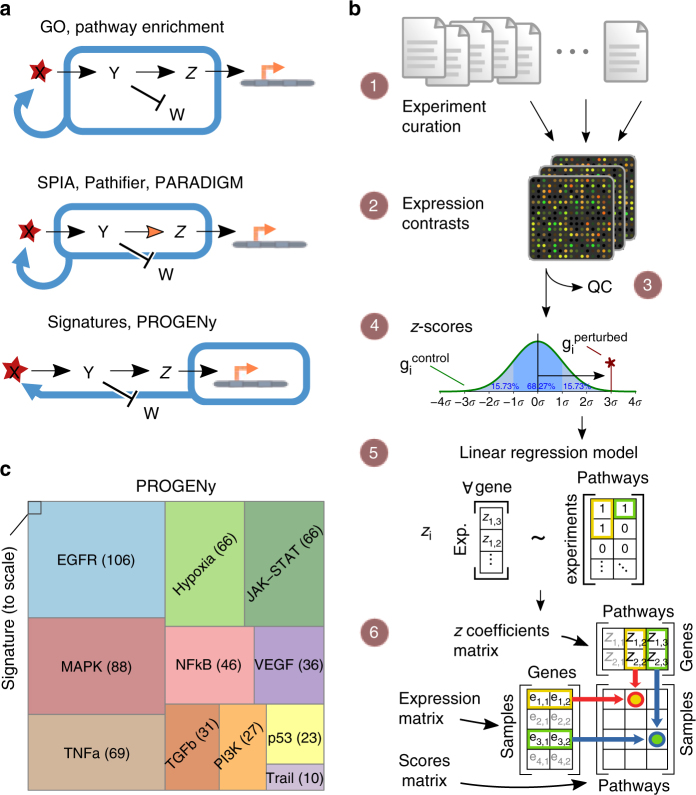
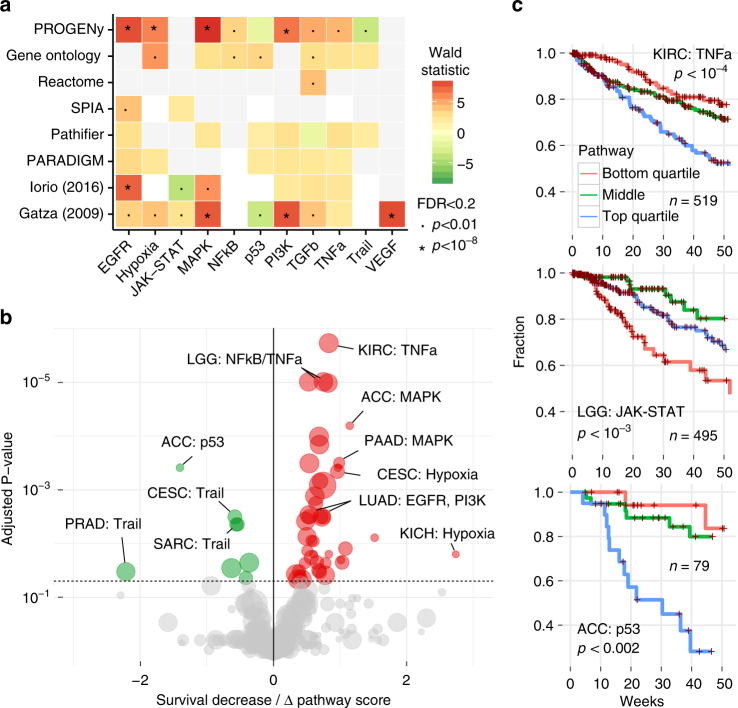
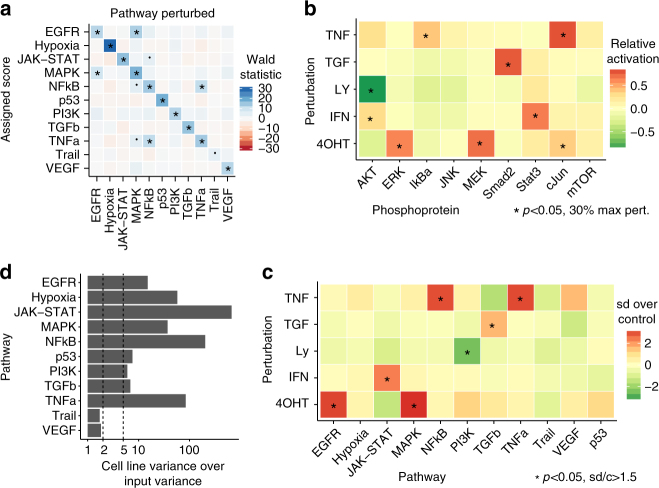
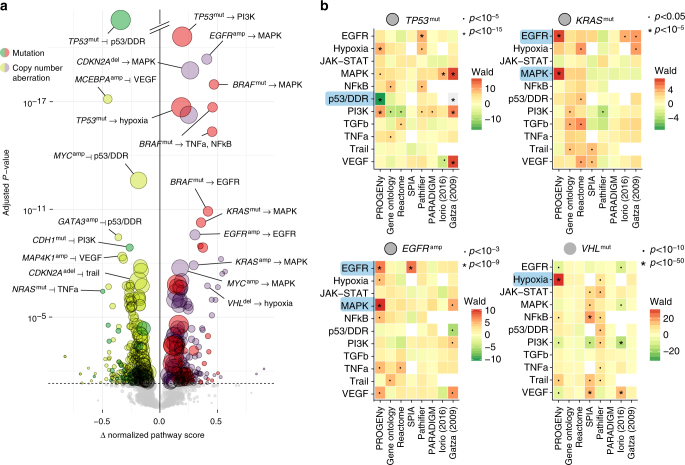
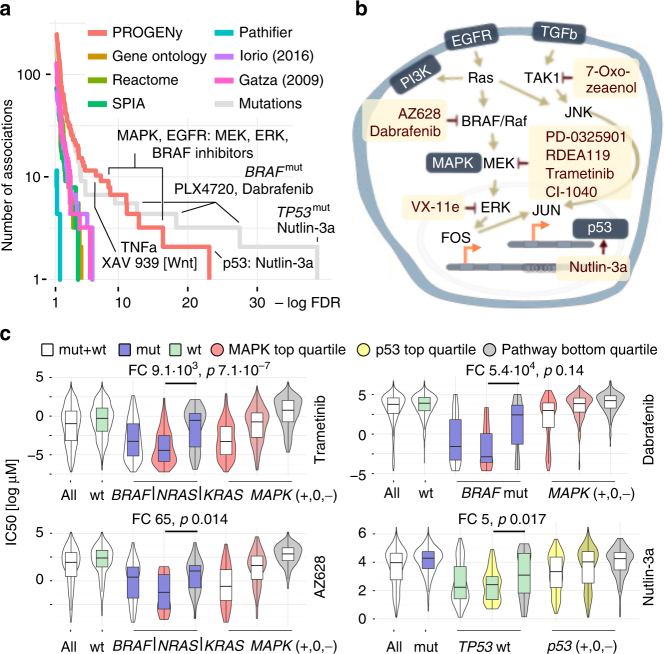
Aberrant cell signaling can cause cancer and other diseases and is a focal point of drug research. A common approach is to infer signaling activity of pathways from gene expression. However, mapping gene expression to pathway components disregards the effect of post-translational modifications, and downstream signatures represent very specific experimental conditions. Here we present PROGENy, a method that overcomes both limitations by leveraging a large compendium of publicly available perturbation experiments to yield a common core of Pathway RespOnsive GENes. Unlike pathway mapping methods, PROGENy can (i) recover the effect of known driver mutations, (ii) provide or improve strong markers for drug indications, and (iii) distinguish between oncogenic and tumor suppressor pathways for patient survival. Collectively, these results show that PROGENy accurately infers pathway activity from gene expression in a wide range of conditions.
异常的细胞信号传导可导致癌症和其他疾病,是药物研究的一个重点。一种常见的方法是从基因表达推断信号通路的活性。然而,将基因表达映射到通路成分时忽略了翻译后修饰的影响,并且下游特征代表非常特定的实验条件。在这里,我们提出了PROGENy,这是一种通过利用大量公开可用的扰动实验来克服这两个限制的方法,以产生通路响应基因的共同核心。与通路映射方法不同,PROGENy能够(i)恢复已知驱动突变的影响,(ii)提供或改进药物适应症的强标记,以及(iii)区分致癌和肿瘤抑制通路对患者生存的影响。总体而言,这些结果表明PROGENy在广泛的条件下能够从基因表达中准确推断通路活性。