Gho Johannes M I H, Postema Pieter G, Conijn Maartje, Bruinsma Nienke, de Jong Jonas S S G, Bezzina Connie R, Wilde Arthur A M, Asselbergs Folkert W
Department of Cardiology, Division Heart and Lungs, University Medical Center Utrecht, Utrecht, The Netherlands.
Department of Clinical and Experimental Cardiology, Heart Center, Academic Medical Center, Amsterdam, The Netherlands.
Open Heart. 2017 Dec 22;4(2):e000551. doi: 10.1136/openhrt-2016-000551. eCollection 2017.
The aim of the current study was to determine the contemporary incidence, risk factors and prognosis of heart failure (HF) after ST-elevation myocardial infarction (STEMI).
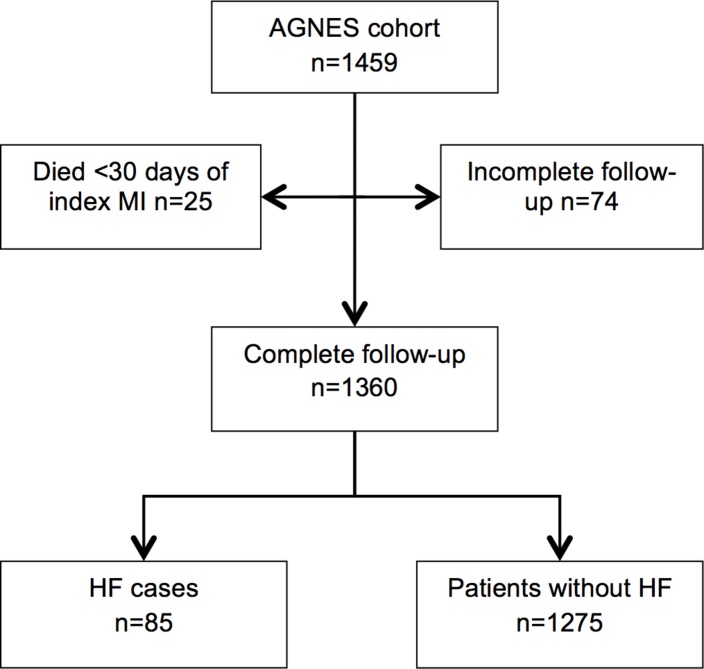
We used the Arrhythmia Genetics in the Netherlands observational cohort study to identify patients with a first STEMI from 2001 onwards (n=1459). HF during follow-up was defined as hospitalisation for HF or an outpatient clinic visit for HF. Cox regression was performed to estimate the relationship between baseline covariates and the onset of HF.
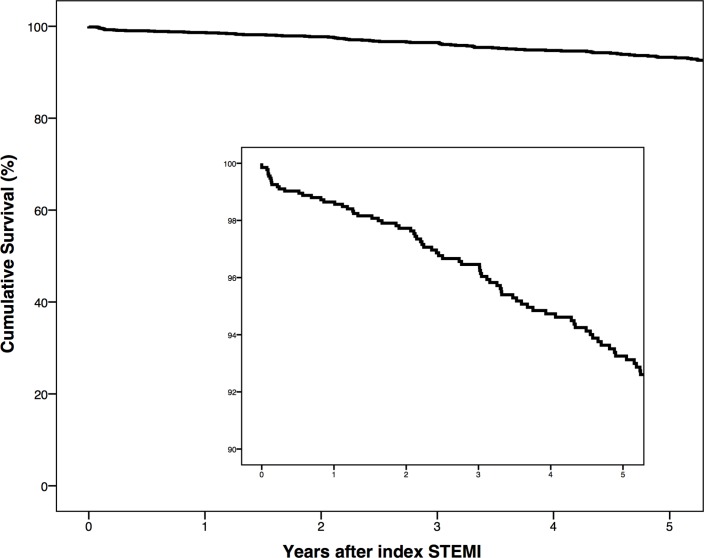
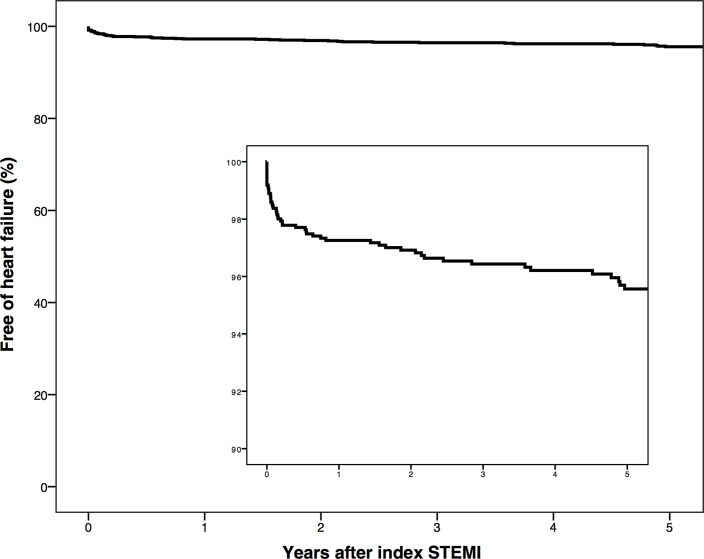
Follow-up was completed for 1360 (93.2%) patients with an overall median follow-up time of 6.7 years, 1232 (90.6%) of these patients had undergone primary percutaneous coronary intervention (PCI). A total of 85 patients (6.3%) developed HF during follow-up. HF cases were significantly older at their index MI (59.9 vs 57.2 years, P<0.001) and more commonly had a history of atrial fibrillation (6.1% vs 1.4%, P=0.001) than controls without HF. The crude incidence rate of HF after STEMI was 9.7 (95% CI 7.7 to 11.8) per 1000 person-years. In multivariable analysis, peak creatine kinase MB (CK-MB) levels (HR 1.11 per 100 U/L (95% CI 1.11 to 1.22)) and a left anterior descending artery (LAD) culprit lesion (HR 2.88 (95% CI 1.53 to 5.40)) were risk factors associated with HF.
We found a relatively low long-term contemporary incidence of HF after a first STEMI in the current PCI era in comparison with other reports. Higher CK-MB levels and a LAD culprit lesion at index STEMI were important risk factors for the development of HF after STEMI.
NCT03007199; Results.
本研究旨在确定ST段抬高型心肌梗死(STEMI)后心力衰竭(HF)的当代发病率、危险因素及预后情况。
我们利用荷兰心律失常遗传学观察队列研究,确定了2001年起首次发生STEMI的患者(n = 1459)。随访期间的HF定义为因HF住院或门诊就诊。采用Cox回归分析来估计基线协变量与HF发病之间的关系。
1360例(93.2%)患者完成随访,总体中位随访时间为6.7年,其中1232例(90.6%)患者接受了直接经皮冠状动脉介入治疗(PCI)。共有85例患者(6.3%)在随访期间发生HF。与无HF的对照组相比,HF患者首次心肌梗死时年龄显著更大(59.9岁对57.2岁,P < 0.001),且更常见有房颤病史(6.1%对1.4%,P = 0.001)。STEMI后HF的粗发病率为每1000人年9.7例(95%CI 7.7至11.8)。在多变量分析中,肌酸激酶同工酶MB(CK-MB)峰值水平(每100 U/L的HR为1.11(95%CI 1.11至1.22))和左前降支(LAD)罪犯病变(HR为2.88(95%CI 1.53至5.40))是与HF相关的危险因素。
与其他报告相比,我们发现在当前PCI时代,首次STEMI后HF的长期当代发病率相对较低。STEMI时较高的CK-MB水平和LAD罪犯病变是STEMI后发生HF的重要危险因素。
NCT03007199;结果