Katsioupa Maria, Kourampi Islam, Oikonomou Evangelos, Tsigkou Vasiliki, Theofilis Panagiotis, Charalambous Georgios, Marinos George, Gialamas Ioannis, Zisimos Konstantinos, Anastasiou Artemis, Katsianos Efstratios, Kalogeras Konstantinos, Katsarou Ourania, Vavuranakis Manolis, Siasos Gerasimos, Tousoulis Dimitris
3rd Department of Cardiology, Thoracic Diseases General Hospital "Sotiria", National and Kapodistrian University of Athens, 11527 Athens, Greece.
1st Department of Cardiology, "Hippokration" General Hospital, National and Kapodistrian University of Athens, 11527 Athens, Greece.
Life (Basel). 2023 Sep 29;13(10):1992. doi: 10.3390/life13101992.
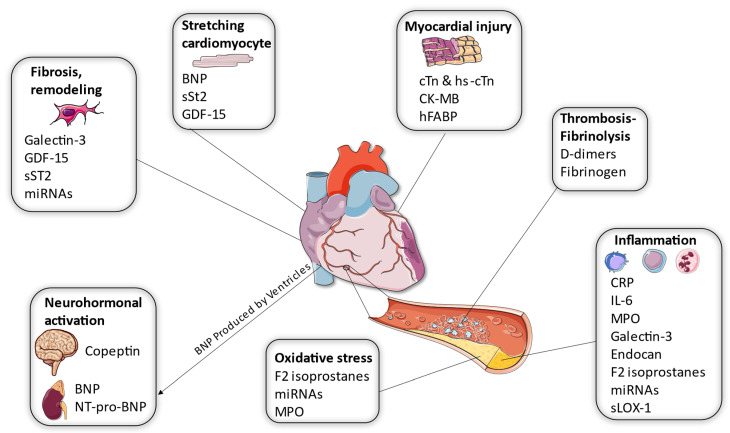
The burden of cardiovascular diseases and the critical role of acute coronary syndrome (ACS) in their progression underscore the need for effective diagnostic and prognostic tools. Biomarkers have emerged as crucial instruments for ACS diagnosis, risk stratification, and prognosis assessment. Among these, high-sensitivity troponin (hs-cTn) has revolutionized ACS diagnosis due to its superior sensitivity and negative predictive value. However, challenges regarding specificity, standardization, and interpretation persist. Beyond troponins, various biomarkers reflecting myocardial injury, neurohormonal activation, inflammation, thrombosis, and other pathways are being explored to refine ACS management. This review article comprehensively explores the landscape of clinically used biomarkers intricately involved in the pathophysiology, diagnosis, and prognosis of ACS (i.e., troponins, creatine kinase MB (CK-MB), B-type natriuretic peptides (BNP), copeptin, C-reactive protein (CRP), interleukin-6 (IL-6), d-dimers, fibrinogen), especially focusing on the prognostic role of natriuretic peptides and of inflammatory indices. Research data on novel biomarkers (i.e., endocan, galectin, soluble suppression of tumorigenicity (sST2), microRNAs (miRNAs), soluble oxidized low-density lipoprotein receptor-1 (sLOX-1), F2 isoprostanes, and growth differentiation factor 15 (GDF-15)) are further analyzed, aiming to shed light on the multiplicity of pathophysiologic mechanisms implicated in the evolution of ACS. By elucidating the complex interplay of these biomarkers in ACS pathophysiology, diagnosis, and outcomes, this review aims to enhance our understanding of the evolving trajectory and advancements in ACS management. However, further research is necessary to establish the clinical utility and integration of these biomarkers into routine practice to improve patient outcomes.
心血管疾病的负担以及急性冠状动脉综合征(ACS)在其进展中的关键作用凸显了有效诊断和预后工具的必要性。生物标志物已成为ACS诊断、风险分层和预后评估的关键工具。其中,高敏肌钙蛋白(hs-cTn)因其卓越的敏感性和阴性预测价值,彻底改变了ACS的诊断方式。然而,特异性、标准化和解读方面的挑战依然存在。除了肌钙蛋白,人们还在探索各种反映心肌损伤、神经激素激活、炎症、血栓形成及其他途径的生物标志物,以优化ACS的管理。这篇综述文章全面探讨了临床上用于ACS病理生理学、诊断和预后的生物标志物(即肌钙蛋白、肌酸激酶MB(CK-MB)、B型利钠肽(BNP)、 copeptin、C反应蛋白(CRP)、白细胞介素-6(IL-6)、D-二聚体、纤维蛋白原)的情况,尤其关注利钠肽和炎症指标的预后作用。进一步分析了新型生物标志物(即内皮糖蛋白、半乳糖凝集素、可溶性肿瘤抑制因子(sST2)、微小RNA(miRNA)、可溶性氧化型低密度脂蛋白受体-1(sLOX-1)、F2异前列腺素和生长分化因子15(GDF-15))的研究数据,旨在揭示ACS演变过程中涉及的多种病理生理机制。通过阐明这些生物标志物在ACS病理生理学、诊断和预后中的复杂相互作用,本综述旨在加深我们对ACS管理演变轨迹和进展的理解。然而,有必要进行进一步研究,以确定这些生物标志物的临床实用性,并将其纳入常规实践以改善患者预后。