Khan Kamran Ahmed, Kumar Rajesh, Shah Jehangir Ali, Farooq Fawad, Shaikh Quratulain, Kumar Dileep, Sial Jawaid Akbar, Saghir Tahir, Achakzai Abdul Samad, Karim Musa
National Institute of Cardiovascular Diseases (NICVD), Karachi, Pakistan.
SAGE Open Med. 2022 Mar 31;10:20503121221088106. doi: 10.1177/20503121221088106. eCollection 2022.
No-reflow is a complication that frequently occurs after stenting during primary percutaneous coronary intervention. In this study, we focused on angiographic results and clinical outcomes after no-reflow in the left anterior descending (LAD) artery versus non-left anterior descending artery ST-elevation myocardial infarction (STEMI).
In this prospective study, a total of 201 patients who had developed no-reflow during primary percutaneous coronary intervention were enrolled. The patients were divided into left anterior descending artery culprit and non-left anterior descending artery culprit groups. The primary endpoints were final thrombolysis in myocardial infarction flow, corrected thrombolysis in myocardial infarction frame count and final myocardial blush grade. Secondary endpoints were major adverse cardiovascular events in-hospital and at 1 month.
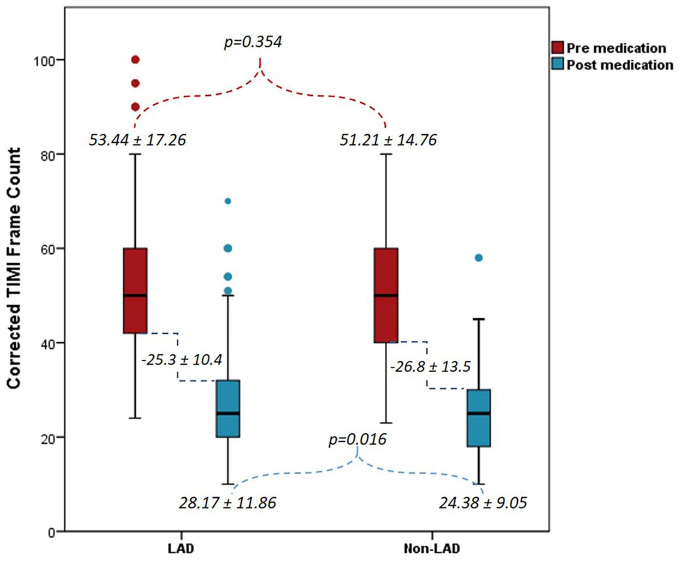
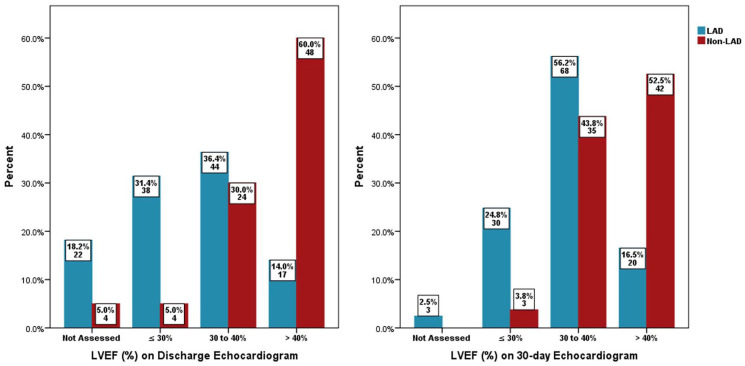
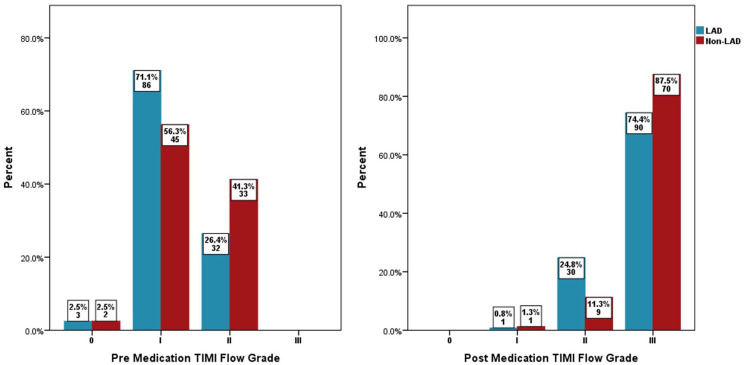
Out of the 201 patients, 60.19% had culprit left anterior descending artery. Pulse rate, baseline systolic and diastolic blood pressure, single-vessel disease, left ventricular ejection fraction <30%, baseline thrombolysis in myocardial infarction I flow and final thrombolysis in myocardial infarction II flow (24.8% vs 11.3%, = .017), and thrombolysis in myocardial infarction frame count (28.17 ± 11.86 vs 24.38 ± 9.05, = .016) were significantly higher in the left anterior descending artery group. In contrast, baseline Killip Class I, three-vessel disease, baseline thrombolysis in myocardial infarction II flow, final thrombolysis in myocardial infarction III flow (74.4% vs 87.5%, = .024) and left ventricular ejection fraction >40% were significantly greater in the non-left anterior descending artery group. However, for both in-hospital and at 30 days, overall major adverse cardiovascular event was similar in the two groups. The demographics, clinical and medication profiles and the routes used to treat no-reflow were all comparable in both groups.
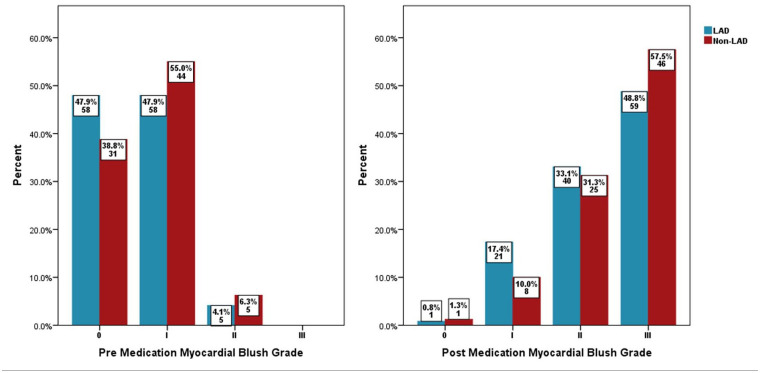
No-reflow in left anterior descending artery ST-elevation myocardial infarction is associated with lower final thrombolysis in myocardial infarction III flow, higher thrombolysis in myocardial infarction frame count and relatively lower Grade III myocardial blush than non-left anterior descending artery ST-elevation myocardial infarction with subsequent lower left ventricular ejection fraction and a higher frequency of in-hospital heart failure and hospitalisation due to heart failure.
无复流是直接经皮冠状动脉介入治疗期间支架置入后经常发生的一种并发症。在本研究中,我们重点关注左前降支(LAD)动脉与非左前降支动脉ST段抬高型心肌梗死(STEMI)发生无复流后的血管造影结果和临床结局。
在这项前瞻性研究中,共纳入201例在直接经皮冠状动脉介入治疗期间发生无复流的患者。这些患者被分为左前降支动脉罪犯血管组和非左前降支动脉罪犯血管组。主要终点为心肌梗死溶栓后最终血流、校正的心肌梗死溶栓帧数和最终心肌灌注分级。次要终点为住院期间和1个月时的主要不良心血管事件。
在201例患者中,60.19%的罪犯血管为左前降支动脉。左前降支动脉组的心率、基线收缩压和舒张压波动、单支血管病变、左心室射血分数<30%、基线心肌梗死溶栓I级血流和最终心肌梗死溶栓II级血流(24.8%对11.3%,P = 0.017)以及心肌梗死帧数(28.17±11.86对24.38±9.05,P = 0.016)显著更高。相比之下,非左前降支动脉组的基线Killip I级、三支血管病变、基线心肌梗死溶栓II级血流、最终心肌梗死溶栓III级血流(74.4%对87.5%,P = 0.024)和左心室射血分数>40%显著更高。然而,在住院期间和30天时,两组的总体主要不良心血管事件相似。两组的人口统计学、临床和用药情况以及用于治疗无复流的途径均具有可比性。
与非左前降支动脉ST段抬高型心肌梗死相比,左前降支动脉ST段抬高型心肌梗死发生无复流时,最终心肌梗死溶栓III级血流较低,心肌梗死帧数较高,心肌灌注III级相对较低,随后左心室射血分数较低,住院期间心力衰竭和因心力衰竭住院的频率较高。