Department of Medical Oncology, Beijing Chest Hospital, Capital Medical University, Beijing Tuberculosis and Thoracic Tumor Research Institute, Beijing, China.
Thorac Cancer. 2018 Feb;9(2):298-304. doi: 10.1111/1759-7714.12582. Epub 2018 Jan 3.
VEGF is critical in the pathogenesis of malignant pleural effusion (MPE). To understand the clinical benefits of antiangiogenic agents, the efficacy of chemotherapy containing bevacizmab was investigated in patients with lung adenocarcinoma-induced MPE.
The data of lung adenocarcinoma patients with MPE treated with bevacizumab plus chemotherapy on day 1, every three weeks, for ≤ 6 cycles was retrospectively collected. Patients who achieved a response or stable disease were administered bevacizumab as maintenance therapy until progression. The primary outcomes of the study were MPE response rate (RR), MPE control rate, and pleural progression-free survival (PPFS), while the secondary outcomes were PFS, overall survival (OS), changes to the lung volume and thoracic cage, and safety profiles.
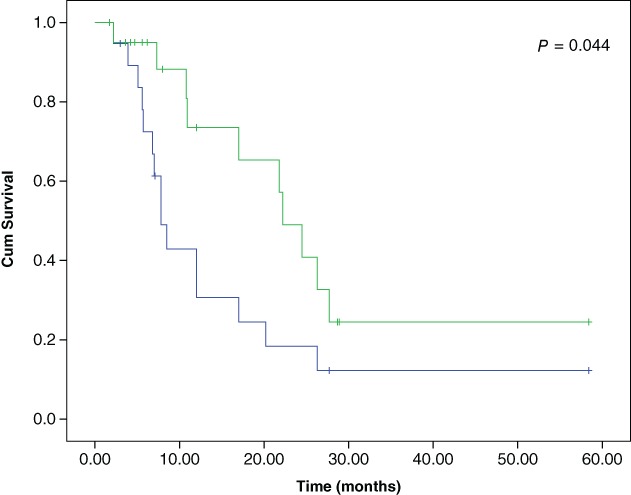
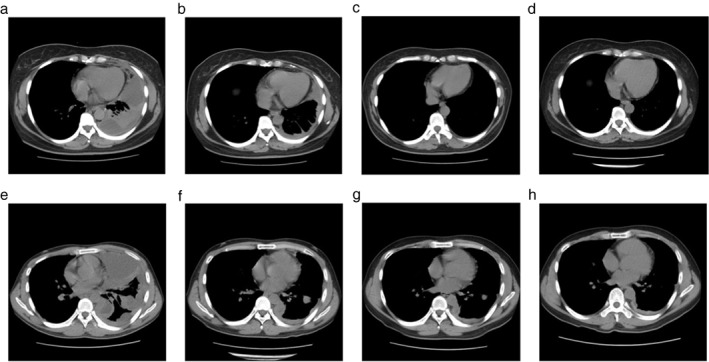
A total of 21 cases were collected, and all were evaluable for response, including 15 chemotherapy-naïve patients and 6 who experienced relapse. The median cycle of treatments was 7 (1-42) and 5 (2-6) for bevacizumab and chemotherapy, respectively. The MPE RR reached 81.0%. The MPE control rate at 6, 12, 24, 48, and 96 weeks were 95.2%, 90.0%, 89.5%, 73.7%, and 43.8%, respectively. Median PPFS was significantly longer than PFS (22.2 vs. 7.8 months; P = 0.044), and median OS was 25.8 months. Nineteen (90.5%) patients experienced lung re-expansion after treatment. Only one (4.8%) patient suffered thoracic volume decrease during treatment and the follow-up period. No unexpected adverse events were observed.
Bevacizumab combined with chemotherapy demonstrated efficacious, persistence, and safety in controlling lung cancer-induced MPE, indicating a potential superior therapeutic option.
VEGF 在恶性胸腔积液(MPE)的发病机制中起关键作用。为了了解抗血管生成药物的临床获益,研究了含贝伐珠单抗的化疗药物在肺腺癌引起的 MPE 患者中的疗效。
回顾性收集了肺腺癌患者 MPE 接受贝伐珠单抗联合化疗(第 1 天,每 3 周 1 次,最多 6 个周期)的资料。对达到缓解或疾病稳定的患者给予贝伐珠单抗维持治疗,直至疾病进展。本研究的主要终点为 MPE 缓解率(RR)、MPE 控制率和胸腔积液无进展生存期(PPFS),次要终点为无进展生存期(PFS)、总生存期(OS)、肺容积和胸廓变化以及安全性。
共收集了 21 例患者,所有患者均对疗效进行了评估,其中 15 例为化疗初治患者,6 例为复发患者。贝伐珠单抗和化疗的中位治疗周期数分别为 7(1-42)和 5(2-6)个周期。MPE RR 达到 81.0%。MPE 在第 6、12、24、48 和 96 周的控制率分别为 95.2%、90.0%、89.5%、73.7%和 43.8%。中位 PPFS明显长于 PFS(22.2 与 7.8 个月;P=0.044),中位 OS 为 25.8 个月。治疗后 19 例(90.5%)患者肺部重新扩张。治疗和随访期间仅有 1 例(4.8%)患者出现胸腔容积减少。未观察到意外的不良事件。
贝伐珠单抗联合化疗在控制肺癌引起的 MPE 方面具有疗效、持久性和安全性,表明这是一种潜在的更优治疗选择。