Tatsukami Yohei, Morisaka Hironobu, Aburaya Shunsuke, Aoki Wataru, Kohsaka Chihiro, Tani Masafumi, Hirooka Kiyoo, Yamamoto Yoshihiro, Kitaoka Atsushi, Fujiwara Hisashi, Wakai Yoshinori, Ueda Mitsuyoshi
Division of Applied Life Sciences, Graduate School of Agriculture, Kyoto University, Sakyo-ku, Kyoto, Japan.
Japan Society for the Promotion of Science, Sakyo-ku, Kyoto, Japan.
PLoS One. 2018 Jan 3;13(1):e0190040. doi: 10.1371/journal.pone.0190040. eCollection 2018.
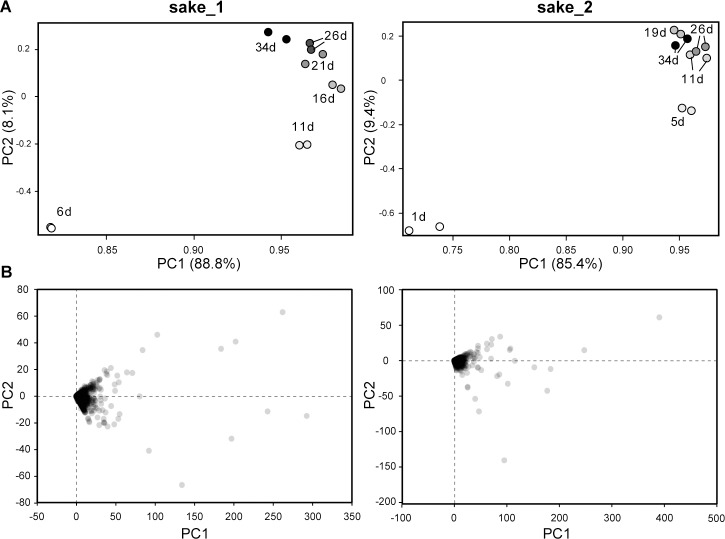
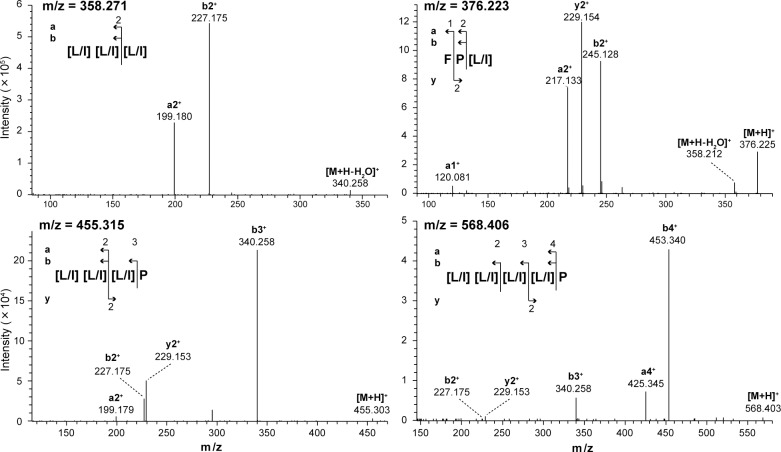
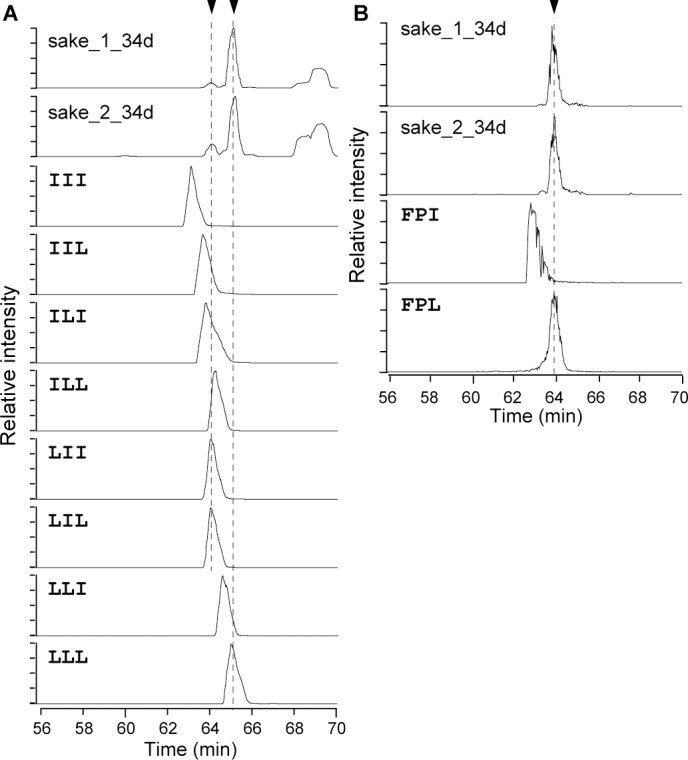
Sake is a traditional Japanese alcoholic beverage prepared by multiple parallel fermentation of rice. The fermentation process of "yamahai-ginjo-shikomi" sake is mainly performed by three microbes, Aspergillus oryzae, Saccharomyces cerevisiae, and Lactobacilli; the levels of various metabolites fluctuate during the fermentation of sake. For evaluation of the fermentation process, we monitored the concentration of moderate-sized molecules (m/z: 200-1000) dynamically changed during the fermentation process of "yamahai-ginjo-shikomi" Japanese sake. This analysis revealed that six compounds were the main factors with characteristic differences in the fermentation process. Among the six compounds, four were leucine- or isoleucine-containing peptides and the remaining two were predicted to be small molecules. Quantification of these compounds revealed that their quantities changed during the month of fermentation process. Our metabolomic approach revealed the dynamic changes observed in moderate-sized molecules during the fermentation process of sake, and the factors found in this analysis will be candidate molecules that indicate the progress of "yamahai-ginjo-shikomi" sake fermentation.
清酒是一种通过大米的多平行发酵制成的传统日本酒精饮料。“山废吟醸仕込”清酒的发酵过程主要由米曲霉、酿酒酵母和乳酸菌这三种微生物进行;在清酒发酵过程中,各种代谢物的水平会发生波动。为了评估发酵过程,我们监测了在“山废吟醸仕込”日本清酒发酵过程中动态变化的中等大小分子(质荷比:200 - 1000)的浓度。该分析表明,六种化合物是发酵过程中具有特征差异的主要因素。在这六种化合物中,四种是含亮氨酸或异亮氨酸的肽,其余两种预计是小分子。对这些化合物的定量分析表明,它们的数量在发酵过程的一个月中发生了变化。我们的代谢组学方法揭示了清酒发酵过程中中等大小分子的动态变化,并且在该分析中发现的因素将是表明“山废吟醸仕込”清酒发酵进程的候选分子。