Ogino Tetsuya, Maegawa Shingo, Shigeno Shuichi, Fujikura Katsunori, Toyohara Haruhiko
Divison of Applied Biosciences, Graduate School of Agriculture, Kyoto University, Kyoto, Kyoto, Japan.
Intelligence Science and Technology, Graduate School of Informatics, Kyoto University, Kyoto, Kyoto, Japan.
PLoS One. 2018 Jan 3;13(1):e0189902. doi: 10.1371/journal.pone.0189902. eCollection 2018.
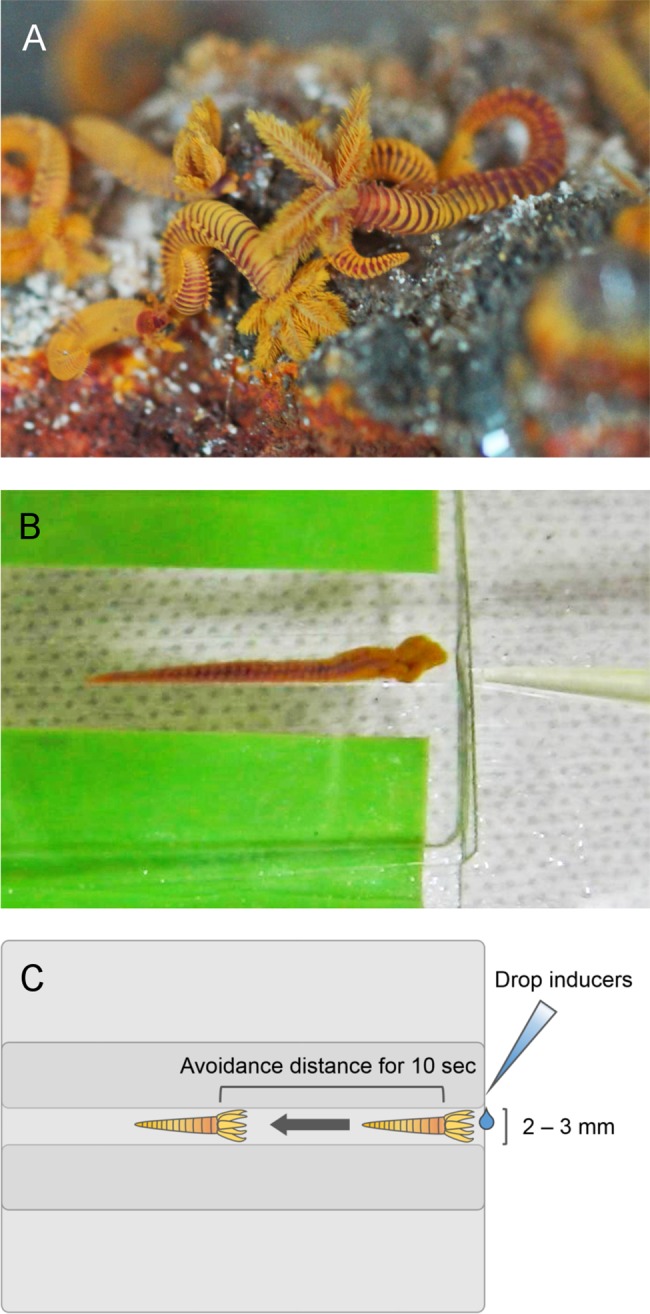
The environments around deep-sea hydrothermal vents are very harsh conditions for organisms due to the possibility of exposure to highly toxic compounds and extremely hot venting there. Despite such extreme environments, some indigenous species have thrived there. Alvinellid worms (Annelida) are among the organisms best adapted to high-temperature and oxidatively stressful venting regions. Although intensive studies of the adaptation of these worms to the environments of hydrothermal vents have been made, little is known about the worms' sensory adaptation to the severe chemical conditions there. To examine the sensitivity of the vent-endemic worm Paralvinella hessleri to low pH and oxidative stress, we determined the concentration of acetic acid and hydrogen peroxide that induced avoidance behavior of this worm, and compared these concentrations to those obtained for related species inhabiting intertidal zones, Thelepus sp. The concentrations of the chemicals that induced avoidance behavior of P. hessleri were 10-100 times lower than those for Thelepus sp. To identify the receptors for these chemicals, chemical avoidance tests were performed with the addition of ruthenium red, a blocker of transient receptor potential (TRP) channels. This treatment suppressed the chemical avoidance behavior of P. hessleri, which suggests that TRP channels are involved in the chemical avoidance behavior of this species. Our results revealed for the first time hypersensitive detection systems for acid and for oxidative stress in the vent-endemic worm P. hessleri, possibly mediated by TRP channels, suggesting that such sensory systems may have facilitated the adaptation of this organism to harsh vent environments.
由于深海热液喷口周围的环境可能会接触到剧毒化合物以及那里极高的热液喷发,因此对生物来说是非常恶劣的条件。尽管环境极端,但一些本土物种仍在那里繁衍生息。阿尔文虫(环节动物)是最适应高温和氧化应激热液喷发区域的生物之一。尽管已经对这些蠕虫适应热液喷口环境进行了深入研究,但对于它们对那里恶劣化学条件的感官适应却知之甚少。为了研究热液喷口特有的赫氏拟阿尔文虫对低pH值和氧化应激的敏感性,我们测定了诱导这种蠕虫产生回避行为的乙酸和过氧化氢浓度,并将这些浓度与栖息在潮间带的相关物种——丝状鳃蚕的浓度进行比较。诱导赫氏拟阿尔文虫产生回避行为的化学物质浓度比丝状鳃蚕的低10至100倍。为了确定这些化学物质的受体,我们在添加了钌红(一种瞬时受体电位(TRP)通道阻滞剂)的情况下进行了化学回避测试。这种处理抑制了赫氏拟阿尔文虫的化学回避行为,这表明TRP通道参与了该物种的化学回避行为。我们的研究结果首次揭示了热液喷口特有的赫氏拟阿尔文虫对酸和氧化应激的超敏感检测系统,可能由TRP通道介导,这表明这种感官系统可能促进了这种生物对恶劣喷口环境的适应。