Yin Jun, Tang Weifeng, Long Tao, Pan Huiwen, Liu Jianchao, Lv Lu, Liu Chao, Shi Yijun, Zhu Jingfeng, Sun Yangyong, Shao Aizhong, Zhou Qiang, Ren Zhengbing, Ding Guowen, Chen Suocheng, Liu Yan, Yao Jun, Ding Hao, Yan Yulan, Gu Haiyong, Qian Cheng, Wang Liming, Wang Qun, Tan Lijie
Department of Cardiothoracic Surgery, Affiliated People's Hospital of Jiangsu University, Zhenjiang, Jiangsu, 212002, China.
Department of Thoracic Surgery, Zhongshan Hospital of Fudan University, Shanghai, 200032, China.
Oncotarget. 2017 Nov 24;8(66):110153-110165. doi: 10.18632/oncotarget.22656. eCollection 2017 Dec 15.
Esophageal cancer (EC) is the sixth leading cause of cancer-associated death worldwide. The interaction of environmental risk factors and genetic factors might contribute to the carcinogenesis of EC synergistically.
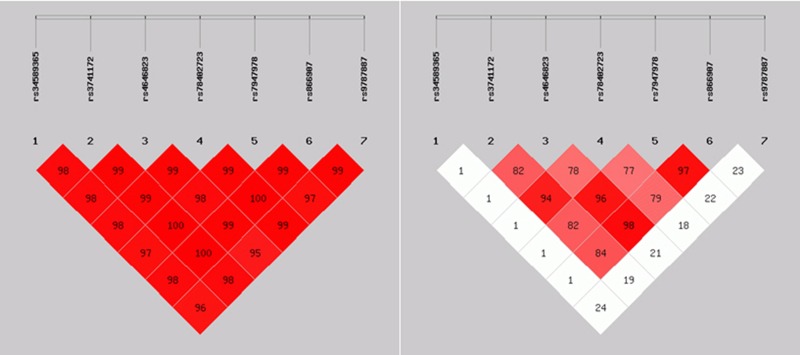
All seven single locus polymorphisms of ALDH3B2 were not associated with risk of ESCC as evaluated by allelic, dominant, co-dominant, recessive and Cochran-Armitage trend tests. Stratified analyses showed these SNPs were not correlated with the susceptibility of ESCC according to different age, gender, cigarette smoking and alcohol drinking status. None of the major haplotypes were related with ESCC susceptibility.
We conducted a hospital-based case-control study to evaluate the combined effects of environmental risk factors and the single nucleotide polymorphisms (SNPs) of ALDH3B2 gene on the development of esophageal squamous carcinoma (ESCC). A total of 1043 ESCC cases and 1315 controls were recruited for this study. Seven ALDH3B2 SNPs and four environmental factors were selected as independent variables. ALDH3B2 SNPs were determined by ligation detection reaction method.
Our study suggested that ALDH3B2 rs34589365, rs3741172, rs4646823, rs78402723, rs7947978, rs866907 and rs9787887 polymorphisms were not implicated with altered susceptibility of ESCC according to different age, gender, cigarette smoking and alcohol drinking status. Yet this conclusion needs to be verified in larger studies among different ethnic populations with validation design, the biological function of these SNPs in carcinogenesis are subject to further investigation.
食管癌(EC)是全球癌症相关死亡的第六大主要原因。环境风险因素与遗传因素的相互作用可能协同促进食管癌的发生。
通过等位基因、显性、共显性、隐性和 Cochr an-Armitage 趋势检验评估,ALDH3B2 的所有七个单基因座多态性均与食管鳞状细胞癌(ESCC)风险无关。分层分析表明,根据不同年龄、性别、吸烟和饮酒状况,这些单核苷酸多态性(SNP)与 ESCC 的易感性无关。没有一种主要单倍型与 ESCC 易感性相关。
我们进行了一项基于医院的病例对照研究,以评估环境风险因素和 ALDH3B2 基因的单核苷酸多态性(SNP)对食管鳞状细胞癌(ESCC)发生发展的联合影响。本研究共招募了 1043 例 ESCC 病例和 1315 名对照。选择七个 ALDH3B2 SNP 和四个环境因素作为自变量。通过连接检测反应法测定 ALDH3B2 SNP。
我们的研究表明,根据不同年龄、性别、吸烟和饮酒状况,ALDH3B2 的 rs34589365、rs3741172、rs4646823、rs78402723、rs7947978、rs866907 和 rs9787887 多态性与 ESCC 易感性改变无关。然而,这一结论需要在具有验证设计的不同种族人群的更大规模研究中得到验证,这些 SNP 在致癌过程中的生物学功能有待进一步研究。