Creighton Francis X, Feng Allen L, Goyal Neerav, Emerick Kevin, Deschler Daniel
Department of Otolaryngology Harvard Medical School, Massachusetts Eye and Ear Infirmary Boston Massachusetts U.S.A.
Department of Otolaryngology Penn State Medical School Hershey Pennsylvania U.S.A.
Laryngoscope Investig Otolaryngol. 2017 Oct 11;2(6):471-474. doi: 10.1002/lio2.94. eCollection 2017 Dec.
Microsurgical techniques are essential for vessel anastomosis in free flap reconstructive surgery. However, teaching these skills intraoperatively is difficult. The chicken thigh microvascular model is a high-fidelity model that has been previously validated to differentiate between skill levels of surgeons. This study aims to determine if this model objectively improves microsurgical skills.
Validation study.
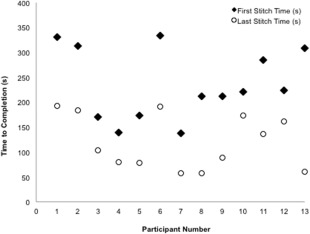
Thirteen residents were given a tutorial on microvascular anastomosis and asked to perform anastomoses on the microvascular model. Anastomoses were video-recorded and the time required for trainees to complete the first stitch of their first anastomosis was compared to the time required for the first stitch of their last anastomosis. Comparison of first and last stitch times was completed using a paired student t-test. All participants completed a survey regarding their experience with the simulator.
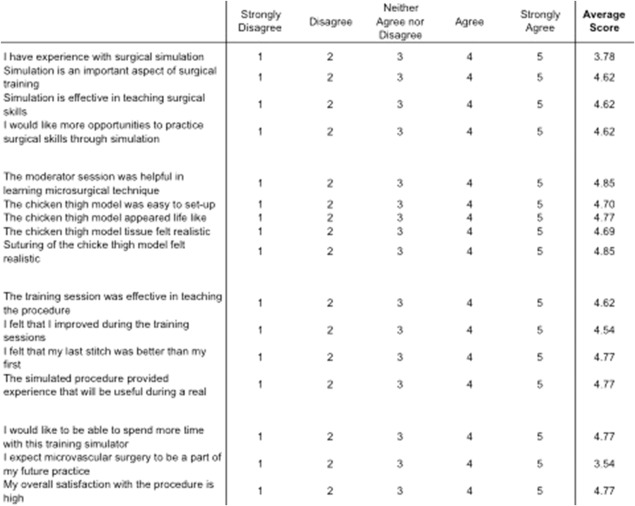
There was a statistically significant decrease between the time required for the first stitch (235 s, 95%CI 198-272 s) compared to last stitch (120 s, 95%CI 92-149 s), and an average 48.7% (115 s) decrease in time ( < 0.001). Junior (PGY 2/3) and senior (PGY 4/5) residents had similar decreases in time, 49.1% and 48.21%, respectively. One hundred percent of residents felt they improved during the session and 92% of residents agreed or strongly agreed that their final stitch was better than their last stitch. All residents agreed or strongly agreed that the simulation is realistic, effective in teaching the procedure, and would translate to improved intraoperative performance.
The chicken thigh model demonstrates objective improvements in resident microvascular surgical skills.
NA.
显微外科技术在游离皮瓣重建手术的血管吻合中至关重要。然而,在术中教授这些技能却很困难。鸡大腿微血管模型是一种高保真模型,此前已被验证可区分外科医生的技能水平。本研究旨在确定该模型是否能客观地提高显微外科技能。
验证性研究。
13名住院医师接受了微血管吻合教程培训,并被要求在微血管模型上进行吻合。吻合过程进行了视频记录,将学员完成第一次吻合的第一针所需时间与完成最后一次吻合的第一针所需时间进行比较。使用配对学生t检验完成第一次和最后一针时间的比较。所有参与者完成了一份关于他们使用模拟器体验的调查问卷。
与最后一针(120秒,95%CI 92 - 149秒)相比,第一针所需时间(235秒,95%CI 198 - 272秒)有统计学意义的下降,时间平均下降48.7%(115秒)(<0.001)。初级(PGY 2/3)和高级(PGY 4/5)住院医师的时间下降相似,分别为49.1%和48.21%。100%的住院医师感觉他们在培训过程中有所提高,92%的住院医师同意或强烈同意他们的最后一针比第一针更好。所有住院医师都同意或强烈同意该模拟是真实的、在教授该操作方面有效,并且会转化为术中表现的改善。
鸡大腿模型证明了住院医师微血管外科技能的客观提高。
无。