a AIDS Research Office , National Traditional Chinese Medicine Research Base in Xinjiang , Urumqi , People's Republic of China.
d Xinjiang Uygur Autonomous Regional the Sixth People's Hospital , Urumqi , People's Republic of China.
Ren Fail. 2018 Nov;40(1):68-74. doi: 10.1080/0886022X.2017.1419975.
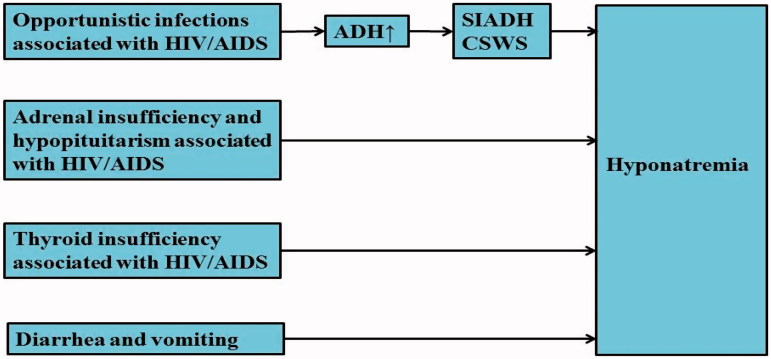
Hyponatremia is the most common electrolyte disorder in hospitals. Many medical illnesses, including congestive heart failure, liver failure, renal failure and pneumonia, may be associated with hyponatremia. In addition, hyponatremia in patients with the acquired immunodeficiency syndrome (AIDS) and AIDS-related complex (ARC) was first reported in 1993. The evidence suggests that severe hyponatremia is associated with increased morbidity and mortality in human immunodeficiency virus (HIV)/AIDS patients; however, the incidence of hyponatremic syndrome in HIV/AIDS patients remains very high in clinical practice, as almost 40% of HIV/AIDS inpatients in Xinjiang, a developing region of China, are hyponatremic. A method for identifying the pathogenesis and therapeutic treatments for hyponatremia in HIV/AIDS patients is needed. This review focuses on the clinical and pathophysiological aspects of hyponatremia and highlights the causes, presentation and treatment recommendations for hyponatremic patients with HIV/AIDS.
低钠血症是医院中最常见的电解质紊乱。许多医学疾病,包括充血性心力衰竭、肝衰竭、肾衰竭和肺炎,都可能与低钠血症有关。此外,1993 年首次报道了获得性免疫缺陷综合征(AIDS)和 AIDS 相关综合征(ARC)患者的低钠血症。有证据表明,严重的低钠血症与人类免疫缺陷病毒(HIV)/艾滋病患者的发病率和死亡率增加有关;然而,在临床实践中,HIV/AIDS 患者低钠血症综合征的发病率仍然很高,因为在中国欠发达地区新疆,几乎 40%的 HIV/AIDS 住院患者存在低钠血症。需要一种方法来确定 HIV/AIDS 患者低钠血症的发病机制和治疗方法。这篇综述重点介绍了低钠血症的临床和病理生理学方面,并强调了 HIV/AIDS 患者低钠血症的病因、表现和治疗建议。