Center for Devices and Radiological Health, U.S. Food and Drug Administration, Silver Spring, MD 20993, USA.
Department of Electrical and Computer Engineering, University of Maryland, College Park, MD 20740, USA.
Sensors (Basel). 2018 Jan 4;18(1):125. doi: 10.3390/s18010125.
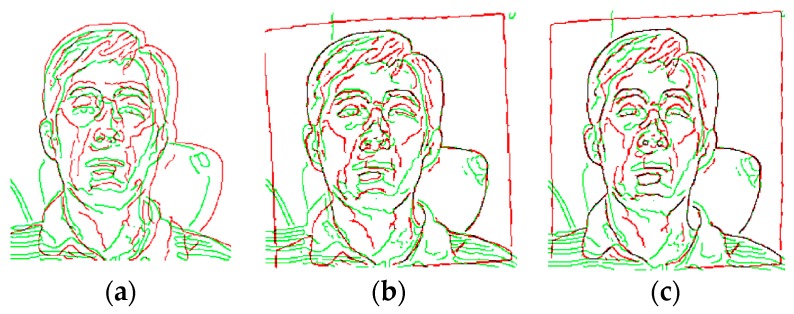
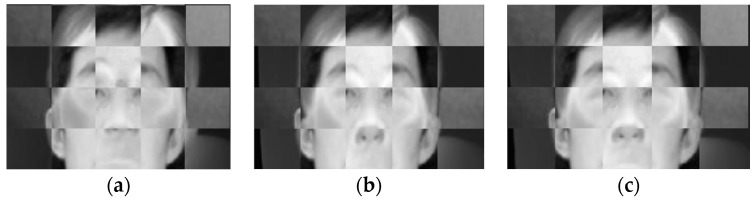
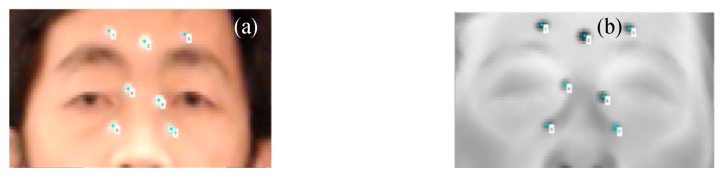
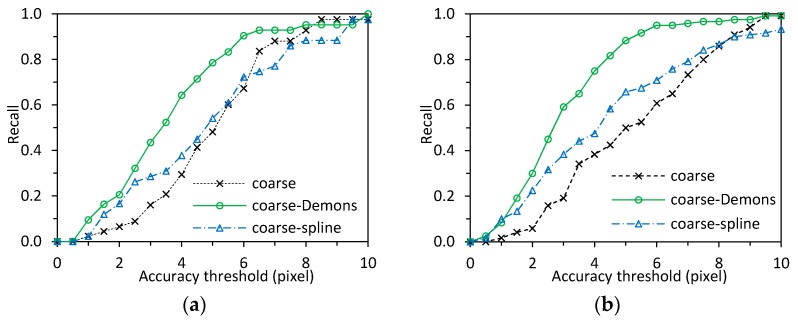
Fever screening based on infrared (IR) thermographs (IRTs) is an approach that has been implemented during infectious disease pandemics, such as Ebola and Severe Acute Respiratory Syndrome. A recently published international standard indicates that regions medially adjacent to the inner canthi provide accurate estimates of core body temperature and are preferred sites for fever screening. Therefore, rapid, automated identification of the canthi regions within facial IR images may greatly facilitate rapid fever screening of asymptomatic travelers. However, it is more difficult to accurately identify the canthi regions from IR images than from visible images that are rich with exploitable features. In this study, we developed and evaluated techniques for multi-modality image registration (MMIR) of simultaneously captured visible and IR facial images for fever screening. We used free form deformation (FFD) models based on edge maps to improve registration accuracy after an affine transformation. Two widely used FFD models in medical image registration based on the Demons and cubic B-spline algorithms were qualitatively compared. The results showed that the Demons algorithm outperformed the cubic B-spline algorithm, likely due to overfitting of outliers by the latter method. The quantitative measure of registration accuracy, obtained through selected control point correspondence, was within 2.8 ± 1.2 mm, which enables accurate and automatic localization of canthi regions in the IR images for temperature measurement.
基于红外(IR)热像图(IRTs)的发热筛查是在传染病大流行期间实施的一种方法,如埃博拉和严重急性呼吸系统综合征。最近发布的一项国际标准表明,内眼角内侧的区域能准确估计核心体温,是发热筛查的首选部位。因此,快速、自动识别面部 IR 图像中的眼角区域可能极大地促进无症状旅行者的快速发热筛查。然而,从红外图像中准确识别眼角区域比从富含可利用特征的可见图像中更具挑战性。在这项研究中,我们开发并评估了同时捕获可见和红外面部图像的多模态图像配准(MMIR)技术,用于发热筛查。我们使用基于边缘图的自由形态变形(FFD)模型来提高仿射变换后的配准精度。定性比较了两种广泛应用于基于 Demons 和三次 B 样条算法的医学图像配准的 FFD 模型。结果表明,Demons 算法优于三次 B 样条算法,这可能是由于后者方法对离群值的过度拟合。通过选择控制点对应关系获得的注册精度定量测量值在 2.8±1.2mm 范围内,这使得能够在 IR 图像中准确自动定位眼角区域以进行温度测量。