Reaungamornrat Sureerat, De Silva Tharindu, Uneri Ali, Vogt Sebastian, Kleinszig Gerhard, Khanna Akhil J, Wolinsky Jean-Paul, Prince Jerry L, Siewerdsen Jeffrey H
IEEE Trans Med Imaging. 2016 Nov;35(11):2413-2424. doi: 10.1109/TMI.2016.2576360. Epub 2016 Jun 2.
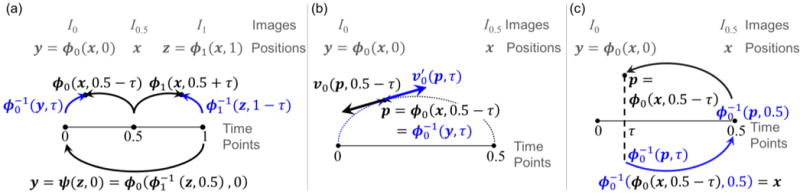
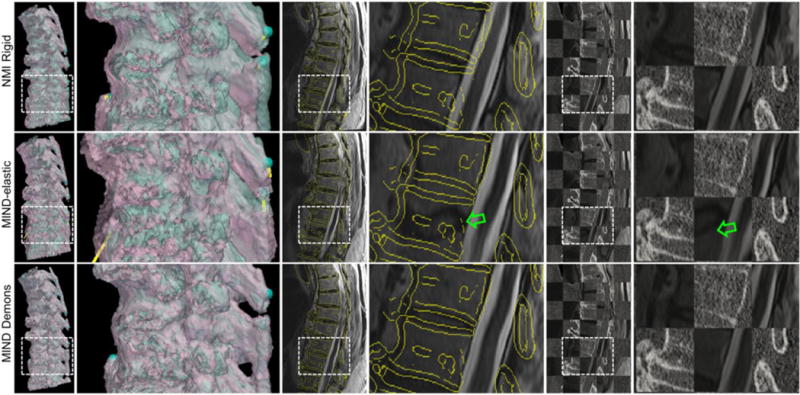
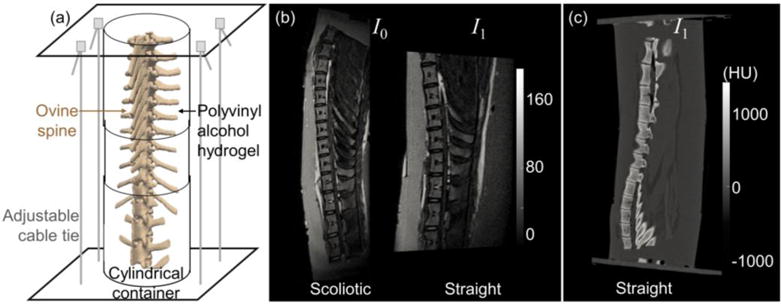
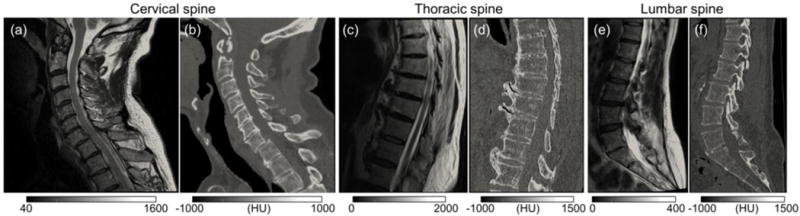
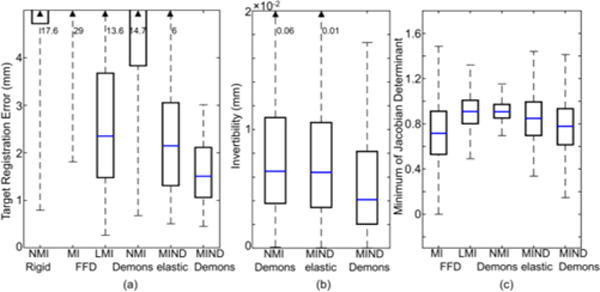
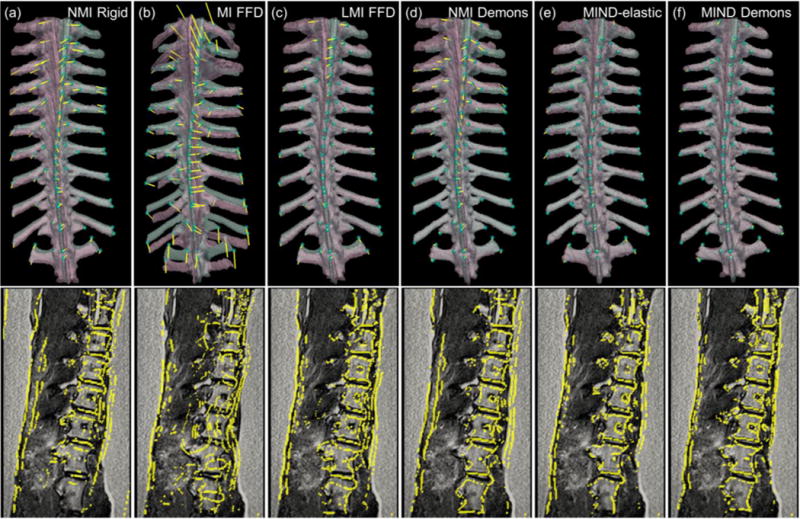
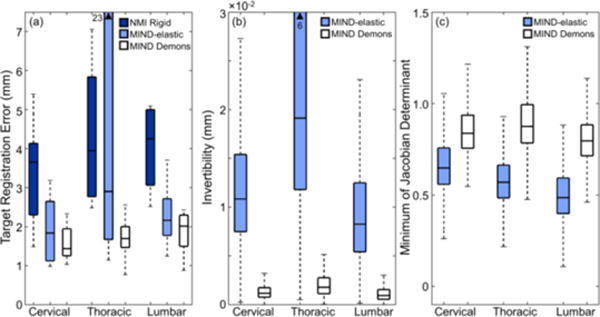
Intraoperative localization of target anatomy and critical structures defined in preoperative MR/CT images can be achieved through the use of multimodality deformable registration. We propose a symmetric diffeomorphic deformable registration algorithm incorporating a modality-independent neighborhood descriptor (MIND) and a robust Huber metric for MR-to-CT registration. The method, called MIND Demons, finds a deformation field between two images by optimizing an energy functional that incorporates both the forward and inverse deformations, smoothness on the integrated velocity fields, a modality-insensitive similarity function suitable to multimodality images, and smoothness on the diffeomorphisms themselves. Direct optimization without relying on the exponential map and stationary velocity field approximation used in conventional diffeomorphic Demons is carried out using a Gauss-Newton method for fast convergence. Registration performance and sensitivity to registration parameters were analyzed in simulation, phantom experiments, and clinical studies emulating application in image-guided spine surgery, and results were compared to mutual information (MI) free-form deformation (FFD), local MI (LMI) FFD, normalized MI (NMI) Demons, and MIND with a diffusion-based registration method (MIND-elastic). The method yielded sub-voxel invertibility (0.008 mm) and nonzero-positive Jacobian determinants. It also showed improved registration accuracy in comparison to the reference methods, with mean target registration error (TRE) of 1.7 mm compared to 11.3, 3.1, 5.6, and 2.4 mm for MI FFD, LMI FFD, NMI Demons, and MIND-elastic methods, respectively. Validation in clinical studies demonstrated realistic deformations with sub-voxel TRE in cases of cervical, thoracic, and lumbar spine.
通过使用多模态可变形配准,可以实现术前磁共振成像(MR)/计算机断层扫描(CT)图像中定义的目标解剖结构和关键结构的术中定位。我们提出了一种对称的微分同胚可变形配准算法,该算法结合了模态无关邻域描述符(MIND)和用于MR到CT配准的鲁棒Huber度量。该方法称为MIND Demons,通过优化一个能量泛函来找到两个图像之间的变形场,该能量泛函包括正向和反向变形、积分速度场上的平滑性、适用于多模态图像的模态不敏感相似性函数以及微分同胚本身的平滑性。使用高斯-牛顿法进行直接优化,无需依赖传统微分同胚Demons中使用的指数映射和静止速度场近似,以实现快速收敛。在模拟、体模实验以及模拟图像引导脊柱手术应用的临床研究中分析了配准性能和对配准参数的敏感性,并将结果与互信息(MI)自由形式变形(FFD)、局部MI(LMI)FFD、归一化MI(NMI)Demons以及采用基于扩散的配准方法的MIND(MIND-elastic)进行了比较。该方法产生了亚体素可逆性(0.008毫米)和非零正雅可比行列式。与参考方法相比,它还显示出更高的配准精度,平均目标配准误差(TRE)为1.7毫米,而MI FFD、LMI FFD、NMI Demons和MIND-elastic方法的平均目标配准误差分别为11.3毫米、3.1毫米、5.6毫米和2.4毫米。临床研究中的验证表明,在颈椎、胸椎和腰椎病例中,变形逼真且具有亚体素TRE。