Deputy Nicholas P, Dub Bhanuja, Sharma Andrea J
MMWR Morb Mortal Wkly Rep. 2018 Jan 5;66(51-52):1402-1407. doi: 10.15585/mmwr.mm665152a3.
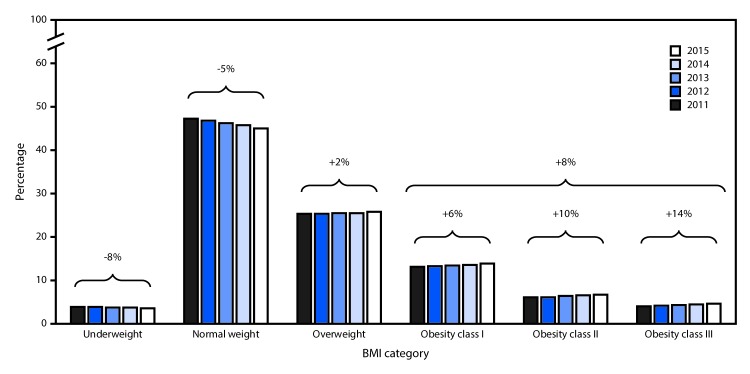
Women who enter pregnancy at a weight above or below normal weight, defined as a body mass index (BMI) of 18.5-24.9 (calculated as weight in kg/height in m), are more likely to experience adverse pregnancy outcomes and to have infants who experience adverse health outcomes. For example, prepregnancy underweight (BMI <18.5) increases the risk for small-for-gestational-age births, whereas prepregnancy overweight (BMI 25.0-29.9) and obesity (BMI ≥30.0) increase risks for cesarean delivery, large-for-gestational-age births, and childhood obesity (1). Given these outcomes, Healthy People 2020 includes an objective to increase the proportion of women entering pregnancy with a normal weight from 52.5% in 2007 to 57.8% by 2020.* Because recent trends in prepregnancy normal weight have not been reported, CDC examined 2011-2015 National Vital Statistics System (NVSS) natality data, which included prepregnancy BMI. In 2015, for 48 states, the District of Columbia (DC), and New York City (NYC) combined, the prevalence of prepregnancy normal weight was 45.0%; prevalence ranged from 37.7% in Mississippi to 52.2% in DC. Among 38 jurisdictions with prepregnancy BMI data during 2011-2015, normal weight prevalence declined from 47.3% to 45.1%; declines were observed in all jurisdictions but were statistically significant for 27 jurisdictions after standardizing to the 2011 national maternal age and race/ethnicity distribution. Screening women's BMI during routine clinical care provides opportunities to promote normal weight before entering pregnancy.
孕期体重高于或低于正常范围(定义为体重指数[BMI]在18.5至24.9之间,计算方法为体重[千克]/身高[米]²)的女性,更有可能经历不良妊娠结局,其婴儿也更有可能出现不良健康结局。例如,孕前体重过轻(BMI<18.5)会增加小于胎龄儿出生的风险,而孕前超重(BMI 25.0至29.9)和肥胖(BMI≥30.0)则会增加剖宫产、大于胎龄儿出生以及儿童期肥胖的风险(1)。鉴于这些结局,《健康人民2020》设定了一个目标,即到2020年,将孕期体重正常的女性比例从2007年的52.5%提高到57.8%*。由于尚未报告孕前正常体重的近期趋势,美国疾病控制与预防中心(CDC)对2011 - 2015年国家生命统计系统(NVSS)的出生数据进行了研究,这些数据包含孕前BMI。2015年,48个州、哥伦比亚特区(DC)和纽约市(NYC)的合并数据显示,孕前体重正常的患病率为45.0%;患病率范围从密西西比州的37.7%到哥伦比亚特区的52.2%。在2011 - 2015年有孕前BMI数据的38个司法管辖区中,正常体重患病率从47.3%降至45.1%;所有司法管辖区均有下降,但在根据2011年全国孕产妇年龄和种族/族裔分布进行标准化后,27个司法管辖区的下降具有统计学意义。在常规临床护理中筛查女性的BMI,为孕前促进正常体重提供了机会。