Didona Dario, Paolino Giovanni, Bottoni Ugo, Cantisani Carmen
Klinik für Dermatologie und Allergologie, Universitätsklinikum Marburg, Baldingerstraße, 35043 Marburg, Germany.
Department of Dermatology, Sapienza Università di Roma, Rome 00100, Italy.
Biomedicines. 2018 Jan 2;6(1):6. doi: 10.3390/biomedicines6010006.
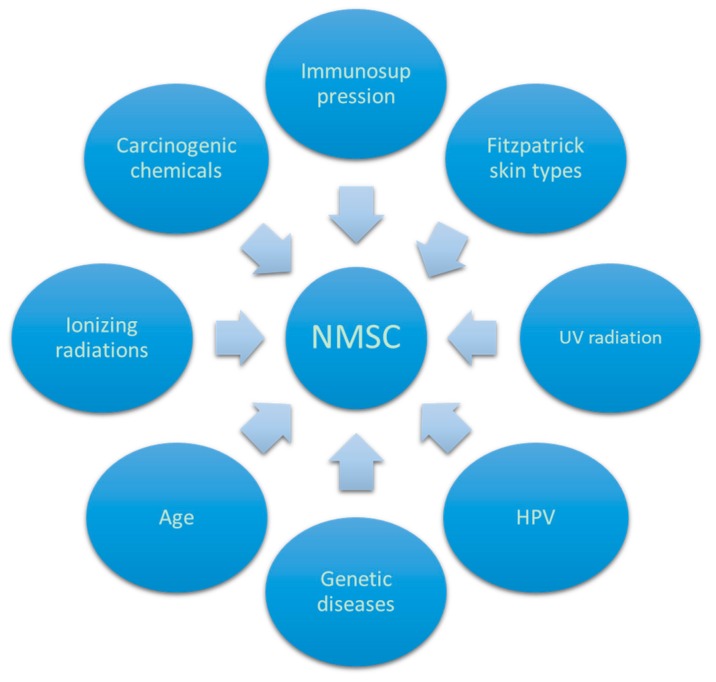
(1) Background: Non-melanoma skin cancer is the most frequently diagnosed cancer in humans. The process of skin carcinogenesis is still not fully understood. However, several studies have been conducted to better explain the mechanisms that lead to malignancy; (2) Methods: We reviewed the more recent literature about the pathogenesis of non-melanoma skin cancer focusing on basal cell carcinomas, squamous cell carcinoma and actinic keratosis; (3) Results: Several papers reported genetic and molecular alterations leading to non-melanoma skin cancer. Plenty of risk factors are involved in non-melanoma skin cancer pathogenesis, including genetic and molecular alterations, immunosuppression, and ultraviolet radiation; (4) Conclusion: Although skin carcinogenesis is still not fully understood, several papers demonstrated that genetic and molecular alterations are involved in this process. In addition, plenty of non-melanoma skin cancer risk factors are now known, allowing for an effective prevention of non-melanoma skin cancer development. Compared to other papers on the same topic, our review focused on molecular and genetic factors and analyzed in detail several factors involved in non-melanoma skin cancer.
(1)背景:非黑色素瘤皮肤癌是人类中最常被诊断出的癌症。皮肤癌发生的过程仍未被完全理解。然而,已经进行了多项研究以更好地解释导致恶性肿瘤的机制;(2)方法:我们回顾了关于非黑色素瘤皮肤癌发病机制的最新文献,重点关注基底细胞癌、鳞状细胞癌和光化性角化病;(3)结果:多篇论文报道了导致非黑色素瘤皮肤癌的遗传和分子改变。非黑色素瘤皮肤癌的发病机制涉及许多风险因素,包括遗传和分子改变、免疫抑制以及紫外线辐射;(4)结论:尽管皮肤癌发生仍未被完全理解,但多篇论文表明遗传和分子改变参与了这一过程。此外,现在已知许多非黑色素瘤皮肤癌的风险因素,这使得有效预防非黑色素瘤皮肤癌的发展成为可能。与关于同一主题的其他论文相比,我们的综述聚焦于分子和遗传因素,并详细分析了非黑色素瘤皮肤癌涉及的几个因素。