Department of Oral and Maxillofacial Surgery, Pusan National University Dental Hospital, 20, Geumo-ro, Mulgeum-eup, Yangsan-si 50612, Gyeongsangnam-do, Korea.
Department of Oral and Maxillofacial Surgery, Medical center, Dong-A University, 26, Daesingongwon-ro, Seo-gu, Busan 49201, Korea.
Int J Mol Sci. 2018 Jan 2;19(1):125. doi: 10.3390/ijms19010125.
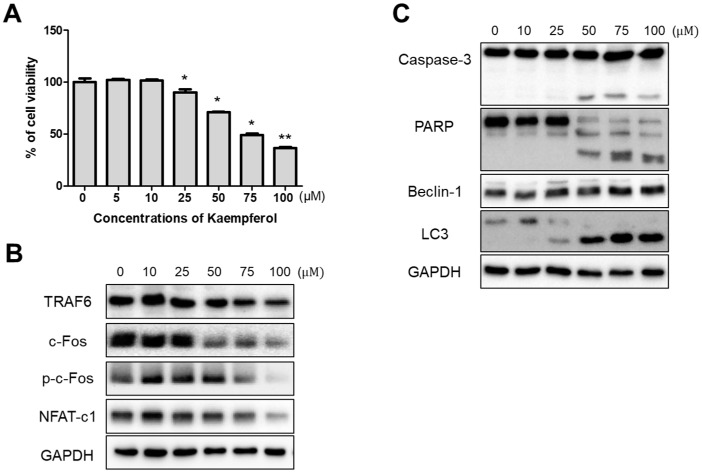
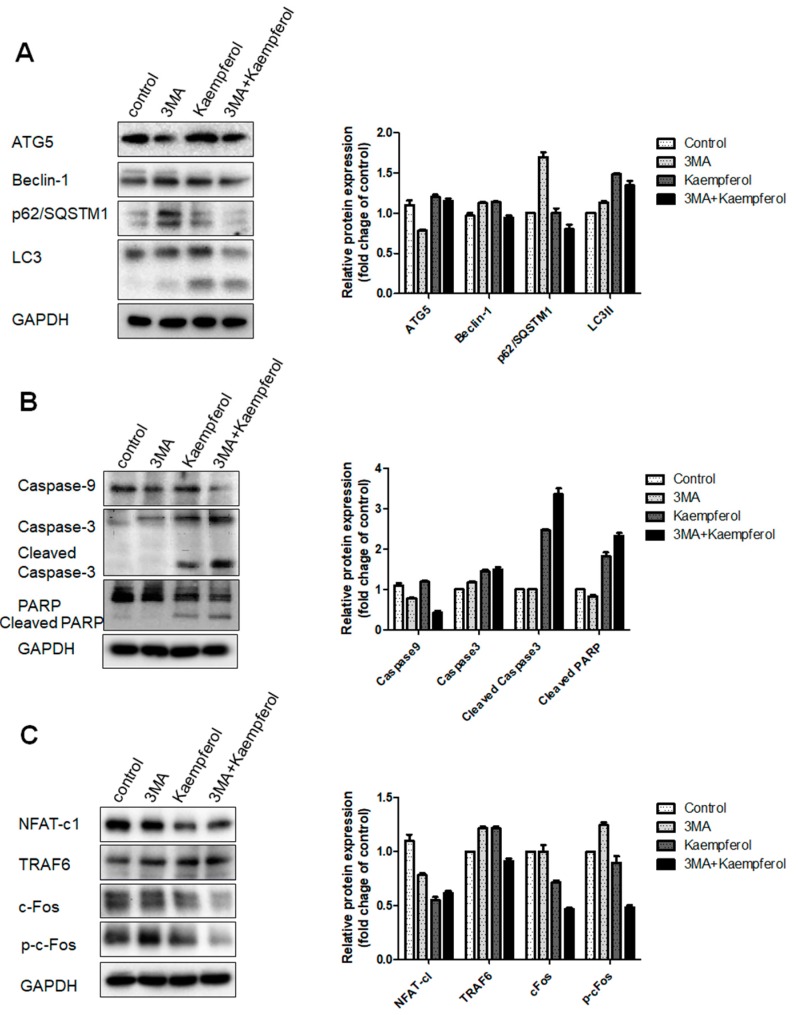
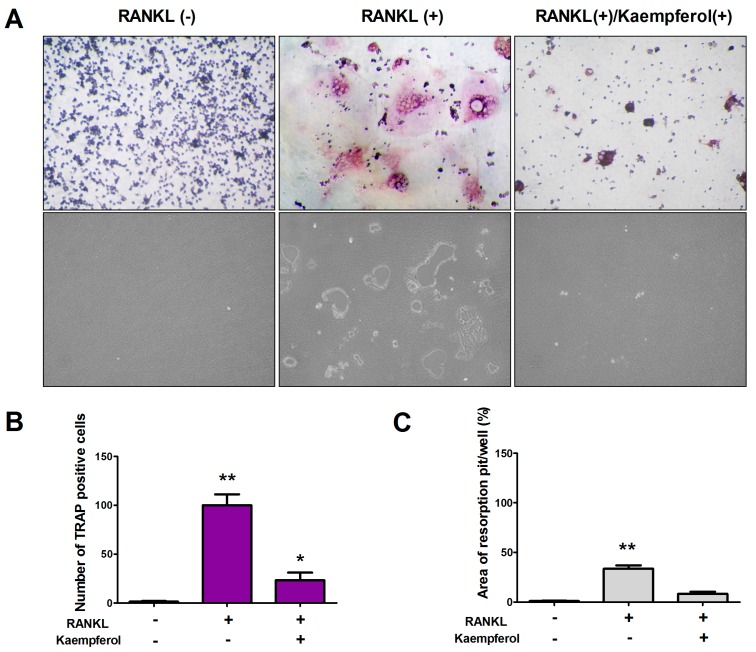
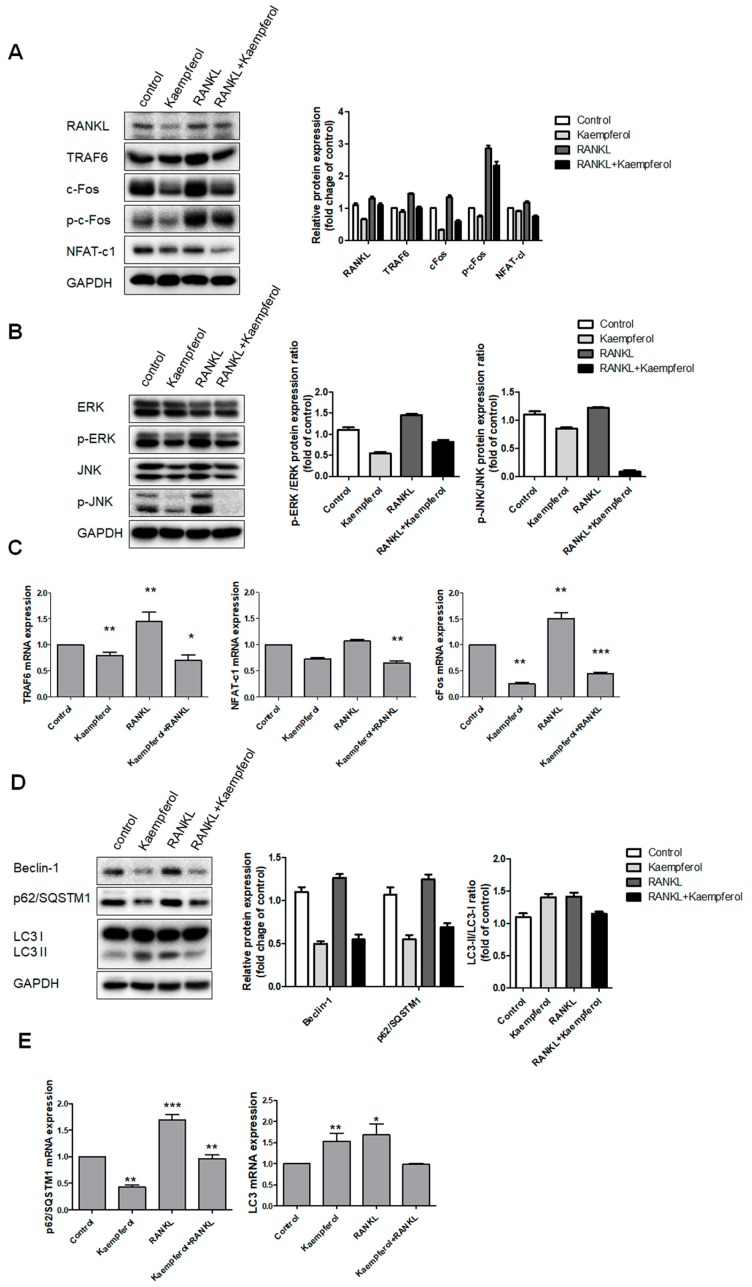
Kaempferol, a flavonoid compound, is derived from the rhizome of ., which is used in traditional medicine in Asia. Autophagy has pleiotropic functions that are involved in cell growth, survival, nutrient supply under starvation, defense against pathogens, and antigen presentation. There are many studies dealing with the inhibitory effects of natural flavonoids in bone resorption. However, no studies have explained the relationship between the autophagic and inhibitory processes of osteoclastogenesis by natural flavonoids. The present study was undertaken to investigate the inhibitory effects of osteoclastogenesis through the autophagy inhibition process stimulated by kaempferol in murin macrophage (RAW 264.7) cells. The cytotoxic effect of Kaempferol was investigated by MTT assay. The osteoclast differentiation and autophagic process were confirmed via tartrate-resistant acid phosphatase (TRAP) staining, pit formation assay, western blot, and real-time PCR. Kaempferol controlled the expression of autophagy-related factors and in particular, it strongly inhibited the expression of p62/SQSTM1. In the western blot and real time-PCR analysis, when autophagy was suppressed with the application of 3-Methyladenine (3-MA) only, osteoclast and apoptosis related factors were not significantly affected. However, we found that after cells were treated with kaempferol, these factors inhibited autophagy and activated apoptosis. Therefore, we presume that kaempferol-inhibited autophagy activated apoptosis by degradation of p62/SQSTM1. Further study of the gene as a target in the autophagy mechanism, may help to delineate the potential role of kaempferol in the treatment of bone metabolism disorders.
山奈酚是一种类黄酮化合物,来源于亚洲传统医学中使用的根茎。自噬具有多种功能,涉及细胞生长、存活、饥饿时的营养供应、防御病原体和抗原呈递。有许多研究涉及天然类黄酮对骨吸收的抑制作用。然而,没有研究解释天然类黄酮对破骨细胞形成的自噬和抑制过程之间的关系。本研究旨在探讨山奈酚通过刺激自噬抑制破骨细胞形成过程的抑制作用。通过 MTT 测定法研究山奈酚的细胞毒性作用。通过抗酒石酸酸性磷酸酶(TRAP)染色、陷窝形成试验、western blot 和实时 PCR 确认破骨细胞分化和自噬过程。山奈酚控制自噬相关因子的表达,特别是强烈抑制 p62/SQSTM1 的表达。在 western blot 和实时 PCR 分析中,仅应用 3-甲基腺嘌呤(3-MA)抑制自噬时,破骨细胞和凋亡相关因子没有明显受到影响。然而,我们发现,在用山奈酚处理细胞后,这些因子抑制自噬并激活凋亡。因此,我们推测山奈酚抑制的自噬通过降解 p62/SQSTM1 激活凋亡。进一步研究基因作为自噬机制的靶点,可能有助于阐明山奈酚在治疗骨代谢紊乱中的潜在作用。