School of Biology, Faculty of Biological Sciences, University of Leeds, Leeds, UK.
Zeeman Institute and School of Life Sciences, University of Warwick, Coventry, UK.
Parasit Vectors. 2018 Jan 4;11(1):7. doi: 10.1186/s13071-017-2587-5.
Antibody responses to sand fly saliva have been suggested to be a useful marker of exposure to sand fly bites and Leishmania infection and a potential tool to monitor the effectiveness of entomological interventions. Exposure to sand fly bites before infection has also been suggested to modulate the severity of the infection. Here, we test these hypotheses by quantifying the anti-saliva IgG response in a cohort study of dogs exposed to natural infection with Leishmania infantum in Brazil.
IgG responses to crude salivary antigens of the sand fly Lutzomyia longipalpis were measured by ELISA in longitudinal serum samples from 47 previously unexposed sentinel dogs and 11 initially uninfected resident dogs for up to 2 years. Antibody responses were compared to the intensity of transmission, assessed by variation in the incidence of infection between seasons and between dogs. Antibody responses before patent infection were then compared with the severity of infection, assessed using tissue parasite loads and clinical symptoms.
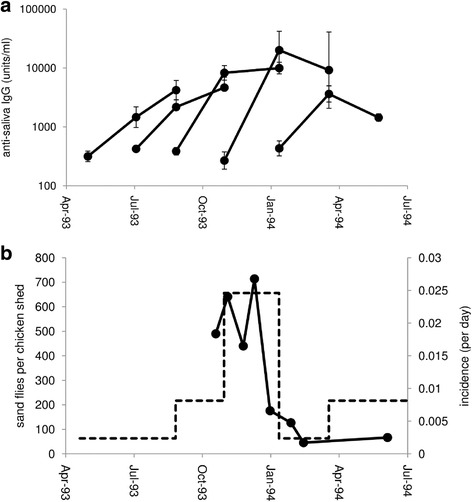
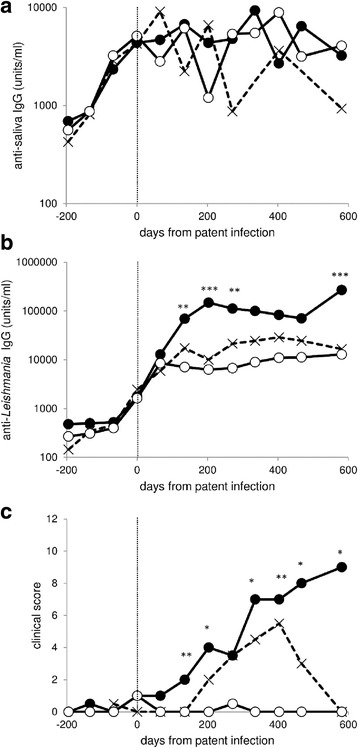
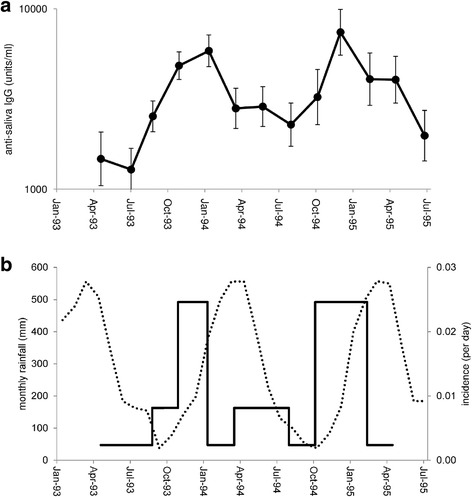
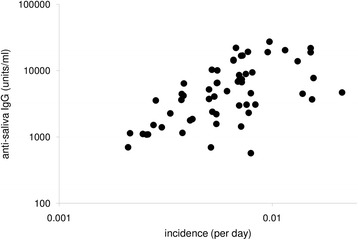
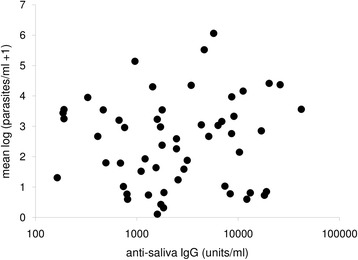
Previously unexposed dogs acquired anti-saliva antibody responses within 2 months, and the rate of acquisition increased with the intensity of seasonal transmission. Over the following 2 years, antibody responses varied with seasonal transmission and sand fly numbers, declining rapidly in periods of low transmission. Antibody responses varied greatly between dogs and correlated with the intensity of transmission experienced by individual dogs, measured by the number of days in the field before patent infection. After infection, anti-saliva antibody responses were positively correlated with anti-parasite antibody responses. However, there was no evidence that the degree of exposure to sand fly bites before infection affected the severity of the infection.
Anti-saliva antibody responses are a marker of current transmission intensity in dogs exposed to natural infection with Leishmania infantum, but are not associated with the outcome of infection.
已有研究表明,对沙蝇唾液的抗体反应可作为被沙蝇叮咬和感染利什曼原虫的暴露标志物,也可能是监测昆虫干预效果的有用工具。在感染之前接触沙蝇叮咬也被认为可以调节感染的严重程度。在这里,我们通过在巴西一项暴露于自然感染利什曼原虫的犬科动物的队列研究中,定量检测抗唾液 IgG 反应来检验这些假说。
我们通过 ELISA 法检测了 47 只先前未暴露的哨犬和 11 只最初未感染的居留犬在长达 2 年的时间内的纵向血清样本中,对沙蝇 Lutzomyia longipalpis 的粗唾液抗原的 IgG 反应。抗体反应与传播强度进行了比较,传播强度通过季节之间和犬之间感染发生率的变化来评估。然后将感染前的抗体反应与感染的严重程度进行了比较,通过组织寄生虫负荷和临床症状来评估。
先前未暴露的犬在 2 个月内获得了抗唾液抗体反应,并且获得的速度随着季节性传播强度的增加而增加。在接下来的 2 年内,抗体反应随季节性传播和沙蝇数量而变化,在低传播期迅速下降。抗体反应在犬之间差异很大,与个体犬经历的传播强度相关,通过感染前在野外的天数来衡量。感染后,抗唾液抗体反应与抗寄生虫抗体反应呈正相关。但是,没有证据表明感染前接触沙蝇叮咬的程度会影响感染的严重程度。
抗唾液抗体反应是暴露于自然感染利什曼原虫的犬科动物当前传播强度的标志物,但与感染结局无关。