Ratnani Imran Jahangirali, Vala Ashok Ukabhai, Panchal Bharat Navinchandra, Tiwari Deepak Sachchidanand, Karambelkar Smruti S, Sojitra Milankumar G, Nagori Nidhi N
Department of Psychiatry, Government Medical College and Sir Takhtasinhji General Hospital, Bhavnagar, Gujarat, India.
Department of Psychiatry, M. P. Shah Government Medical College, Guru Gobind Singh Government Hospital, Jamnagar, Gujarat, India.
J Family Med Prim Care. 2017 Apr-Jun;6(2):243-248. doi: 10.4103/2249-4863.219992.
Social anxiety disorder (SAD), (also known as social phobia), is characterized by intense fear of social interaction and often associated with social avoidance and impairments. There is high risk for depression, substance use disorder, and suicide among them.
It is an observational, cross-sectional, single centered, questionnaire-based study assessing the frequency of SAD and depression and their possible association with quality of life among 290 consenting medical undergraduate students. Social Phobia Inventory (SPIN), Beck's Depression Inventory (BDI II), and the World Health Organization Quality of Life assessment scale (WHOQOL-BREF) were used to screen and assess severity of SAD, depression, and quality of life, respectively. The statistical analysis of proportions was done by Chi-square test, while the scores of SPIN, BDI II, and WHOQOL-BREF was compared using Mann-Whitney test or Kruskal-Wallis test followed by Dunn posttest multiple comparison, using GraphPad InStat version 3.06.
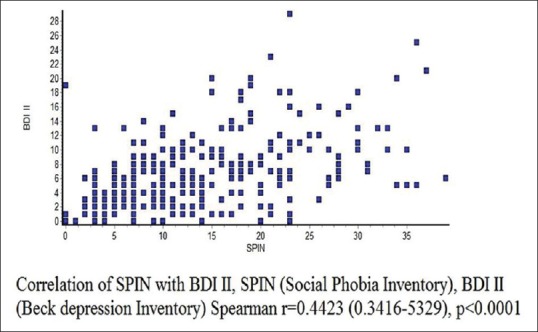
Frequency of SAD is 11.37%, and depression is 8.96%. Females are more likely to experience SAD. Participants with SAD are more likely to experience depression ( < 0.0001) and have poor quality of life ( = 0.01). Participants with depression have higher SPIN score ( < 0.0001) and poor quality of life ( < 0.0001). Females are more likely to experience social fear ( = 0.02). Participants staying away from their family are more likely to experience social anxiety in comparison to their peers ( = 0.01). Severity of depression is correlated with severity of social anxiety (Spearman r = 0.4423 [0.3416-0.5329], < 0.0001).
Participants with SAD are more likely to experience depressive symptoms and have poor quality of life and vice versa.
社交焦虑障碍(SAD)(也称为社交恐惧症)的特征是对社交互动有强烈恐惧,且常伴有社交回避和功能损害。其中存在患抑郁症、物质使用障碍和自杀的高风险。
这是一项基于问卷调查的观察性横断面单中心研究,评估290名同意参与的医学本科生中社交焦虑障碍和抑郁症的发生率及其与生活质量的可能关联。分别使用社交恐惧症量表(SPIN)、贝克抑郁量表(BDI II)和世界卫生组织生活质量评估量表(WHOQOL - BREF)来筛查和评估社交焦虑障碍、抑郁症的严重程度以及生活质量。比例的统计分析采用卡方检验,而SPIN、BDI II和WHOQOL - BREF的得分则使用曼 - 惠特尼检验或克鲁斯卡尔 - 沃利斯检验,随后进行邓恩事后多重比较,使用GraphPad InStat 3.06版本。
社交焦虑障碍的发生率为11.37%,抑郁症的发生率为8.96%。女性更易患社交焦虑障碍。患有社交焦虑障碍的参与者更易患抑郁症(<0.0001)且生活质量较差(=0.01)。患有抑郁症的参与者SPIN得分较高(<0.0001)且生活质量较差(<0.0001)。女性更易经历社交恐惧(=0.02)。与同龄人相比,远离家人的参与者更易经历社交焦虑(=0.01)。抑郁症的严重程度与社交焦虑的严重程度相关(斯皮尔曼r = 0.4423 [0.3416 - 0.5329],<0.0001)。
患有社交焦虑障碍的参与者更易出现抑郁症状且生活质量较差,反之亦然。