Kim Jieun E, Dager Stephen R, Jeong Hyeonseok S, Ma Jiyoung, Park Shinwon, Kim Jungyoon, Choi Yera, Lee Suji L, Kang Ilhyang, Ha Eunji, Cho Han Byul, Lee Sunho, Kim Eui-Jung, Yoon Sujung, Lyoo In Kyoon
Ewha Brain Institute, Ewha Womans University, Seoul, South Korea.
Department of Brain and Cognitive Sciences, Ewha Womans University, Seoul, South Korea.
PLoS One. 2018 Jan 5;13(1):e0190630. doi: 10.1371/journal.pone.0190630. eCollection 2018.
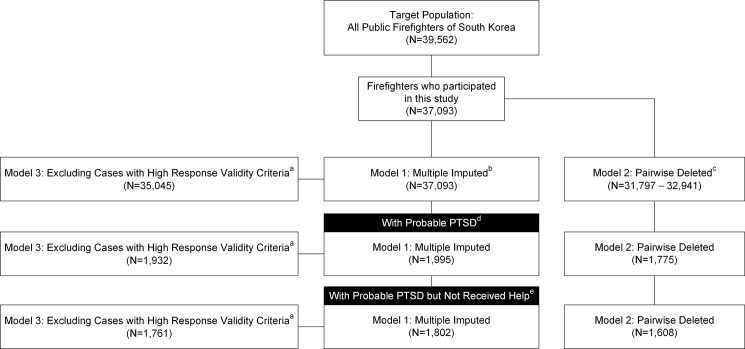
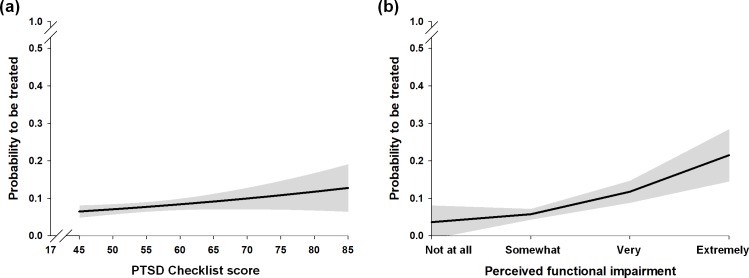
Repeated exposure to traumatic experiences may put professional firefighters at increased risk of developing posttraumatic stress disorder (PTSD). To date, however, the rate of PTSD symptoms, unmet need for mental health treatment, and barriers to treatment have only been investigated in subsamples rather than the total population of firefighters. We conducted a nationwide, total population-based survey of all currently employed South Korean firefighters (n = 39,562). The overall response rate was 93.8% (n = 37,093), with 68.0% (n = 26,887) complete responses for all variables. The rate of current probable PTSD was estimated as 5.4%. Among those with current probable PTSD (n = 1,995), only a small proportion (9.7%) had received mental health treatment during the past month. For those who had not received treatment, perceived barriers of accessibility to treatment (29.3%) and concerns about potential stigma (33.8%) were reasons for not receiving treatment. Although those with higher PTSD symptom severity and functional impairment were more likely to seek treatment, greater symptom severity and functional impairment were most strongly associated with increased concerns about potential stigma. This nationwide study points to the need for new approaches to promote access to mental health treatment in professional firefighters.
反复接触创伤性经历可能会使职业消防员患创伤后应激障碍(PTSD)的风险增加。然而,迄今为止,PTSD症状的发生率、未满足的心理健康治疗需求以及治疗障碍仅在子样本中进行了调查,而非全体消防员。我们对韩国所有在职消防员(n = 39,562)进行了一项全国性的基于总人口的调查。总体回复率为93.8%(n = 37,093),所有变量的完整回复率为68.0%(n = 26,887)。当前可能患有PTSD的比例估计为5.4%。在当前可能患有PTSD的人群(n = 1,995)中,只有一小部分(9.7%)在过去一个月接受过心理健康治疗。对于未接受治疗的人来说,认为治疗难以获得(29.3%)和担心潜在的污名化(33.8%)是未接受治疗的原因。尽管PTSD症状严重程度和功能损害较高的人更有可能寻求治疗,但症状严重程度和功能损害的增加与对潜在污名化的担忧增加最为密切相关。这项全国性研究表明,需要采取新方法来促进职业消防员获得心理健康治疗服务。