Alanazi Sattam Zaid, Abusharha Ali, Afsar Tayyaba, Trembley Janeen H, Razak Suhail
Department of Optometry, College of Applied Medical Sciences, King Saud University, Riyadh, Saudi Arabia.
Department of Community Health Sciences, College of Applied Medical Sciences, King Saud University, Riyadh, Saudi Arabia.
Front Psychiatry. 2024 May 8;15:1391586. doi: 10.3389/fpsyt.2024.1391586. eCollection 2024.
Determining the prevalence of PTSD and contributing variables among (EMS) specialists was the goal of the current investigation. Furthermore, limited evidence exists regarding the application of PCL-5 for EMT practitioners, and the incidence of PTSD among different age groups and genders in Saudi Arabia.
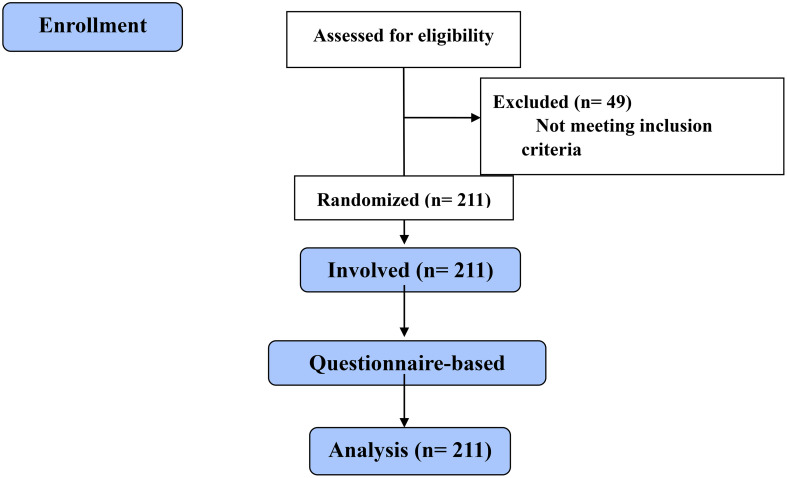
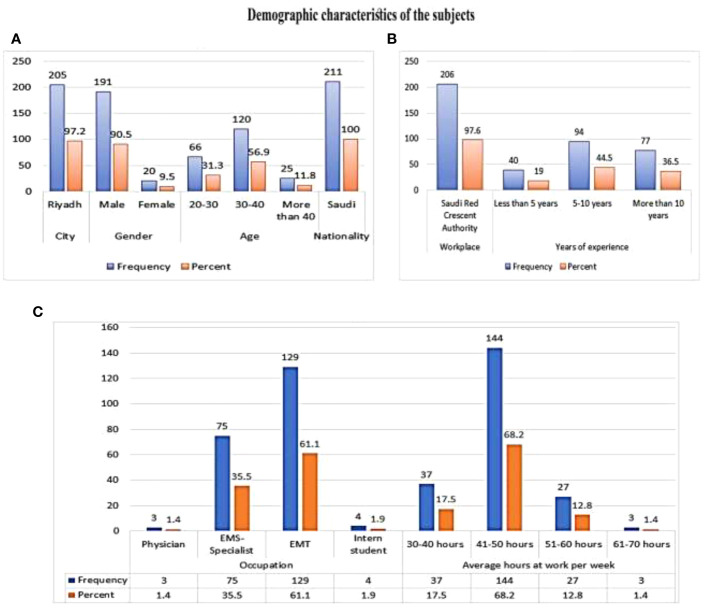
This cross-sectional descriptive study includes 211 prehospital care providers of the Saudi Red Crescent Authority stations in Riyadh. The randomization was done using Google Forms into subgroups according to participants' gender, years of experience, occupations, and average working hours. The presence and severity of PTSD symptoms were evaluated using the 20-item PTSD Checklist for DSM-5 (PCL-5) self-report questionnaire. Data were analyzed using Pearson Chi-Square, Mann-Whitney and Kruskal-Wallis tests. The reliability statistics were calculated using Cronbach's Alpha for the 20-survey questionnaire.
The comparison of PCL-5 total scores indicated more PTSD symptomatology among females (1.61 + 0.799) as compared to male workers (1.13 + 0.642). The total score of PTSD demonstrated no statistically significant (P=0.79) differences between our age group classifications. In terms of the participants' city (Riyadh), the total PTSD score was less than the cutoff point which is 31. PTSD total score may not be affected by working experience as indicated by the non-significant difference in prevalence among EMT practitioners having <5 years, 5-10 years and above 10 years of working experience (P=0.215 with X2 = 3.076). PTSD incidence is affected by the type of occupation as statistically significant differences between groups (P=0.001) were recorded depending on the position and responsibilities of EMS practitioners. PTSD is also affected by average working hours per week, and there were statistically significant differences between groups (P=0.001).
The total score of PTSD in the case of emergency service practitioners was found to be 33.7% among all the research participants, which may be regarded as a high prevalence when compared to the general population. Our investigations would contribute to a better understanding of the underlying factors of mental stress in EMS specialists in Saudi Arabia and to the development of adequate mental health practices.
确定创伤后应激障碍(PTSD)的患病率以及急救医疗服务(EMS)专业人员中的相关影响因素是本次调查的目标。此外,关于PCL - 5在急救医疗技术员中的应用,以及沙特阿拉伯不同年龄组和性别的PTSD发病率,现有证据有限。
这项横断面描述性研究纳入了利雅得沙特红新月会站点的211名院前护理人员。使用谷歌表单根据参与者的性别、工作年限、职业和平均工作时长将其随机分为不同亚组。使用20项DSM - 5创伤后应激障碍检查表(PCL - 5)自评问卷评估PTSD症状的存在情况和严重程度。数据采用Pearson卡方检验、Mann - Whitney检验和Kruskal - Wallis检验进行分析。使用Cronbach's Alpha计算20项调查问卷的信度统计量。
PCL - 5总分比较显示,女性(1.61 + 0.799)的PTSD症状比男性工作者(1.13 + 0.642)更多。PTSD总分在我们的年龄组分类之间没有统计学显著差异(P = 0.79)。就参与者所在城市(利雅得)而言,PTSD总分低于临界值31。如工作经验不足5年、5 - 10年和10年以上的急救医疗技术员患病率无显著差异所示(P = 0.215,X2 = 3.076),PTSD总分可能不受工作经验影响。PTSD发病率受职业类型影响,根据急救医疗服务人员的职位和职责,各亚组间存在统计学显著差异(P = 0.001)。PTSD还受每周平均工作时长影响,各亚组间存在统计学显著差异(P = 我们的调查将有助于更好地理解沙特阿拉伯急救医疗服务专业人员心理压力的潜在因素,并有助于制定适当的心理健康措施。
在所有研究参与者中,发现急救服务人员的PTSD总分患病率为33.7%,与普通人群相比,这可能被视为高患病率。001)。
我们的调查将有助于更好地理解沙特阿拉伯急救医疗服务专业人员心理压力的潜在因素,并有助于制定适当的心理健康措施。
在所有研究参与者中,发现急救服务人员的PTSD总分患病率为33.7%,与普通人群相比,这可能被视为高患病率。