Grupo de Pesquisa em Biologia Molecular e Imunologia da Malária, Instituto René Rachou (IRR), Fundação Oswaldo Cruz (Fiocruz), Belo Horizonte/MG, 30190-009, Brazil.
Malaria Unit, Department of Pathology, Institute of Tropical Medicine, Nagasaki University, Nagasaki, 852-8523, Japan.
Sci Rep. 2018 Jan 8;8(1):86. doi: 10.1038/s41598-017-18216-x.
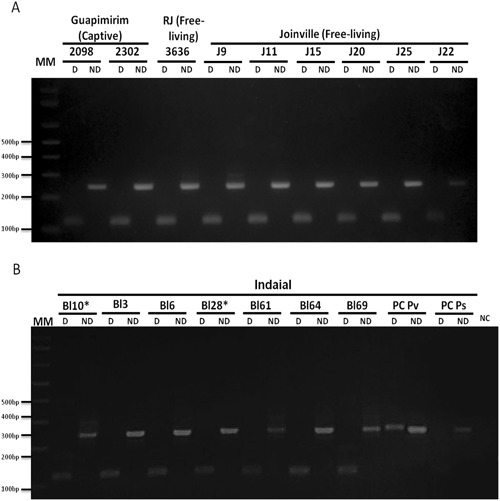
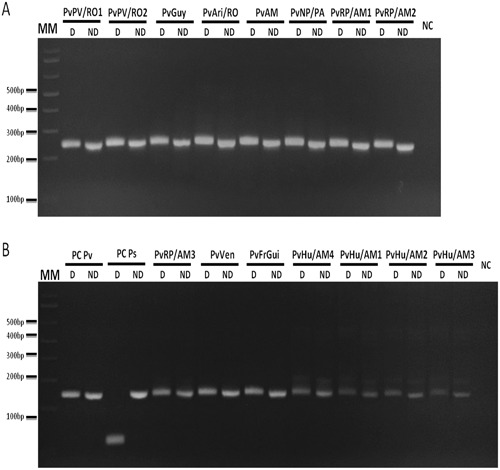
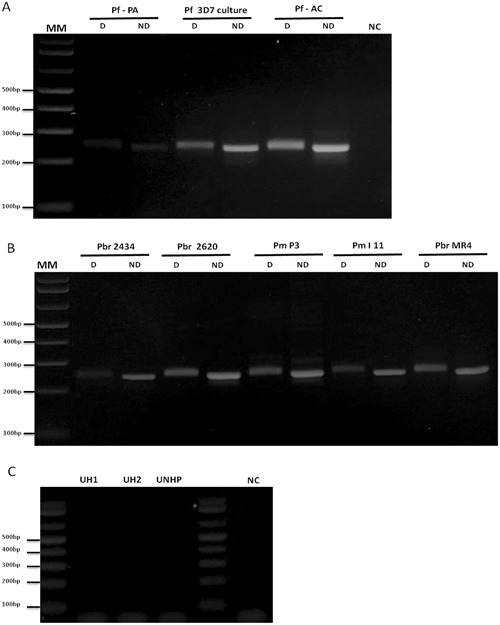
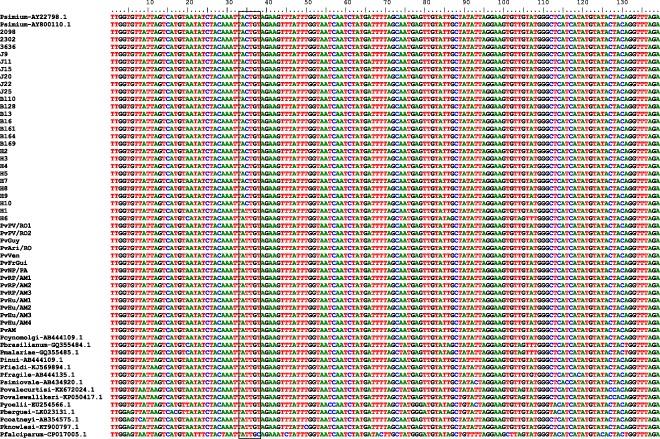
Zoonotic malaria poses a unique problem for malaria control. Autochthonous cases of human malaria in the Atlantic Forest have recently been attributed to Plasmodium simium, a parasite that commonly infects non-human primates in this Brazilian biome. However, due to its close similarity at both the morphological and molecular level to Plasmodium vivax, the diagnosis of P. simium in this region remains problematic. Therefore, a diagnostic assay able to accurately identify P. simium is important for malaria surveillance. Based on mitochondrial genome sequences, primers were designed to amplify a region containing a SNP specific to P. simium. This region can then be digested with the restriction enzyme HpyCH4III, which results in digestion of P. simium sequences, but not of any other malaria parasite. Fifty-two human and monkey blood samples from different regions and infected with different Plasmodium species were used to validate this protocol. This easy and inexpensive tool can be used for the diagnosis of P. simium in non-human primates and human infections from the Atlantic Forest region to monitor zoonotic malaria transmission in Brazil.
人兽共患疟疾给疟疾控制带来了一个独特的问题。最近,在大西洋森林中发现了源自食蟹猕猴疟原虫(Plasmodium simium)的人体疟疾本地病例,这种寄生虫通常会感染巴西这一生物群系中的非人类灵长类动物。然而,由于其在形态和分子水平上与间日疟原虫(Plasmodium vivax)极为相似,因此该地区对 P. simium 的诊断仍然存在问题。因此,能够准确识别 P. simium 的诊断检测方法对于疟疾监测非常重要。本研究基于线粒体基因组序列设计了用于扩增包含 P. simium 特异性 SNP 的区域的引物。然后,用限制性内切酶 HpyCH4III 对该区域进行消化,这会导致 P. simium 序列被消化,但不会消化任何其他疟原虫。该方案使用了来自不同地区的 52 个人类和猴子血液样本,这些样本感染了不同的疟原虫物种,用于对该方案进行验证。这种简单且廉价的工具可用于诊断来自大西洋森林地区的非人类灵长类动物和人类感染中的 P. simium,以监测巴西的人兽共患疟疾传播。