van Dijsseldonk Rosanne B, Rijken Hennie, van Nes Ilse J W, van de Meent Henk, Keijsers Noel L W
Department of Research, Sint Maartenskliniek Research, Nijmegen, Netherlands.
Department of Rehabilitation, Sint Maartenskliniek, Nijmegen, Netherlands.
Front Neurosci. 2017 Dec 12;11:699. doi: 10.3389/fnins.2017.00699. eCollection 2017.
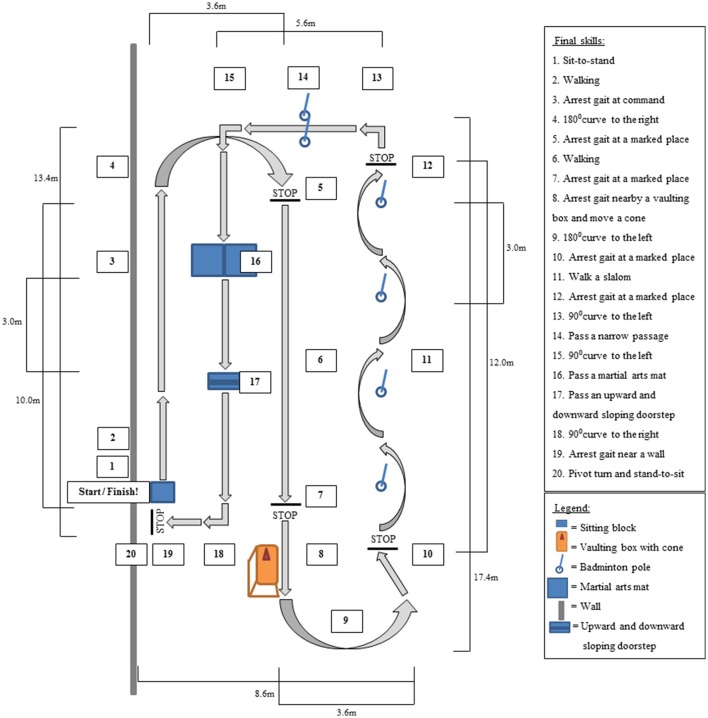
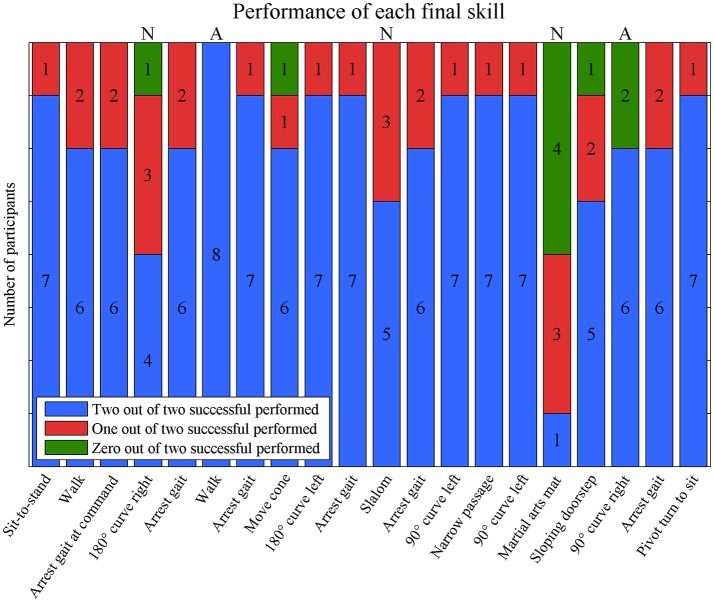
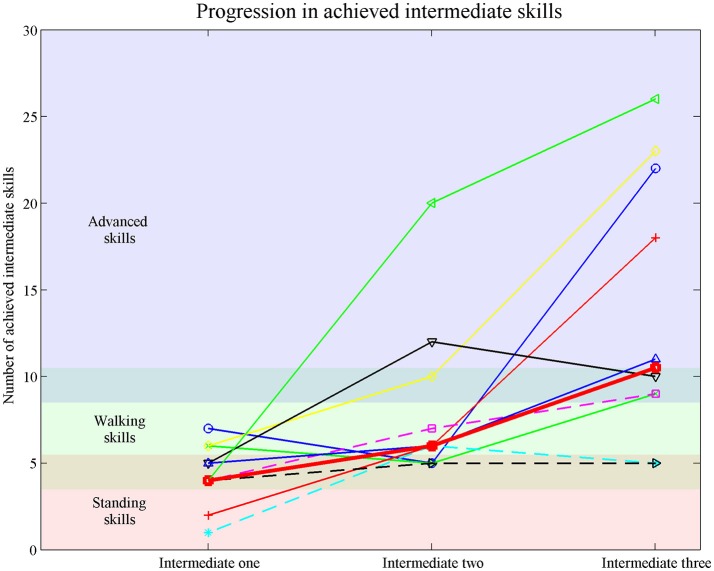
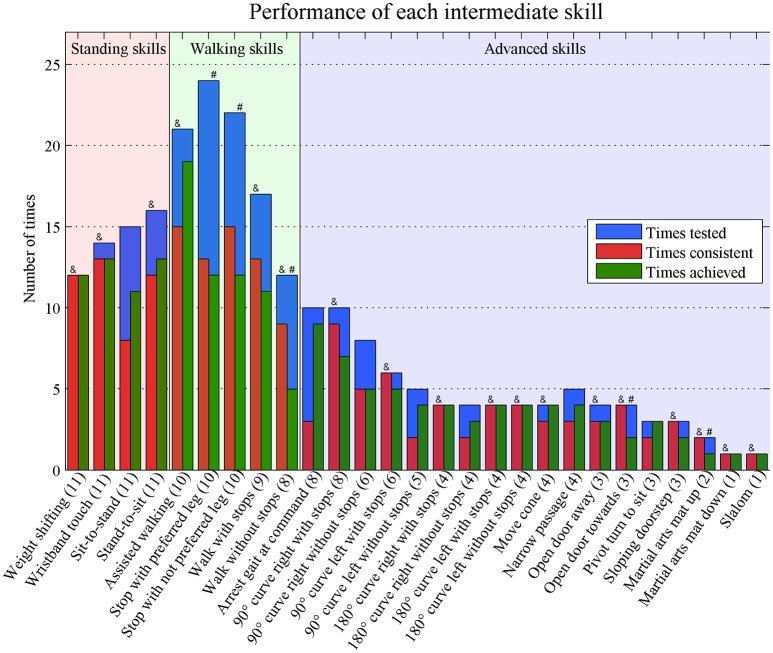
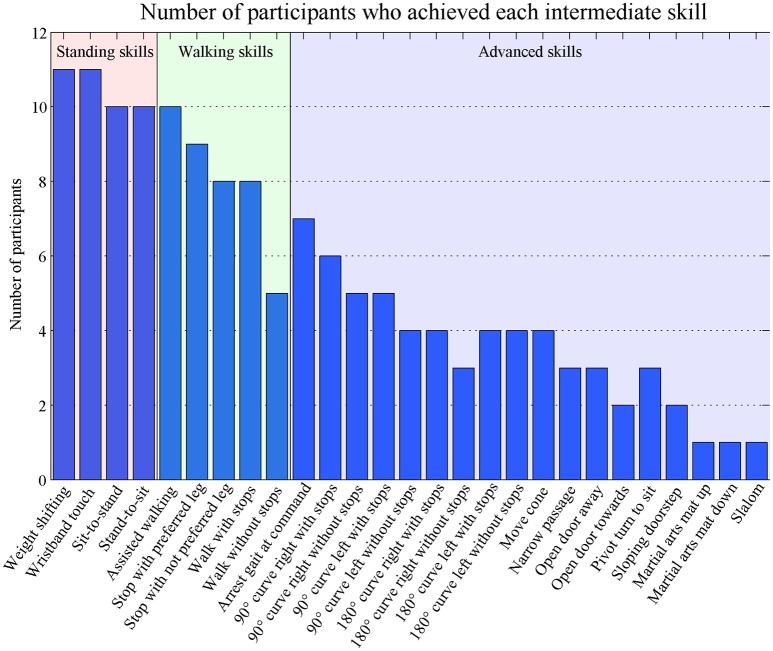
For safe application of exoskeletons in people with spinal cord injury at home or in the community, it is required to have completed an exoskeleton training in which users learn to perform basic and advanced skills. So far, a framework to test exoskeleton skills is lacking. The aim of this study was to develop and test the hierarchy and reliability of a framework for measuring the progress in the ability to perform basic and advanced skills. Twelve participants with paraplegia were given twenty-four training sessions in 8 weeks with the Rewalk-exoskeleton. During the 2nd, 4th, and 6th training week the Intermediate-skills-test was performed consisting of 27 skills, measured in an hierarchical order of difficulty, until two skills were not achieved. When participants could walk independently, the Final-skills-test, consisting of 20 skills, was performed in the last training session. Each skill was performed at least two times with a maximum of three attempts. As a reliability measure the consistency was used, which was the number of skills performed the same in the first two attempts relative to the total number. Ten participants completed the training program. Their number of achieved intermediate skills was significantly different between the measurements X(2) = 12.36, = 0.001. analysis revealed a significant increase in the median achieved intermediate skills from 4 [1-7] at the first to 10.5 [5-26] at the third Intermediate-skills-test. The rate of participants who achieved the intermediate skills decreased and the coefficient of reproducibility was 0.98. Eight participants met the criteria to perform the Final-skills-test. Their median number of successfully performed final skills was 16.5 [13-20] and 17 [14-19] skills in the first and second time. The overall consistency of >70% was achieved in the Intermediate-skills-test (73%) and the Final-skills-test (81%). Eight out of twelve participants experienced skin damage during the training, in four participants this resulted in missed training sessions. The framework proposed in this study measured the progress in performing basic and advanced exoskeleton skills during a training program. The hierarchical ordered skills-test could discriminate across participants' skill-level and the overall consistency was considered acceptable.
为了使外骨骼在脊髓损伤患者家庭或社区中安全应用,需要完成外骨骼训练,让使用者学习执行基本和高级技能。到目前为止,缺乏一个测试外骨骼技能的框架。本研究的目的是开发并测试一个用于衡量执行基本和高级技能能力进展的框架的层次结构和可靠性。12名截瘫参与者在8周内使用Rewalk外骨骼进行了24次训练。在第2、4和6个训练周进行中级技能测试,该测试由27项技能组成,按照难度等级顺序进行测量,直到两项技能未完成。当参与者能够独立行走时,在最后一次训练中进行由20项技能组成的最终技能测试。每项技能至少执行两次,最多尝试三次。作为可靠性度量,使用了一致性,即前两次尝试中执行相同技能的数量相对于总技能数量的比例。10名参与者完成了训练计划。他们在各次测量中获得的中级技能数量有显著差异,X(2)=12.36,P = 0.001。分析显示,中级技能的中位数从第一次测试时的4[1 - 7]显著增加到第三次中级技能测试时的10.5[5 - 26]。达到中级技能的参与者比例下降,再现系数为0.98。8名参与者符合进行最终技能测试的标准。他们在第一次和第二次成功执行的最终技能中位数分别为16.5[13 - 20]和17[14 - 19]项。中级技能测试(73%)和最终技能测试(81%)的总体一致性均达到70%以上。12名参与者中有8名在训练期间出现皮肤损伤,其中4名因此错过训练课程。本研究提出的框架在训练计划中测量了执行基本和高级外骨骼技能的进展。按层次排序的技能测试能够区分参与者的技能水平总体一致性被认为是可接受的。