Buttler Leila, Jordão Maria T, Fragas Matheus G, Ruggeri Adriana, Ceroni Alexandre, Michelini Lisete C
Department Physiology and Biophysics, Institute of Biomedical Sciences, University of São Paulo, São Paulo, Brazil.
Front Physiol. 2017 Dec 12;8:1048. doi: 10.3389/fphys.2017.01048. eCollection 2017.
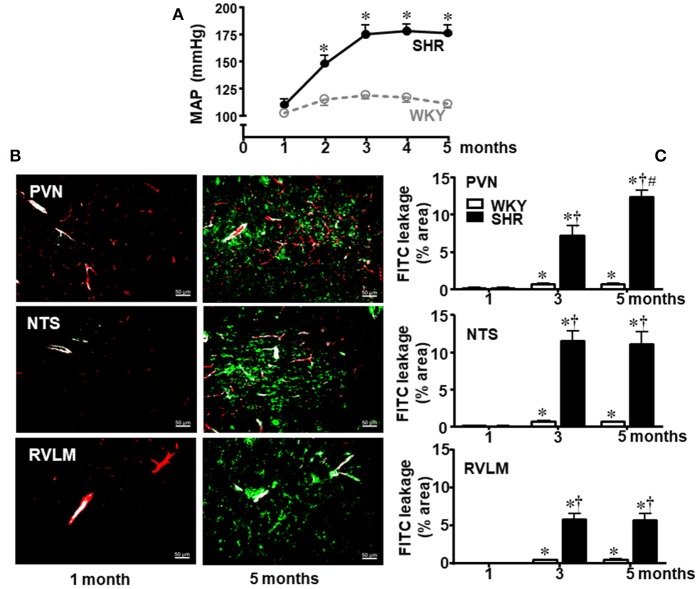
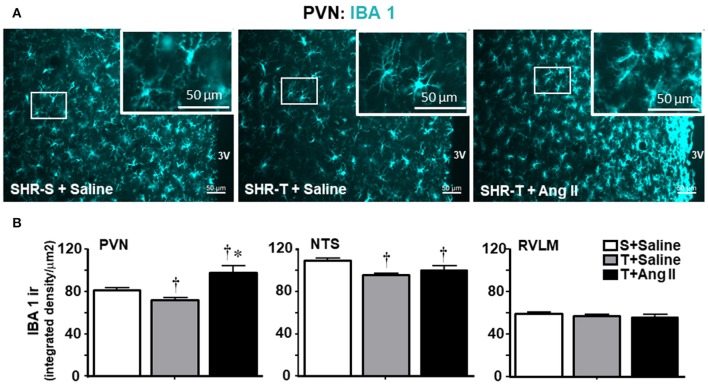
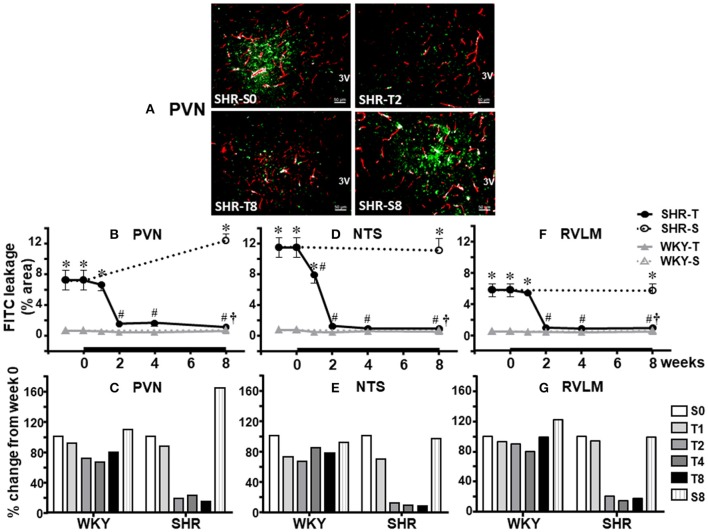
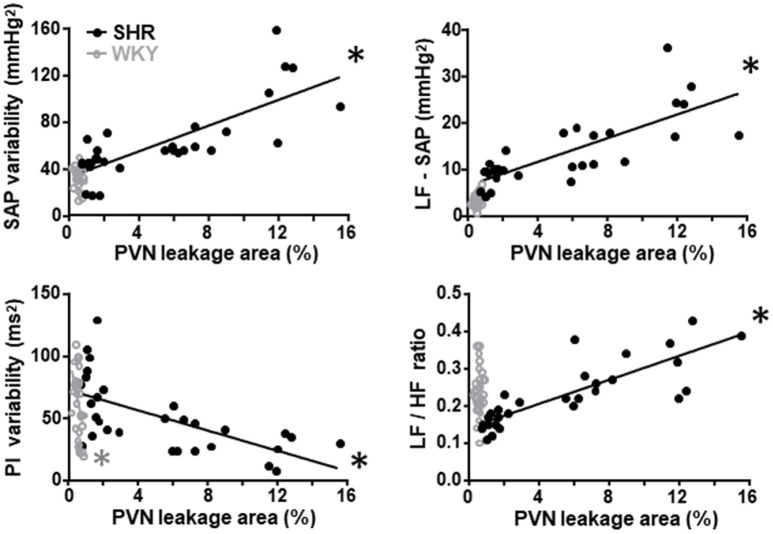
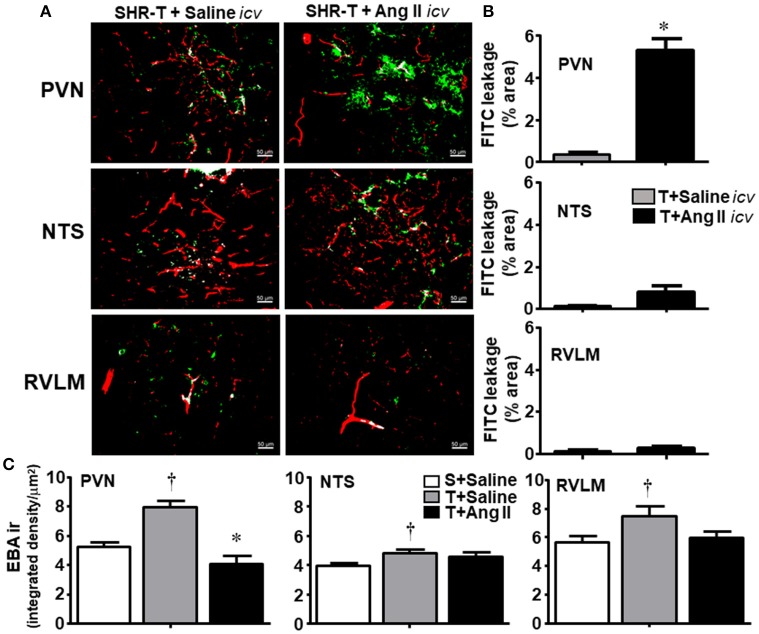
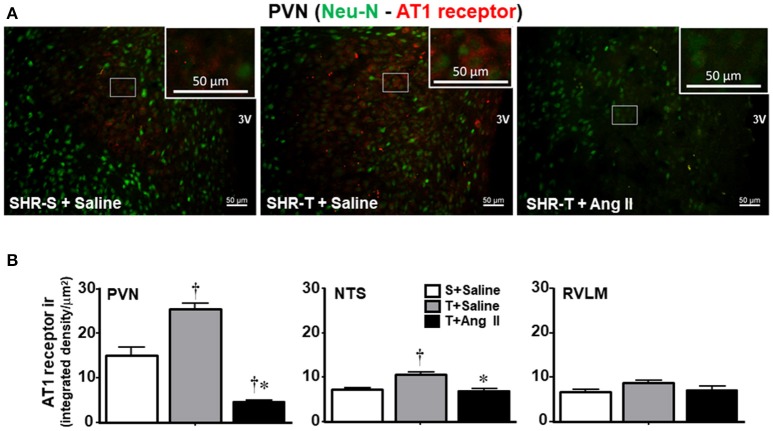
The blood-brain barrier (BBB) is a complex multicellular structure acting as selective barrier controlling the transport of substances between these compartments. Accumulating evidence has shown that chronic hypertension is accompanied by BBB dysfunction, deficient local perfusion and plasma angiotensin II (Ang II) access into the parenchyma of brain areas related to autonomic circulatory control. Knowing that spontaneously hypertensive rats (SHR) exhibit deficient autonomic control and brain Ang II hyperactivity and that exercise training is highly effective in correcting both, we hypothesized that training, by reducing Ang II content, could improve BBB function within autonomic brain areas of the SHR. After confirming the absence of BBB lesion in the pre-hypertensive SHR, but marked fluorescein isothiocyanate dextran (FITC, 10 kD) leakage into the brain parenchyma of the hypothalamic paraventricular nucleus (PVN), nucleus of the solitary tract, and rostral ventrolateral medulla during the established phase of hypertension, adult SHR, and age-matched WKY were submitted to a treadmill training (T) or kept sedentary (S) for 8 weeks. The robust FITC leakage within autonomic areas of the SHR-S was largely reduced and almost normalized since the 2nd week of training (T). BBB leakage reduction occurred simultaneously and showed strong correlations with both decreased LF/HF ratio to the heart and reduced vasomotor sympathetic activity (power spectral analysis), these effects preceding the appearance of resting bradycardia (T) and partial pressure fall (T). In other groups of SHR-T simultaneously infused with Ang II or saline (osmotic mini-pumps connected to a lateral ventricle cannula) we proved that decreased local availability of this peptide and reduced microglia activation (IBA1 staining) are crucial mechanisms conditioning the restoration of BBB integrity. Our data also revealed that Ang II-induced BBB lesion was faster within the PVN (T), suggesting the prominent role of this nucleus in driven hypertension-induced deficits. These original set of data suggest that reduced local Ang II content (and decreased activation of its downstream pathways) is an essential and early-activated mechanism to maintain BBB integrity in trained SHR and uncovers a novel beneficial effect of exercise training to improve autonomic control even in the presence of hypertension.
血脑屏障(BBB)是一种复杂的多细胞结构,作为选择性屏障控制着这些腔室之间物质的运输。越来越多的证据表明,慢性高血压伴有血脑屏障功能障碍、局部灌注不足以及血浆血管紧张素II(Ang II)进入与自主循环控制相关的脑区实质。鉴于自发性高血压大鼠(SHR)表现出自主控制不足和脑Ang II活性亢进,且运动训练在纠正这两者方面非常有效,我们推测训练通过降低Ang II含量,可以改善SHR自主脑区内的血脑屏障功能。在确认高血压前期SHR不存在血脑屏障损伤,但在高血压确立期,成年SHR以及年龄匹配的WKY大鼠的下丘脑室旁核(PVN)、孤束核和延髓头端腹外侧部的脑实质中出现明显的异硫氰酸荧光素葡聚糖(FITC,10 kD)渗漏后,将成年SHR和年龄匹配的WKY大鼠分为两组,一组进行跑步机训练(T),另一组保持久坐不动(S),持续8周。自训练(T)第2周起,SHR-S自主区域内强烈的FITC渗漏大幅减少并几乎恢复正常。血脑屏障渗漏减少同时发生,并且与心脏的低频/高频比值降低以及血管运动交感神经活动减少(功率谱分析)密切相关,这些效应在静息心动过缓(T)和分压下降(T)出现之前就已出现。在另一组同时向SHR-T侧脑室内注入Ang II或生理盐水(通过连接到侧脑室套管的渗透微型泵)的实验中,我们证明该肽的局部可用性降低和小胶质细胞激活减少(IBA1染色)是调节血脑屏障完整性恢复的关键机制。我们的数据还显示,Ang II诱导的血脑屏障损伤在PVN内(T)更快出现,表明该核在驱动高血压诱导的缺陷中起重要作用。这组原始数据表明,局部Ang II含量降低(及其下游途径的激活减少)是维持训练后SHR血脑屏障完整性的一种重要且早期激活的机制,并揭示了运动训练即使在存在高血压的情况下对改善自主控制的新的有益作用。