Zhu Leina, Gonzalez Jorge
Psychological, Health & Learning Sciences, University of Houston, Houston, TX, United States.
Front Psychol. 2017 Dec 12;8:2146. doi: 10.3389/fpsyg.2017.02146. eCollection 2017.
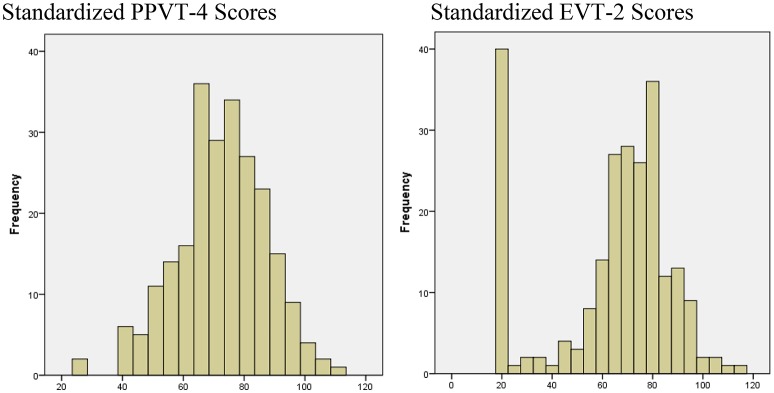
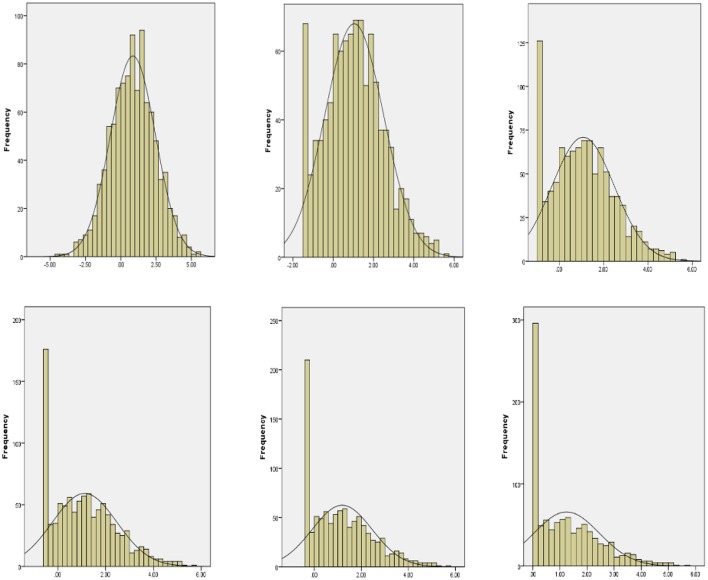
Researchers and practitioners often use standardized vocabulary tests such as the Peabody Picture Vocabulary Test-4 (PPVT-4; Dunn and Dunn, 2007) and its companion, the Expressive Vocabulary Test-2 (EVT-2; Williams, 2007), to assess English vocabulary skills as an indicator of children's school readiness. Despite their psychometric excellence in the norm sample, issues arise when standardized vocabulary tests are used to asses children from culturally, linguistically and ethnically diverse backgrounds (e.g., Spanish-speaking English language learners) or delayed in some manner. One of the biggest challenges is establishing the appropriateness of these measures with non-English or non-standard English speaking children as often they score one to two standard deviations below expected levels (e.g., Lonigan et al., 2013). This study re-examines the issues in analyzing the PPVT-4 and EVT-2 scores in a sample of 4-to-5-year-old low SES Hispanic preschool children who were part of a larger randomized clinical trial on the effects of a supplemental English shared-reading vocabulary curriculum (Pollard-Durodola et al., 2016). It was found that data exhibited strong floor effects and the presence of floor effects made it difficult to differentiate the invention group and the control group on their vocabulary growth in the intervention. A simulation study is then presented under the multilevel structural equation modeling (MSEM) framework and results revealed that in regular multilevel data analysis, ignoring floor effects in the outcome variables led to biased results in parameter estimates, standard error estimates, and significance tests. Our findings suggest caution in analyzing and interpreting scores of ethnically and culturally diverse children on standardized vocabulary tests (e.g., floor effects). It is recommended appropriate analytical methods that take into account floor effects in outcome variables should be considered.
研究人员和从业者经常使用标准化词汇测试,如皮博迪图片词汇测试第4版(PPVT - 4;邓恩和邓恩,2007年)及其配套测试——表达性词汇测试第2版(EVT - 2;威廉姆斯,2007年),来评估儿童的英语词汇技能,以此作为儿童入学准备情况的一个指标。尽管这些测试在常模样本中具有出色的心理测量学特性,但当使用标准化词汇测试来评估来自文化、语言和种族背景多样的儿童(例如说西班牙语的英语学习者)或以某种方式发育迟缓的儿童时,问题就出现了。最大的挑战之一是确定这些测量方法对于非英语或非标准英语儿童的适用性,因为他们的得分往往比预期水平低一到两个标准差(例如,洛尼根等人,2013年)。本研究重新审视了在一个4至5岁的低社会经济地位西班牙裔学龄前儿童样本中分析PPVT - 4和EVT - 2分数时出现的问题,这些儿童是一项关于补充性英语共享阅读词汇课程效果的大型随机临床试验的一部分(波拉德 - 杜罗多拉等人,2016年)。研究发现,数据呈现出强烈的地板效应,而地板效应的存在使得难以区分干预组和对照组在干预过程中的词汇增长情况。然后在多水平结构方程建模(MSEM)框架下进行了一项模拟研究,结果表明,在常规的多水平数据分析中,忽略结果变量中的地板效应会导致参数估计、标准误差估计和显著性检验结果出现偏差。我们的研究结果表明,在分析和解释来自不同种族和文化背景儿童的标准化词汇测试分数(例如地板效应)时要谨慎。建议考虑采用适当的分析方法,将结果变量中的地板效应考虑在内。