AgriFood Economics Centre, Lund University, Scheelevägen 15 D, 223 63, Lund, Sweden.
Appl Health Econ Health Policy. 2018 Apr;16(2):243-257. doi: 10.1007/s40258-017-0369-z.
The main objective of this study was to derive cost estimates of five major foodborne illnesses (campylobacteriosis, salmonellosis, enterohemorrhagic Escherichia coli (EHEC), yersiniosis and shigellosis) in Sweden. These estimates provide a necessary contribution to perform future cost-benefit analyses aimed at reducing the burden of foodborne disease. A secondary aim was to obtain estimates of the true number of cases that occur in the community, thus providing necessary ground for calculating costs.
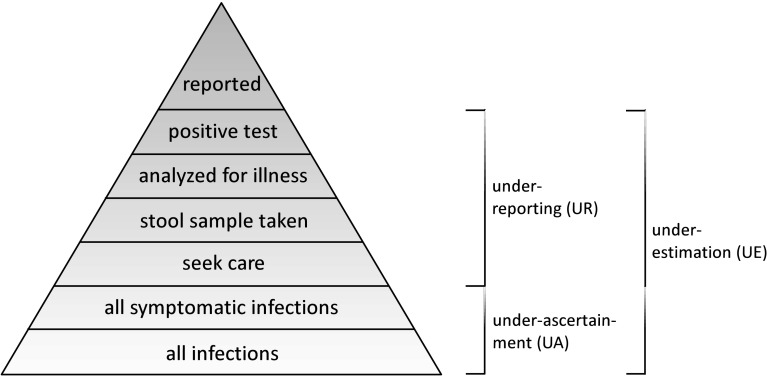
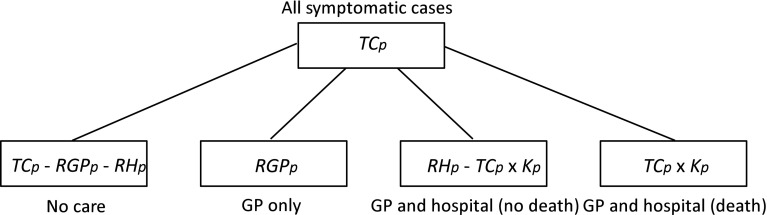
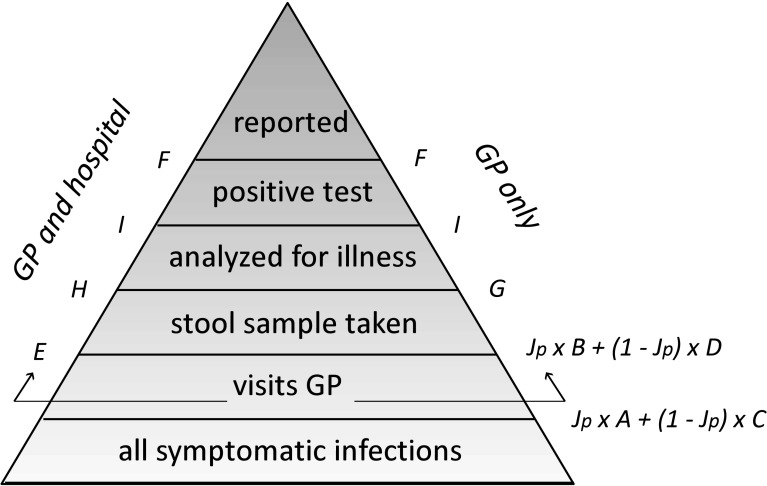
The true number of cases for each foodborne illness was simulated by multiplying the reported number of cases by sequential multipliers, one for each potential source of information loss about a case. This assessment of the true number of cases was then used to estimate the number of cases of sequelae for each illness. An incidence-based analysis was then used to calculate direct medical and non-medical costs, as well as indirect costs. Data for estimating the true number of cases for each illness were primarily based on an expert panel, while the derivation of costs mainly utilized national registries, databases and published literature.
The estimated number of cases was between 7- and 11-fold higher than the reported number of cases, indicating the importance of taking information loss into account when calculating costs. By far the most common pathogen of the five was campylobacter, with an estimated 101,719 (90% credibility interval [CI] 59,640-158,025) human cases occurring annually. For salmonella, 19,678 (90% CI 8394-40,456) cases were estimated to occur each year, while the other three pathogens were less common, with a yearly incidence of approximately 2500-5500 cases each. The total cost for the five pathogens (including sequelae) amounted to €142 million annually. Campylobacter was the most costly pathogen, representing 69% of the total costs. Salmonellosis and EHEC constituted 18 and 9% of these costs, respectively, while yersiniosis and shigellosis represented approximately 2% each. Costs for sequelae were significant and accounted for approximately 50% of the total costs.
Our simulations indicated that campylobacter infection was more common and more costly than salmonella, EHEC, yersinia and shigella combined. Estimated costs for all illnesses were highly influenced by (1) considering potential information losses about cases in the population (which increased costs 7- to 11-fold), and (2) taking account of post-infection sequelae (which doubled the costs).
本研究的主要目的是在瑞典推导五种主要食源性疾病(弯曲杆菌病、沙门氏菌病、肠出血性大肠杆菌(EHEC)、耶尔森菌病和志贺氏菌病)的成本估算。这些估算为进行旨在减轻食源性疾病负担的未来成本效益分析提供了必要的贡献。次要目的是获得社区中实际发生病例的估计数,从而为计算成本提供必要的依据。
通过将报告的病例数乘以连续的乘数来模拟每种食源性疾病的实际病例数,每个乘数对应病例信息丢失的一个潜在来源。然后,使用此实际病例数评估来估计每种疾病的后遗症病例数。然后使用基于发病率的分析来计算直接医疗和非医疗成本以及间接成本。用于估算每种疾病实际病例数的数据主要基于专家小组,而成本推导主要利用国家登记册、数据库和已发表的文献。
估计的病例数是报告病例数的 7-11 倍,这表明在计算成本时考虑信息丢失的重要性。在这五种病原体中,弯曲杆菌是最常见的病原体,估计每年有 101719 例(90%可信区间[CI]59640-158025)人类病例。沙门氏菌每年估计有 19678 例(90%CI8394-40456)病例,而其他三种病原体则较少见,每年约有 2500-5500 例。这五种病原体(包括后遗症)的总成本为每年 1.42 亿欧元。弯曲杆菌是最昂贵的病原体,占总成本的 69%。沙门氏菌和 EHEC 分别占这些成本的 18%和 9%,而耶尔森菌和志贺氏菌各占约 2%。后遗症的成本很高,占总成本的 50%左右。
我们的模拟表明,与沙门氏菌、EHEC、耶尔森菌和志贺氏菌相比,弯曲杆菌感染更为常见且成本更高。所有疾病的估计成本都受到以下两个因素的高度影响:(1)考虑人群中病例的潜在信息损失(将成本增加了 7-11 倍);(2)考虑感染后后遗症(使成本增加了一倍)。