Department of Environmental and Occupational Health, Milken Institute School of Public Health, George Washington University, Washington D.C., USA.
Department of Obstetrics, Gynecology, and Reproductive Sciences, University of California, San Francisco, San Francisco, CA, USA.
Environ Int. 2018 Mar;112:269-278. doi: 10.1016/j.envint.2017.12.030. Epub 2018 Jan 6.
Human fetal exposures to polybrominated diphenyl ethers (PBDEs) and their metabolites (OH-PBDEs) are unique from adults, and in combination with a different metabolic profile, may make fetal development more sensitive to adverse health outcomes from these exposures. However, we lack data to characterize human fetal PBDE exposures and the metabolic factors that can influence these exposures.
We examined differences between 2nd trimester maternal and fetal exposures to PBDEs and OH-PBDEs. We also characterized fetal cytochrome P450 (CYP) mRNA expression and its associations with PBDE exposures.
We collected paired samples of maternal serum and fetal liver (n=86) with a subset having matched placenta (n=50). We measured PBDEs, OH-PBDEs, and mRNA expression of CYP genes (e.g. CYP1A1, -2E1, -2J2, -2C9) in all samples. As a sensitivity analysis, we measured PBDEs and OH-PBDEs in umbilical cord serum from a subset (n=22).
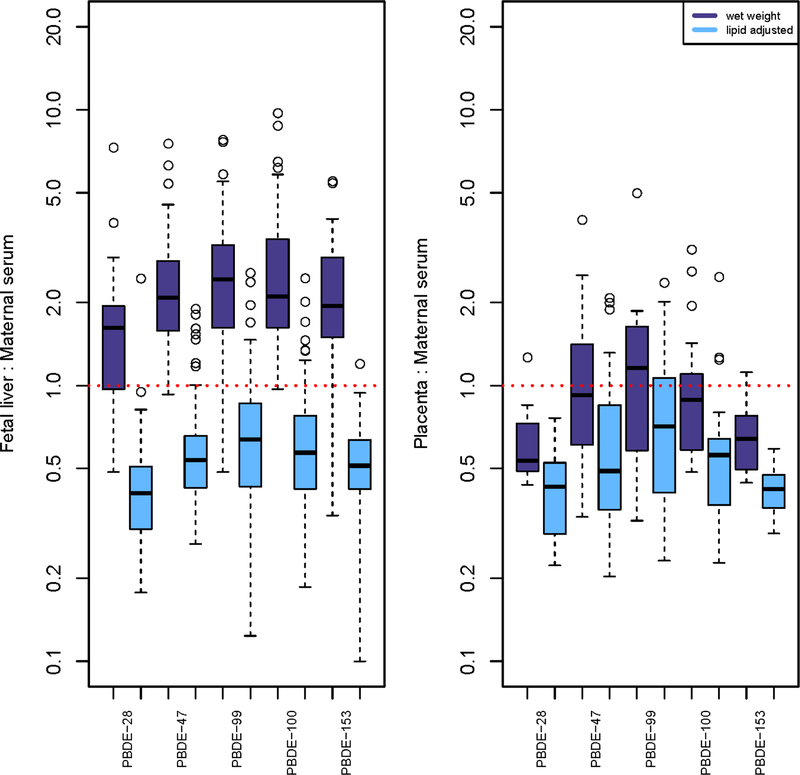
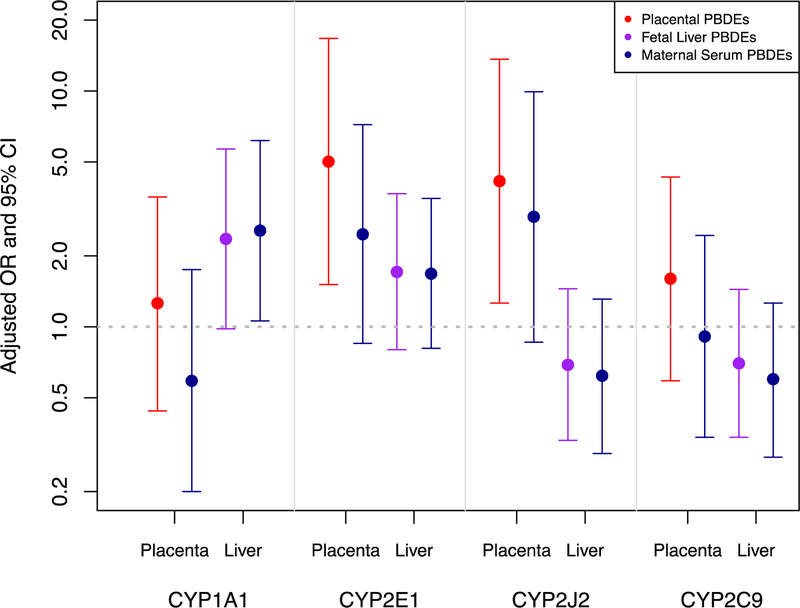
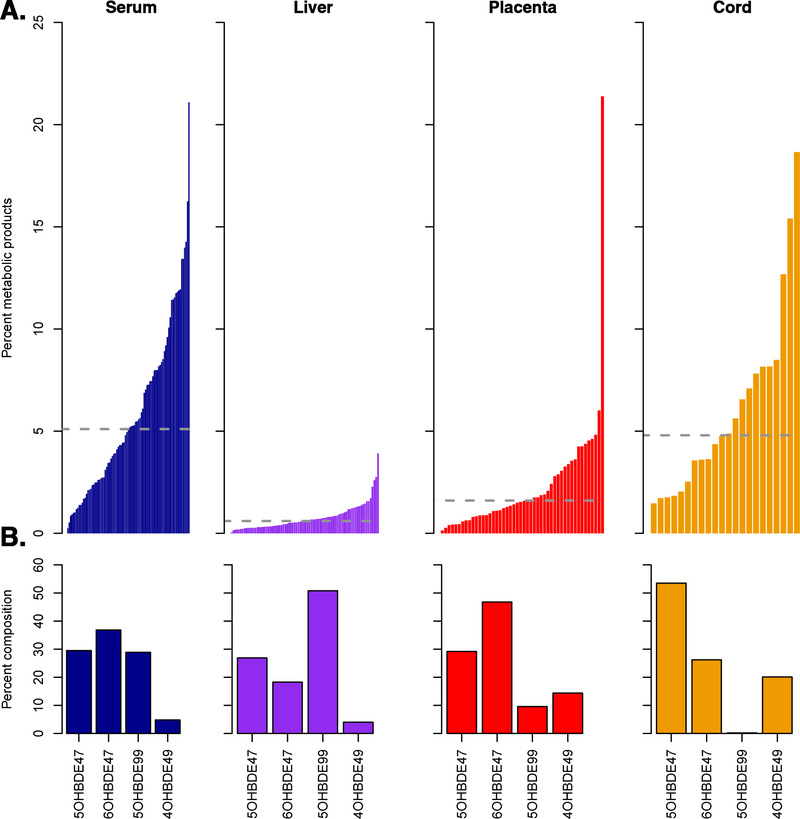
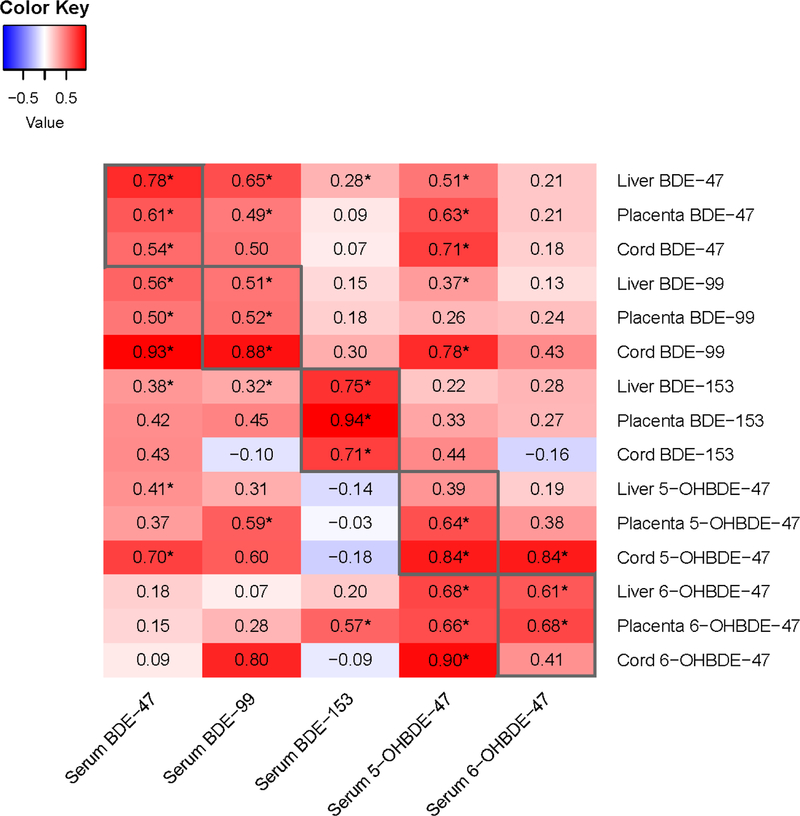
BDE-47 was detected in ≥96% of all tissues. Unadjusted ∑PBDEs concentrations were highest in fetal liver (geometric mean (GM)=0.72ng/g), whereas lipid-adjusted concentrations were highest in cord serum (111.12ng/g lipid). In both cases, fetal concentrations were approximately two times higher than maternal serum levels (GM=0.33ng/g or 48.75ng/g lipid). ΣOH-PBDEs were highest in maternal and cord sera and 20-200 times lower than PBDE concentrations. In regression models, maternal BDE-47 explained more of the model variance of liver than of placenta BDE-47 concentrations (adjusted R=0.79 vs 0.48, respectively). In adjusted logistic regression models, ∑PBDEs were positively associated with expression of CYP2E1 and -2J2 (placenta), and -1A1 (liver) (p<0.05).
Our findings suggest that under normal conditions of mid-gestation, the human fetus is directly exposed to concentrations of PBDEs that may be higher than previously estimated based on maternal serum and that these exposures are associated with the expression of mRNAs coding for CYP enzymes. These results will help frame and interpret findings from studies that use maternal or cord blood as proxy measures of fetal exposures, and will inform the molecular pathways by which PBDEs affect human health.
人类胎儿暴露于多溴联苯醚(PBDEs)及其代谢物(OH-PBDEs)的情况与成年人不同,再加上代谢模式的不同,可能使胎儿发育对这些暴露的不良健康后果更加敏感。然而,我们缺乏数据来描述人类胎儿 PBDE 暴露情况以及影响这些暴露的代谢因素。
我们研究了妊娠中期母体和胎儿 PBDEs 和 OH-PBDEs 暴露的差异。我们还描述了胎儿细胞色素 P450(CYP)mRNA 表达及其与 PBDE 暴露的关联。
我们收集了 86 对母体血清和胎儿肝脏样本(其中一部分有匹配的胎盘样本),并对其中 50 对样本进行了测量。我们测量了所有样本中的 PBDEs、OH-PBDEs 和 CYP 基因(如 CYP1A1、-2E1、-2J2、-2C9)的 mRNA 表达。作为敏感性分析,我们测量了一部分(n=22)脐带血清中的 PBDEs 和 OH-PBDEs。
BDE-47 在所有组织中的检出率均超过 96%。未调整的∑PBDEs 浓度在胎儿肝脏中最高(几何平均值(GM)=0.72ng/g),而脂调整后的浓度在脐带血清中最高(111.12ng/g 脂质)。在这两种情况下,胎儿浓度都比母体血清水平高约两倍(GM=0.33ng/g 或 48.75ng/g 脂质)。∑OH-PBDEs 在母体和脐带血清中最高,浓度比 PBDEs 低 20-200 倍。在回归模型中,母体 BDE-47 对肝脏中 BDE-47 浓度的模型方差的解释程度高于胎盘(调整后的 R2 分别为 0.79 和 0.48)。在调整后的逻辑回归模型中,∑PBDEs 与 CYP2E1 和 -2J2(胎盘)和 -1A1(肝脏)的 mRNA 表达呈正相关(p<0.05)。
我们的研究结果表明,在妊娠中期的正常情况下,胎儿直接暴露于可能高于以前基于母体血清估计的 PBDEs 浓度,这些暴露与编码 CYP 酶的 mRNA 表达有关。这些结果将有助于解释和解释使用母体或脐带血作为胎儿暴露的替代测量的研究结果,并为 PBDEs 影响人类健康的分子途径提供信息。