Department of Hematology, Beijing Hospital, National Center of Gerontology, Beijing, People's Republic of China
Department of Hematology, Beijing Hospital, National Center of Gerontology, Beijing, People's Republic of China.
Oncologist. 2018 Jun;23(6):722-729. doi: 10.1634/theoncologist.2017-0361. Epub 2018 Jan 9.
We aimed to validate and refine the Age, Comorbidities, and Albumin (ACA) index in elderly Chinese patients with diffuse large B-cell lymphoma (DLBCL) and propose a more effective method for comprehensive geriatric assessment (CGA).
Patients ≥65 years of age who had been diagnosed with de novo DLBCL in the Institute of Hematology, Beijing Hospital, were screened for eligibility ( = 99).
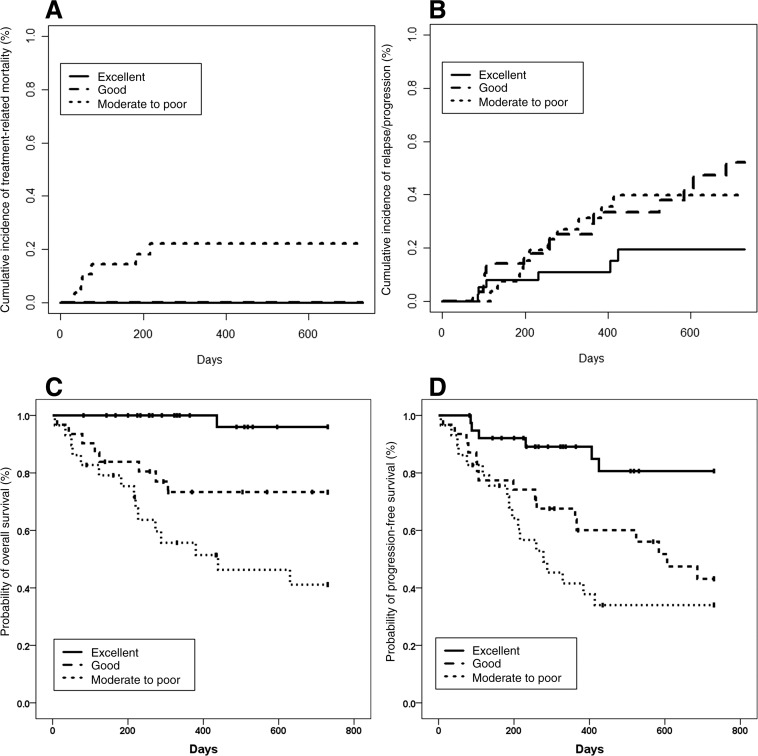
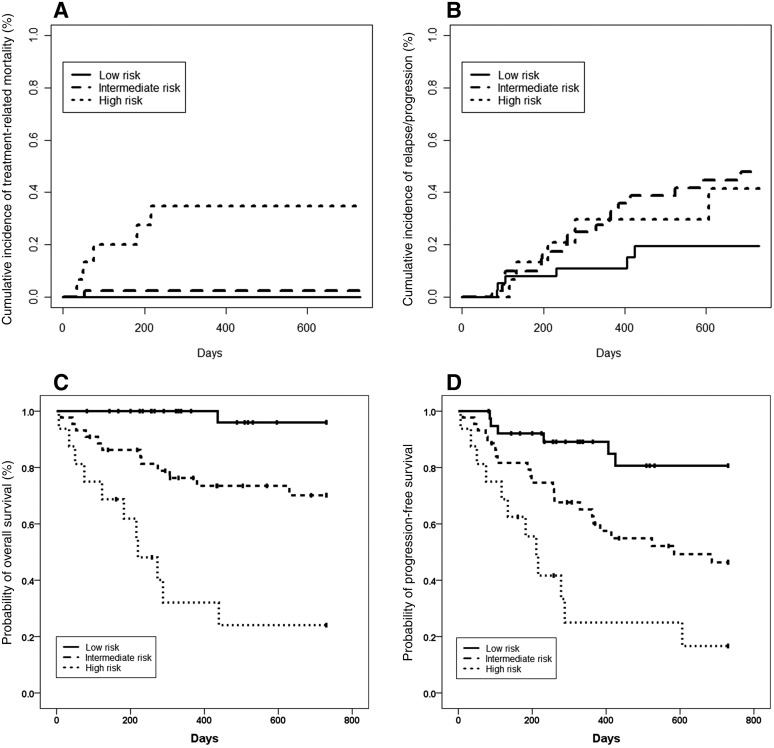
Based on the ACA index, 39, 31, 26, and 3 patients were categorized into the "excellent," "good," "moderate," and "poor" groups, respectively. The 2-year treatment-related mortality rate was significantly higher and the survival rates poorer in the ACA "moderate to poor" group compared with those of the ACA "good" and "excellent" groups. Multivariable model analysis identified two independent predictors of overall survival: the instrumental activities of daily living (IADL) scale and the ACA index. IADL scores of 6 to 7 and the ACA "good" group were assigned 1 point; IADL scores ≤5 and the ACA "moderate to poor" group were assigned 2 points. Based on these data, we created a three-category system (IADL ACA index [IACA index]): low risk, score 0; intermediate risk, score 1 to 2; and high risk, score 3 to 4. The IACA index could effectively discriminate the response rates, overall survival, and progression-free survival rates in elderly patients with DLBCL.
We observed that the ACA index could partially predict the clinical outcomes of elderly DLBCL patients in China. Based on this index, we proposed the IACA index as an effective tool for CGA in DLBCL.
Diffuse large B-cell lymphoma (DLBCL) is one of the most frequent types of malignant lymphoma in elderly people, and identifying patients suitable for curative therapy is critical in the improvement of clinical outcomes. Recently, some authors proposed the Age, Comorbidities, and Albumin (ACA) index. Combining the use of the instrumental activities of daily living (IADL) scale and the ACA index, this article describes the IADL ACA index (IACA index), which is an effective tool for comprehensive geriatric assessment in DLBCL.
我们旨在验证和改进适用于老年弥漫大 B 细胞淋巴瘤(DLBCL)患者的年龄、合并症和白蛋白(ACA)指数,并提出一种更有效的综合老年评估(CGA)方法。
在北京医院血液研究所筛选了 99 例初诊为弥漫大 B 细胞淋巴瘤的年龄≥65 岁的患者。
基于 ACA 指数,39、31、26 和 3 例患者分别被归类为“优秀”、“良好”、“中等”和“差”组。与 ACA“良好”和“优秀”组相比,ACA“中等至差”组的 2 年治疗相关死亡率显著更高,生存率更差。多变量模型分析确定了总生存的两个独立预测因素:工具性日常生活活动(IADL)量表和 ACA 指数。IADL 评分 6-7 分和 ACA“良好”组记 1 分;IADL 评分≤5 分和 ACA“中等至差”组记 2 分。根据这些数据,我们创建了一个三分类系统(IADL-ACA 指数[IACA 指数]):低危,评分 0;中危,评分 1-2;高危,评分 3-4。IACA 指数可有效区分老年 DLBCL 患者的反应率、总生存率和无进展生存率。
我们观察到 ACA 指数可部分预测中国老年 DLBCL 患者的临床结局。基于该指数,我们提出了 IACA 指数作为 DLBCL 中 CGA 的有效工具。
弥漫大 B 细胞淋巴瘤(DLBCL)是老年人中最常见的恶性淋巴瘤类型之一,确定适合治愈性治疗的患者对于改善临床结局至关重要。最近,一些作者提出了年龄、合并症和白蛋白(ACA)指数。本文结合使用工具性日常生活活动(IADL)量表和 ACA 指数,描述了 IADL-ACA 指数(IACA 指数),这是 DLBCL 中综合老年评估的有效工具。