Department of Microbial Infection and Immunity, Infectious Diseases Institute, The Ohio State University, Columbus, Ohio, USA.
School of Mathematics and Natural Sciences, University of Rio Grande, P.O. Box 500, Rio Grande, OH, USA.
Sci Rep. 2018 Jan 9;8(1):222. doi: 10.1038/s41598-017-18516-2.
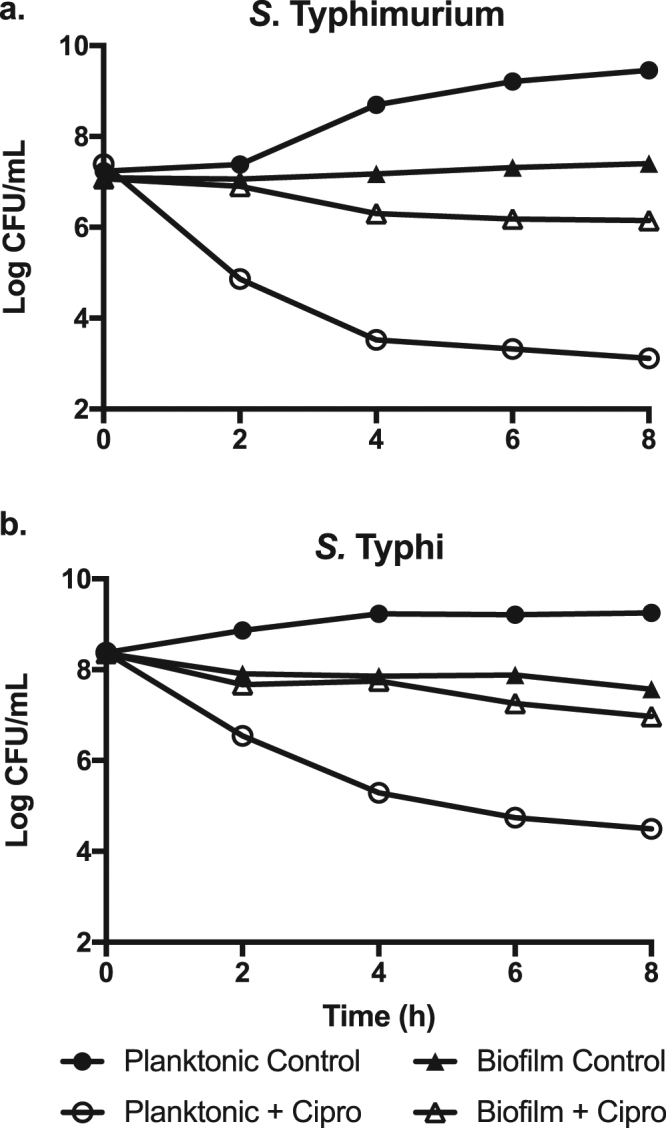
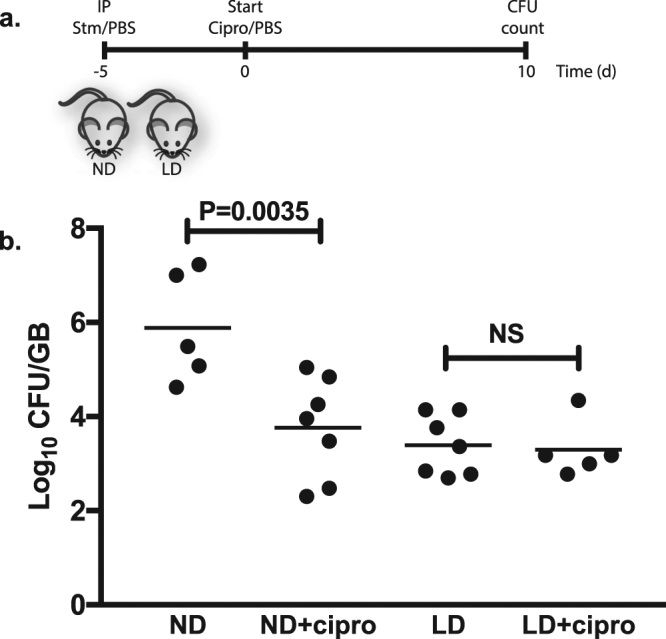
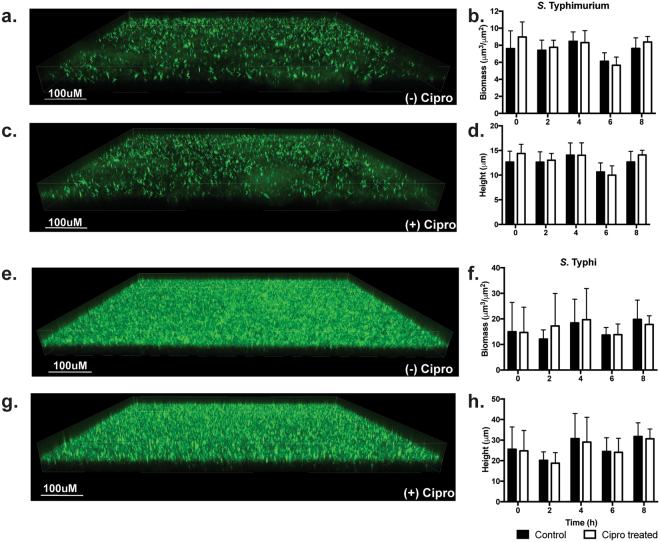
Typhoid fever is caused by the human-restricted pathogen Salmonella enterica sv. Typhi. Approximately 5% of people that resolve the disease become chronic carriers, with the gallbladder as the main reservoir of the bacteria. Of these, about 90% present with gallstones, on which Salmonella form biofilms. Because S. Typhi is a human-restricted pathogen, these carriers are the main source of dissemination of the disease; unfortunately, antibiotic treatment has shown to be an ineffective therapy. This is believed to be caused by the inherent antibiotic resistance conferred by Salmonella biofilms growing on gallstones. The gallstone mouse model with S. Typhimurium has proven to be an excellent surrogate for S. Typhi chronic infection. In this study, we test the hypothesis that the biofilm state confers Salmonella with the increased resistance to antibiotics observed in cases of chronic carriage. We found that, in the biofilm state, Salmonella is significantly more resistant to ciprofloxacin, a common antibiotic used for the treatment of Salmonella, both in vitro (p < 0.001 for both S. Typhi and S. Typhimurium with respect to planktonic cells) and in vivo (p = 0.0035 with respect to control mice).
伤寒是由人类局限性病原体沙门氏菌肠炎亚种 Typhi 引起的。大约 5%的患者在治愈后成为慢性携带者,而胆囊是细菌的主要储存库。其中,约 90%的人患有胆结石,沙门氏菌在这些胆结石上形成生物膜。由于 S. Typhi 是一种人类局限性病原体,这些携带者是疾病传播的主要来源;不幸的是,抗生素治疗已被证明是一种无效的疗法。这被认为是由于生长在胆结石上的沙门氏菌生物膜赋予的固有抗生素耐药性所致。鼠胆结石携带鼠伤寒沙门氏菌模型已被证明是沙门氏菌慢性感染的理想替代模型。在这项研究中,我们检验了这样一个假设,即生物膜状态赋予沙门氏菌对慢性携带中观察到的抗生素耐药性增加。我们发现,在生物膜状态下,沙门氏菌对环丙沙星的耐药性明显增强,环丙沙星是一种用于治疗沙门氏菌的常用抗生素,无论是在体外(p<0.001,分别针对浮游细胞的 S. Typhi 和 S. Typhimurium)还是在体内(p=0.0035,与对照小鼠相比)。