Department of Critical Care Medicine, Nanjing Zhongda Hospital, School of Medicine, Southeast University, Nanjing, 210009, China.
Sci Rep. 2018 Jan 9;8(1):204. doi: 10.1038/s41598-017-18509-1.
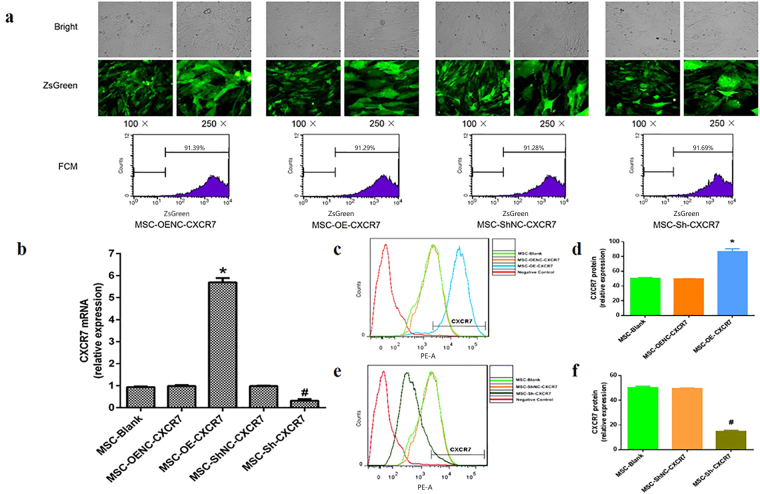
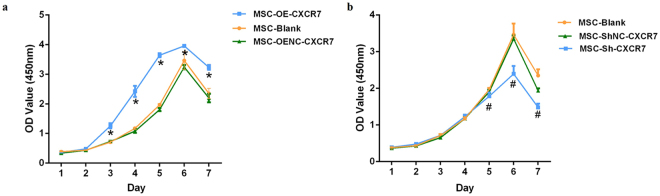
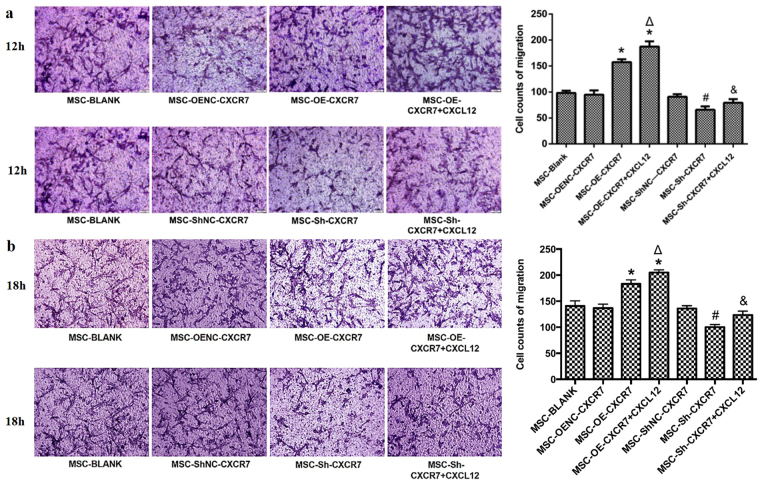
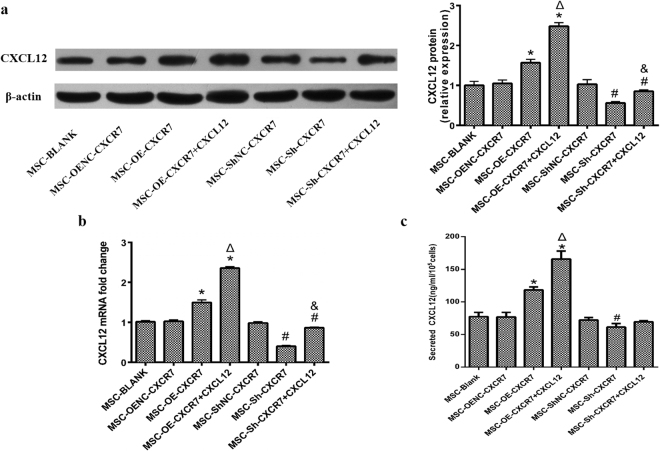
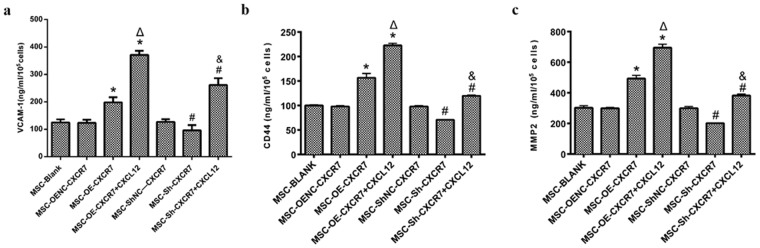
Great interest has been shown in mesenchymal stem cell (MSC) therapy in a wide variety of clinical domains. However, the therapeutic efficiency depends on the proliferation and migration of MSCs. Chemokine receptors are involved in regulating the proliferation and migration to the specific organs of MSCs in different microenvironments. CXC receptor seven (CXCR7), a newly discovered Chemokine ligand 12 (CXCL12) receptor, has organ specificity for tumour migration. We hypothesized that CXCR7 expression affects proliferation and migration of MSCs. In present study, we constructed long-term and stable mMSCs lines overexpressing and suppressing CXCR7 modifications with lentiviral vectors. The transduction efficiencies, mRNA and protein expression of CXCR7 were significantly regulated. CXCR7 gene overexpression promoted mMSCs proliferation and migration, whereas suppressing CXCR7 had the opposite effect. Additional CXCL12 improved the vertical migration of mMSCs. The overexpression of CXCR7 increased the MSC-secreted CXCL12, VCAM-1, CD44 and MMP2 levels, which contributed to the improvement of mMSC proliferation and migration. Therefore, overexpressing CXCR7 improved the proliferation and migration of mMSCs, which may be attributable to the CXCL12 secreted by MSCs, leading to a positive feedback loop for CXCL12/CXCR7 axis. Our results may provide a potential method for improving the treatment effectiveness of mMSCs by overexpressing CXCR7.
人们对间充质干细胞(MSC)疗法在广泛的临床领域表现出极大的兴趣。然而,治疗效果取决于 MSC 的增殖和迁移。趋化因子受体参与调节 MSC 在不同微环境中向特定器官的增殖和迁移。CXC 受体 7(CXCR7)是一种新发现的趋化因子配体 12(CXCL12)受体,对肿瘤迁移具有器官特异性。我们假设 CXCR7 的表达会影响 MSC 的增殖和迁移。在本研究中,我们使用慢病毒载体构建了长期和稳定过表达和抑制 CXCR7 修饰的 mMSC 系。转导效率、CXCR7 的 mRNA 和蛋白表达均得到显著调节。CXCR7 基因过表达促进 mMSC 的增殖和迁移,而抑制 CXCR7 则产生相反的效果。额外的 CXCL12 改善了 mMSC 的垂直迁移。CXCR7 的过表达增加了 MSC 分泌的 CXCL12、VCAM-1、CD44 和 MMP2 水平,这有助于促进 mMSC 的增殖和迁移。因此,过表达 CXCR7 可改善 mMSC 的增殖和迁移,这可能归因于 MSC 分泌的 CXCL12,导致 CXCL12/CXCR7 轴的正反馈循环。我们的研究结果可能为通过过表达 CXCR7 提高 mMSC 的治疗效果提供一种潜在的方法。