Department of Public Health and Primary Care, Leiden University Medical Centre, Leiden.
Department of Oral Kinesiology, Academic Centre for Dentistry Amsterdam (ACTA), University of Amsterdam and VU University Amsterdam.
Clin Interv Aging. 2017 Dec 22;13:25-34. doi: 10.2147/CIA.S144651. eCollection 2018.
Detection and measurement of pain in persons with dementia by using observational pain measurement tools is essential. However, the evidence for the psychometric properties of existing observational tools remains limited. Therefore, a new meta-tool has been developed: Pain Assessment in Impaired Cognition (PAIC), as a collaborative EU action. The aim is to describe the translation procedure and content validity of the Dutch version of the PAIC.
Translation of the PAIC into Dutch followed the forward-backward approach of the Guidelines for Establishing Cultural Equivalence of Instruments. A questionnaire survey was administered to clinical nursing home experts (20 physicians and 20 nurses) to determine whether the PAIC items are indicative of pain and whether items are specific for pain or for other disorders (anxiety disorder, delirium, dementia, or depression). To quantify content validity, mean scores per item were calculated.
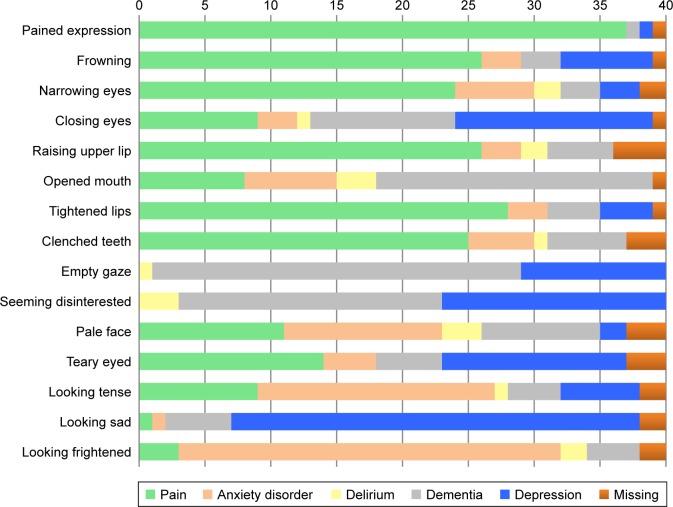
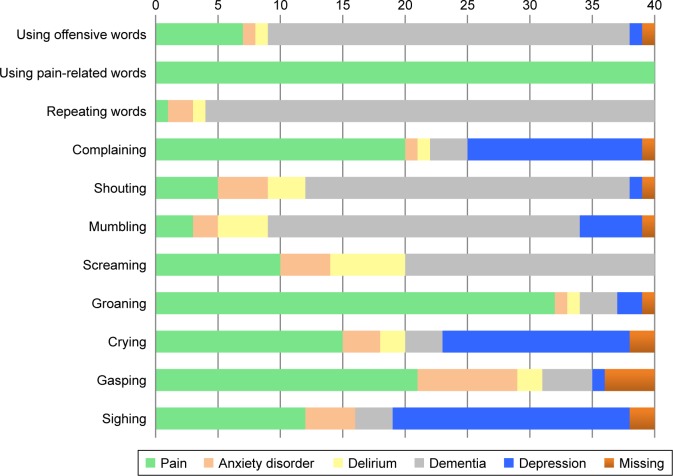
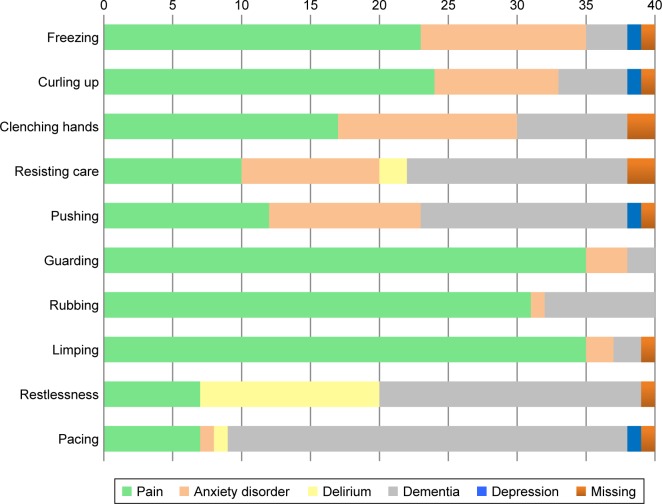
Eleven items were indicative of pain, for example, "frowning," "freezing," and "groaning." Fifteen items were considered to be pain-specific, for example, "frowning," "curling up," and "complaining." There were discrepancies between the notion of pain characteristics according to nurses and physicians, especially in the facial expressions domain.
Within the body movement domain, PAIC items correspond well with the clinical experience of the physicians and nurses. However, items in the facial expressions and vocalizations domains need further study with respect to item reduction. Also, differences were revealed in the notion of pain characteristics between physicians and nurses, suggesting the need for more interdisciplinary education on pain in dementia.
通过使用观察性疼痛测量工具来检测和测量痴呆患者的疼痛是至关重要的。然而,现有的观察性工具的心理测量学特性的证据仍然有限。因此,作为一项欧盟合作行动,开发了一种新的元工具:认知障碍疼痛评估(PAIC)。其目的是描述 PAIC 荷兰语版本的翻译过程和内容效度。
PAIC 被翻译成荷兰语,遵循了仪器文化等效性建立指南的正向-反向方法。对临床养老院专家(20 名医生和 20 名护士)进行了问卷调查,以确定 PAIC 项目是否提示疼痛,以及项目是否针对疼痛或其他疾病(焦虑障碍、谵妄、痴呆或抑郁)具有特异性。为了量化内容效度,计算了每个项目的平均得分。
有 11 个项目提示疼痛,例如“皱眉”、“冻结”和“呻吟”。有 15 个项目被认为是疼痛特异性的,例如“皱眉”、“蜷缩”和“抱怨”。护士和医生对疼痛特征的概念存在差异,尤其是在面部表情领域。
在身体运动领域,PAIC 项目与医生和护士的临床经验相符。然而,在面部表情和发声领域的项目需要进一步研究,以减少项目数量。此外,医生和护士对疼痛特征的概念存在差异,这表明需要更多关于痴呆症疼痛的跨学科教育。