Kardos Peter, Hagedorn-Peinz Ina
Pulmonary Department, Respiratory and Sleep Medicine at Red Cross Maingau Hospital, Group Practice Allergy, Frankfurt, Germany.
Novartis Pharma GmbH, Nuremberg, Germany.
Int J Chron Obstruct Pulmon Dis. 2017 Dec 22;13:69-77. doi: 10.2147/COPD.S146189. eCollection 2018.
The objective of the FAVOR study was to evaluate the effect of indacaterol/glycopyrronium (IND/GLY) versus tiotropium on peak forced expiratory volume in 1 s (FEV) and also to investigate patient satisfaction and treatment preference.
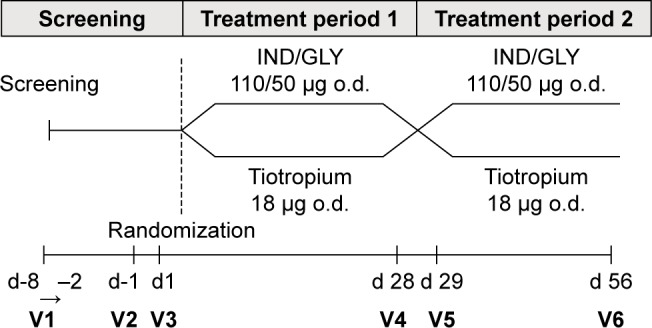
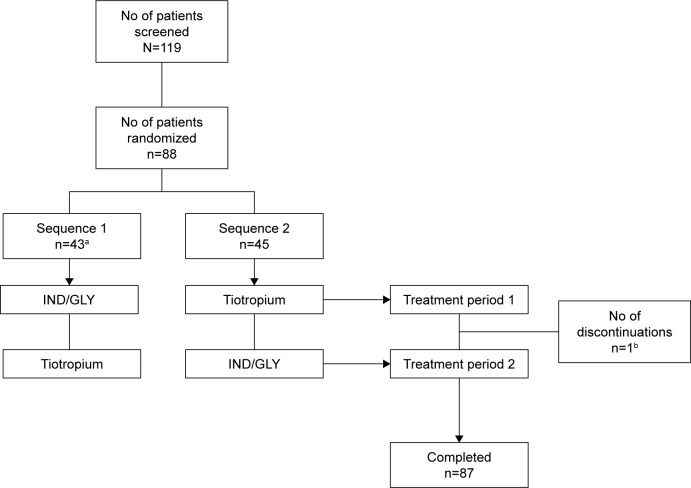
Patients with moderate-to-severe airflow limitation (FEV/forced vital capacity ratio of <0.70), those with a COPD assessment test score of ≥10, and those who were maintained on tiotropium HandiHaler therapy prior to enrollment were recruited for the study, and randomized (1:1) to receive either 4 weeks open-label IND/GLY (110/50 μg) once daily followed by 4 weeks of tiotropium (18 μg) once daily or vice versa. The primary endpoint was FEV 1 h post-inhalation after 4 weeks of treatment. Other endpoints included patient's and physician's preference for treatment, patient's satisfaction evaluated using a study-specific questionnaire and the abbreviated Treatment Satisfaction Questionnaire for Medication, and safety and tolerability.
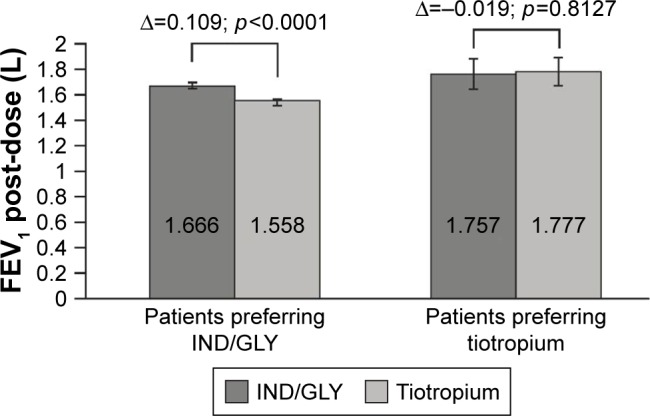
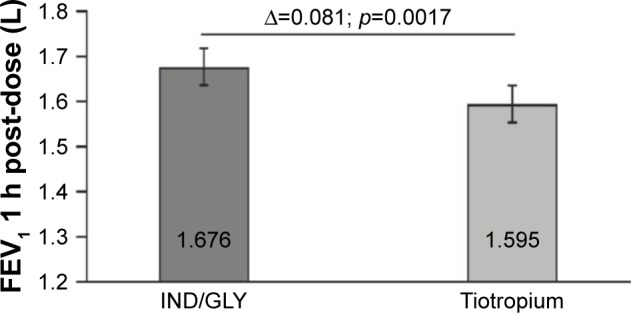
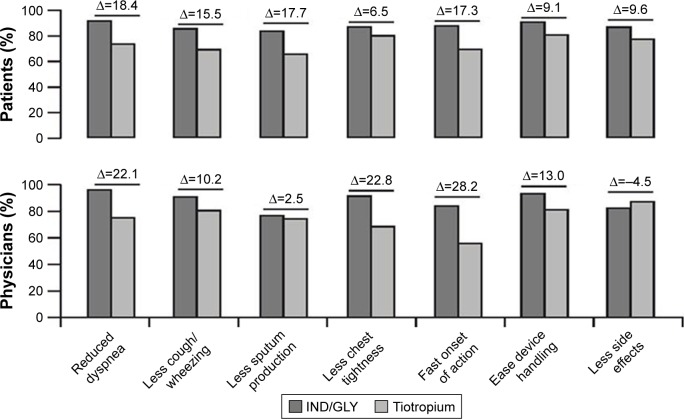
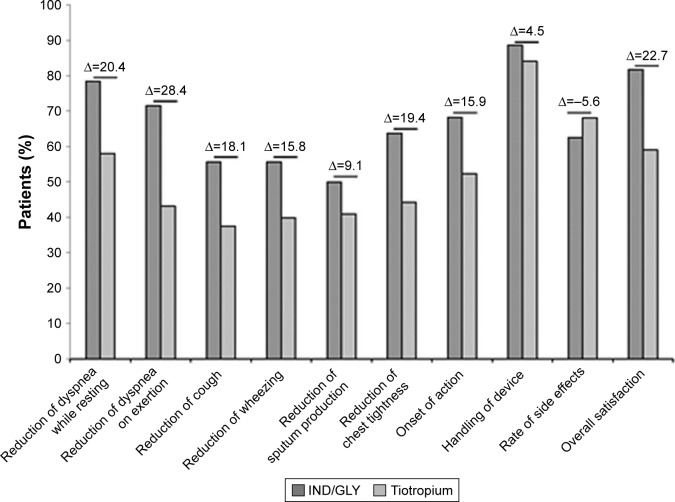
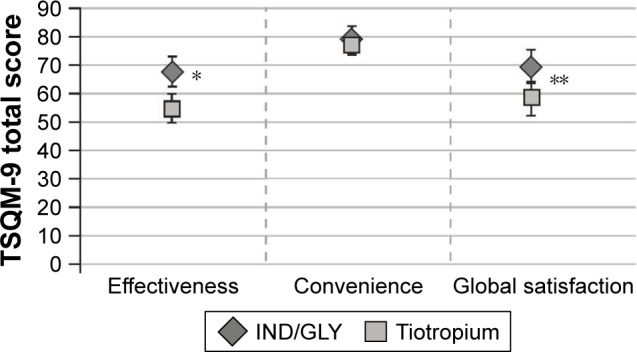
Eighty-seven out of 88 randomized patients completed the study and showed significantly higher FEV 1 h post-inhalation after 4 weeks of treatment with IND/GLY versus tiotropium (treatment difference =0.081 L; =0.0017). IND/GLY was preferred over tiotropium among the patients (69.4% versus 30.6%, =0.0004) and the physicians (81.6% versus 18.4%, <0.0001). A higher proportion of the patients stated they were very satisfied or satisfied with IND/GLY versus tiotropium with regard to dyspnea reduction (79.3% versus 58.0%, respectively) and reduction of dyspnea on exertion (72.4% versus 43.2%, respectively). Patients treated with IND/GLY showed significant improvement in Treatment Satisfaction Questionnaire for Medication domain scores versus tiotropium. IND/GLY demonstrated a good safety and tolerability profile.
This study indicated that, beyond FEV, important patient-reported outcomes improved with the open-label dual bronchodilator IND/GLY when compared with tiotropium. This study suggests that individual patients felt the lung function benefits with IND/GLY compared with tiotropium, which, in turn, may also have contributed to the preference for IND/GLY.
FAVOR研究的目的是评估茚达特罗/格隆溴铵(IND/GLY)与噻托溴铵相比对1秒用力呼气量(FEV₁)的影响,并调查患者满意度和治疗偏好。
招募中度至重度气流受限(FEV₁/用力肺活量比值<0.70)、慢性阻塞性肺疾病评估测试评分≥10且在入组前接受噻托溴铵HandiHaler治疗的患者进行该研究,并随机(1:1)接受4周的开放标签IND/GLY(110/50μg)每日一次,随后4周的噻托溴铵(18μg)每日一次,或反之。主要终点是治疗4周后吸入药物1小时后的FEV₁。其他终点包括患者和医生对治疗的偏好、使用特定研究问卷和简化药物治疗满意度问卷评估的患者满意度,以及安全性和耐受性。
88名随机分组的患者中有87名完成了研究,结果显示与噻托溴铵相比,IND/GLY治疗4周后吸入药物1小时后的FEV₁显著更高(治疗差异=0.081L;P=0.0017)。患者(69.4%对30.6%,P=0.0004)和医生(81.6%对18.4%,P<0.0001)中,IND/GLY比噻托溴铵更受青睐。与噻托溴铵相比,更高比例的患者表示他们对IND/GLY在减轻呼吸困难(分别为79.3%对58.0%)和运动时呼吸困难减轻(分别为72.4%对43.2%)方面非常满意或满意。与噻托溴铵相比,接受IND/GLY治疗的患者在药物治疗满意度问卷领域得分有显著改善。IND/GLY显示出良好的安全性和耐受性。
本研究表明,与噻托溴铵相比,除了FEV₁外,开放标签的双重支气管扩张剂IND/GLY还改善了重要的患者报告结局。本研究表明,与噻托溴铵相比,个体患者感受到IND/GLY对肺功能的益处,这反过来也可能导致了对IND/GLY的偏好。