Hitsumoto Takashi
Hitsumoto Medical Clinic, 2-7-7, Takezakicyou, Shimonoseki-City, Yamaguchi 750-0025, Japan. Email:
Cardiol Res. 2017 Dec;8(6):304-311. doi: 10.14740/cr632w. Epub 2017 Dec 22.
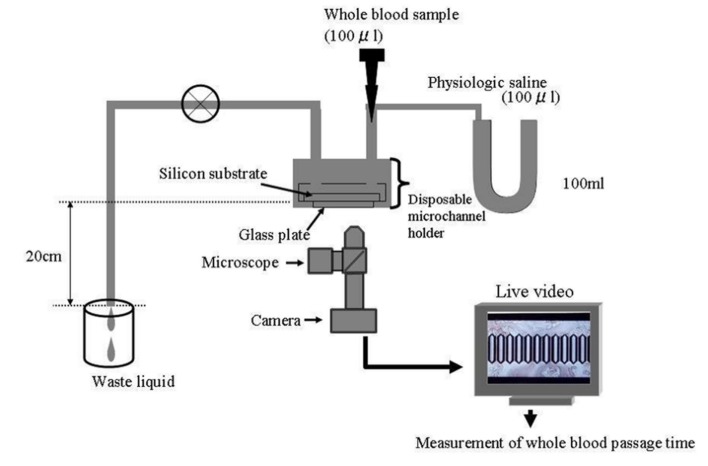
Recent studies on high-sensitivity cardiac troponin T (hs-cTnT) and whole blood passage time (WBPT), estimated by hemorheology assessed with the microchannel array flow analyzer (MC-FAN), have revealed the significance of cardiovascular risk factors. However, there are no known reports on the relationship between these two clinical parameters. This cross-sectional study aimed to clarify the associations between WBPT and hs-cTnT levels in patients with type 2 diabetes mellitus from the perspective of subclinical myocardial injury or the primary prevention of cardiovascular events.
A total of 301 outpatients (men, 116; women, 185; mean age, 65 ± 11 years), with no history of cardiovascular diseases, undergoing treatment for diabetes mellitus were enrolled. Hs-cTnT levels and WBPT were measured using a commercial device, and the relationship between hs-cTnT levels and various clinical parameters, including WBPT, was examined.
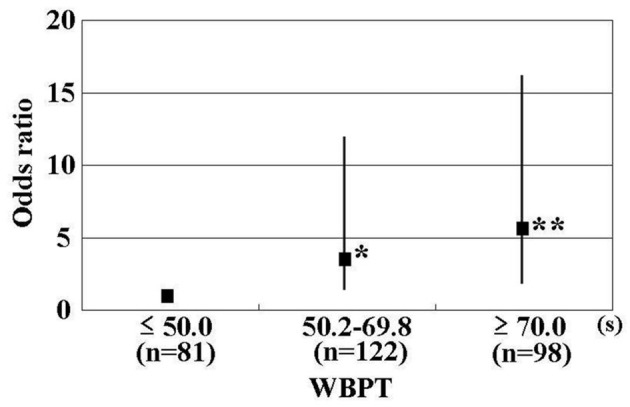
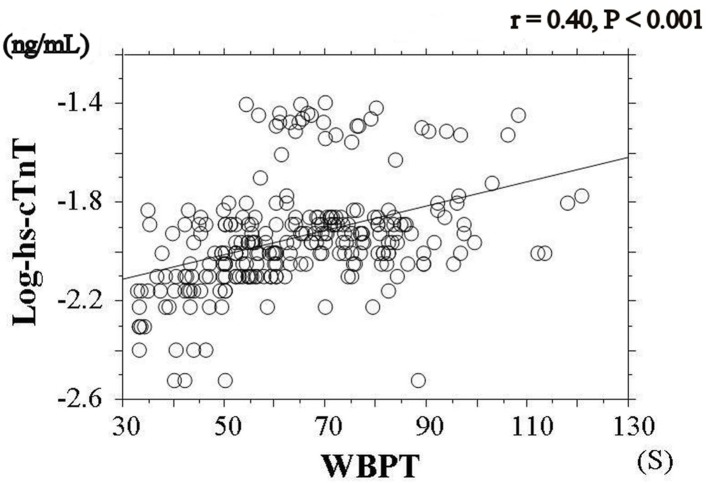
Hs-cTnT levels were detected in 261 (86.7%) patients. WBPT was significantly higher in patients with detectable hs-cTnT levels than in those with undetectable hs-cTnT levels (64 ± 18 s vs. 51 ± 13 s, P < 0.001). In patients with detectable hs-cTnT levels, there was a significantly positive correlation between WBPT and hs-cTnT levels (r = 0.40; P < 0.001). Furthermore, multiple regression analysis revealed that WBPT (β = 0.24; P < 0.001) was an independent variable when hs-cTnT was a subordinate factor. Conversely, patients with high (≥ 70 s; odds ratio, 5.3 (95% CI, 1.6 - 16.1); P < 0.01) and median (50.2 - 69.8 s; odds ratio, 3.8 (95% CI, 1.2 - 12.4); P < 0.05) WBPT had a significantly higher risk for high hs-cTnT levels (≥ 0.014 ng/mL) than those with low WBPT (≤ 50.0 s).
The results of this study indicated independent associations of hemorheology with hs-cTnT in patients with type 2 diabetes mellitus assessed by MC-FAN. We suggest that an increase in hs-cTnT levels can be prevented by maintaining WBPT at ≤ 50.0 s.
近期关于高敏心肌肌钙蛋白T(hs-cTnT)和全血通过时间(WBPT)的研究,通过微通道阵列血流分析仪(MC-FAN)评估血液流变学得出,揭示了心血管危险因素的重要性。然而,关于这两个临床参数之间的关系尚无已知报道。这项横断面研究旨在从亚临床心肌损伤或心血管事件一级预防的角度,阐明2型糖尿病患者WBPT与hs-cTnT水平之间的关联。
共纳入301例无心血管疾病史且正在接受糖尿病治疗的门诊患者(男性116例,女性185例;平均年龄65±11岁)。使用商用设备测量hs-cTnT水平和WBPT,并检查hs-cTnT水平与包括WBPT在内的各种临床参数之间的关系。
261例(86.7%)患者检测到hs-cTnT水平。hs-cTnT水平可检测的患者WBPT显著高于hs-cTnT水平不可检测的患者(64±18秒对51±13秒,P<0.001)。在hs-cTnT水平可检测的患者中,WBPT与hs-cTnT水平之间存在显著正相关(r = 0.40;P<0.001)。此外,多元回归分析显示,当hs-cTnT为从属因素时,WBPT(β = 0.24;P<0.001)是一个自变量。相反,WBPT高(≥70秒;比值比,5.3(95%CI,1.6 - 16.1);P<0.01)和中等(50.2 - 69.8秒;比值比,3.8(95%CI,1.2 - 12.4);P<0.05)的患者hs-cTnT水平高(≥0.014 ng/mL)的风险显著高于WBPT低(≤50.0秒)的患者。
本研究结果表明,通过MC-FAN评估,血液流变学与2型糖尿病患者的hs-cTnT存在独立关联。我们建议将WBPT维持在≤50.0秒可预防hs-cTnT水平升高。