School of Electronic Science, National University of Defense Technology, Changsha 410073, China.
Sensors (Basel). 2018 Jan 10;18(1):179. doi: 10.3390/s18010179.
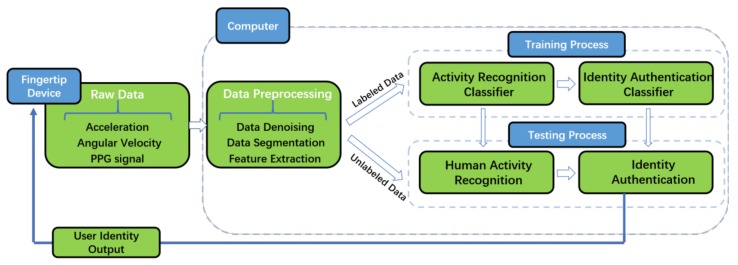
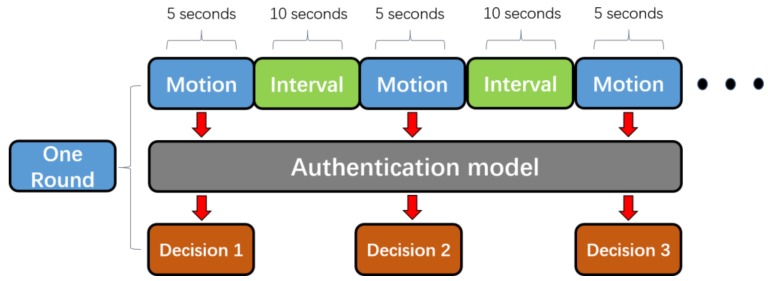
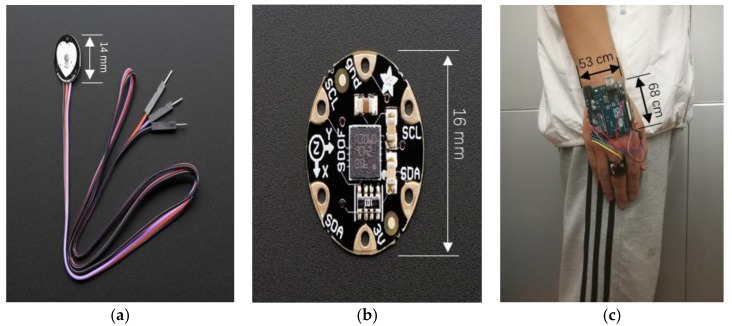
Wearable devices have flourished over the past ten years providing great advantages to people and, recently, they have also been used for identity authentication. Most of the authentication methods adopt a one-time authentication manner which cannot provide continuous certification. To address this issue, we present a two-step authentication method based on an own-built fingertip sensor device which can capture motion data (e.g., acceleration and angular velocity) and physiological data (e.g., a photoplethysmography (PPG) signal) simultaneously. When the device is worn on the user's fingertip, it will automatically recognize whether the wearer is a legitimate user or not. More specifically, multisensor data is collected and analyzed to extract representative and intensive features. Then, human activity recognition is applied as the first step to enhance the practicability of the authentication system. After correctly discriminating the motion state, a one-class machine learning algorithm is applied for identity authentication as the second step. When a user wears the device, the authentication process is carried on automatically at set intervals. Analyses were conducted using data from 40 individuals across various operational scenarios. Extensive experiments were executed to examine the effectiveness of the proposed approach, which achieved an average accuracy rate of 98.5% and an F1-score of 86.67%. Our results suggest that the proposed scheme provides a feasible and practical solution for authentication.
可穿戴设备在过去十年中蓬勃发展,为人们带来了巨大的优势,最近它们也被用于身份验证。大多数身份验证方法采用一次性身份验证方式,无法提供持续认证。为了解决这个问题,我们提出了一种基于自建指尖传感器设备的两步身份验证方法,该设备可以同时捕获运动数据(例如,加速度和角速度)和生理数据(例如,光电容积脉搏波(PPG)信号)。当设备戴在用户的指尖上时,它会自动识别佩戴者是否为合法用户。更具体地说,我们会收集和分析多传感器数据,以提取代表性和密集的特征。然后,应用人体活动识别作为第一步,以增强身份验证系统的实用性。在正确区分运动状态后,我们会应用一类机器学习算法作为第二步进行身份验证。当用户佩戴设备时,认证过程会在设定的时间间隔内自动进行。我们使用来自 40 名个体在各种操作场景下的数据进行了分析。我们还进行了广泛的实验来检验所提出方法的有效性,该方法的平均准确率达到 98.5%,F1 得分为 86.67%。我们的结果表明,所提出的方案为身份验证提供了一种可行且实用的解决方案。