Department of Computer Engineering and Mathematics, Universitat Rovira i Virgili, Av. Països Catalans 26, 43007 Tarragona, Spain.
SIMPPLE S.L., C. Joan Maragall 1A, 43003 Tarragona, Spain.
Sensors (Basel). 2021 Oct 17;21(20):6886. doi: 10.3390/s21206886.
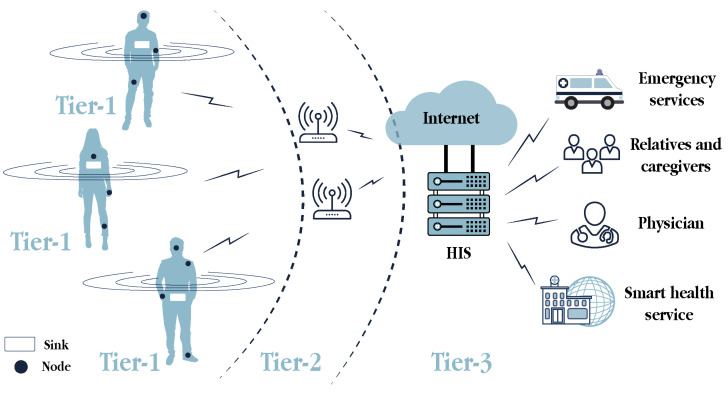
The advances in the miniaturisation of electronic devices and the deployment of cheaper and faster data networks have propelled environments augmented with contextual and real-time information, such as smart homes and smart cities. These context-aware environments have opened the door to numerous opportunities for providing added-value, accurate and personalised services to citizens. In particular, smart healthcare, regarded as the natural evolution of electronic health and mobile health, contributes to enhance medical services and people's welfare, while shortening waiting times and decreasing healthcare expenditure. However, the large number, variety and complexity of devices and systems involved in smart health systems involve a number of challenging considerations to be considered, particularly from security and privacy perspectives. To this aim, this article provides a thorough technical review on the deployment of secure smart health services, ranging from the very collection of sensors data (either related to the medical conditions of individuals or to their immediate context), the transmission of these data through wireless communication networks, to the final storage and analysis of such information in the appropriate health information systems. As a result, we provide practitioners with a comprehensive overview of the existing vulnerabilities and solutions in the technical side of smart healthcare.
电子设备的小型化和更便宜、更快的数据网络的部署推动了具有上下文和实时信息的环境的发展,例如智能家居和智能城市。这些上下文感知环境为向公民提供增值、准确和个性化的服务开辟了无数机会。特别是,被视为电子健康和移动健康的自然发展的智能医疗保健有助于提高医疗服务水平和人们的福利,同时缩短等待时间并减少医疗支出。然而,智能健康系统中涉及的大量、多样化和复杂的设备和系统涉及到许多需要考虑的挑战,特别是从安全和隐私的角度来看。为此,本文对安全智能健康服务的部署进行了全面的技术审查,范围从传感器数据(与个人的医疗状况或其直接环境有关)的采集,到这些数据通过无线通信网络的传输,再到最终在适当的健康信息系统中存储和分析这些信息。因此,我们为从业者提供了智能医疗保健技术方面现有漏洞和解决方案的全面概述。