Department of Maxillofacial and Plastic Surgery, University of Bonn, Sigmund-Freud Str. 25, 53127, Bonn, Germany.
Department of Oral, Maxillofacial and Plastic Surgery, University of Bonn, Welschnonnenstraße 17, D - 53111, Bonn, Germany.
Head Face Med. 2018 Jan 10;14(1):3. doi: 10.1186/s13005-017-0159-8.
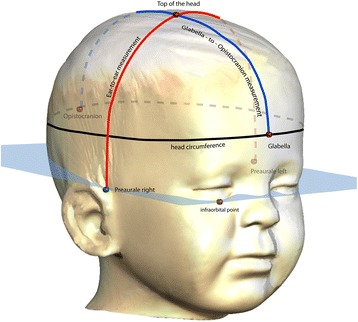
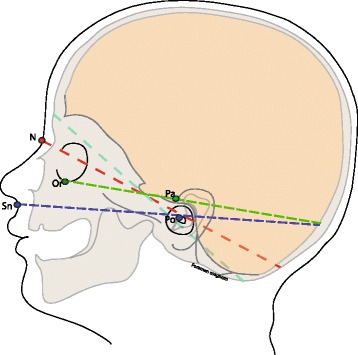
The measurement of maximal head circumference is a standard procedure in the examination of childrens' cranial growth and brain development. The objective of the study was to evaluate the validity of maximal head circumference to cranial volume in the first year of life using a new method which includes ear-to-ear over the head distance and maximal cranial length measurement.
3D surface scans for cranial volume assessment were conducted in this method comparison study of 44 healthy Caucasian children (29 male, 15 female) at the ages of 4 and 12 months.
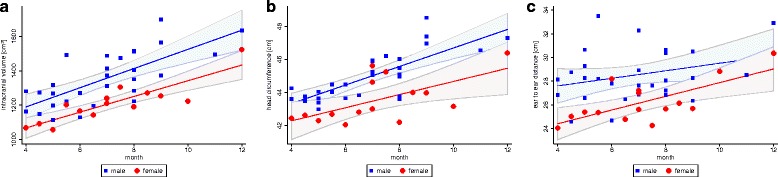
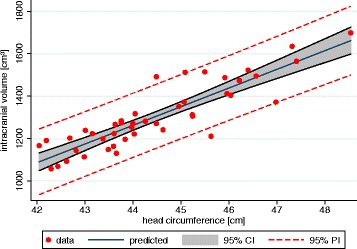
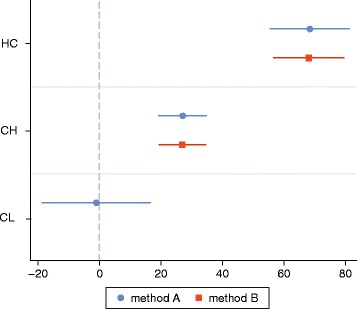
Cranial volume increased from measurements made at 4 months to 12 months of age by an average of 1174 ± 106 to 1579 ± 79 ml. Maximal cranial circumference increased from 43.4 ± 9 cm to 46.9 ± 7 cm and the ear-to ear measurement increased from 26.3 ± 21 cm to 31.6 ± 18 cm at the same time points. There was a monotone association between maximal head circumference (HC) and increase in volume, yet a backwards inference from maximal circumference to the volume had a predictive value of only 78% (adjusted R). Including the additional measurement of distance from ear to ear strengthened the ability of the model to predict the true value attained to 90%. The addition of the parameter skull length appeared to be negligible.
The results demonstrate that for a distinct improvement in the evaluation of a physiological cranial volume development, the additional measurement of the ear-to ear distance using a measuring tape is expedient, and, especially for cases with pathological skull changes, such as craniosynostosis, ought to be conducted.
测量最大头围是检查儿童头颅生长和大脑发育的标准程序。本研究的目的是使用一种新方法评估头围与出生后第一年颅骨容积的相关性,该方法包括头部两侧耳际距离和最大颅长的测量。
本研究为方法比较研究,纳入 44 名健康白种儿童(男 29 名,女 15 名),分别在 4 月龄和 12 月龄时进行 3D 头颅表面扫描,以评估颅骨容积。
颅骨容积从 4 月龄的(1174 ± 106)ml 增加到 12 月龄的(1579 ± 79)ml,平均增加了 1174 ± 106ml。最大头围从 43.4 ± 9cm 增加到 46.9 ± 7cm,耳距从 26.3 ± 21cm 增加到 31.6 ± 18cm,同时增加。最大头围(HC)与容积增加之间存在单调关联,但从最大头围推断容积的预测值仅为 78%(调整 R)。包括从耳到耳的距离测量可将模型预测真实值的能力提高到 90%。增加颅骨长度参数的效果似乎可以忽略不计。
结果表明,为了更准确地评估生理性颅骨容积发育,使用卷尺测量耳距是有益的,特别是对于颅骨形态发生异常,如颅缝早闭的病例。