Department of Zoology, University of Cambridge, UK.
Department of Biology, University of York, Heslington York, UK.
FEBS Lett. 2018 Mar;592(5):679-691. doi: 10.1002/1873-3468.12972. Epub 2018 Jan 26.
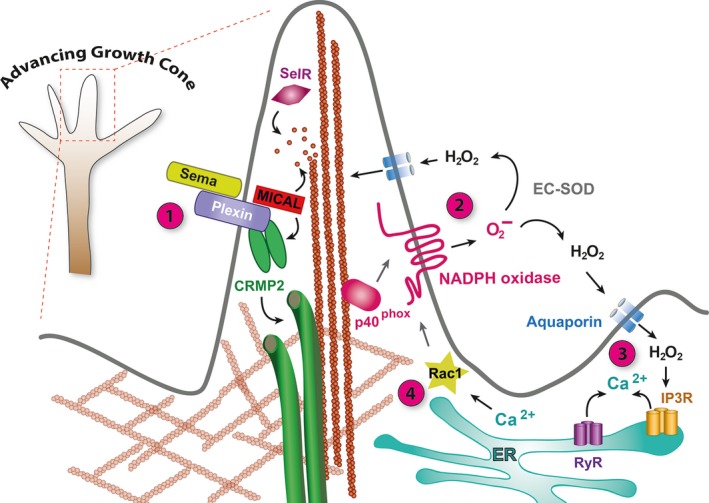
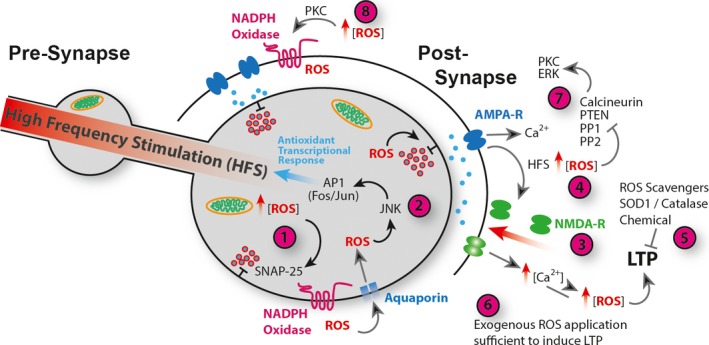
Reactive oxygen species (ROS) have long been studied as destructive agents in the context of nervous system ageing, disease and degeneration. Their roles as signalling molecules under normal physiological conditions is less well understood. Recent studies have provided ample evidence of ROS-regulating neuronal development and function, from the establishment of neuronal polarity to growth cone pathfinding; from the regulation of connectivity and synaptic transmission to the tuning of neuronal networks. Appreciation of the varied processes that are subject to regulation by ROS might help us understand how changes in ROS metabolism and buffering could progressively impact on neuronal networks with age and disease.
活性氧 (ROS) 长期以来一直被研究为神经系统衰老、疾病和退化背景下的破坏性因素。它们在正常生理条件下作为信号分子的作用还不太清楚。最近的研究提供了充分的证据表明 ROS 调节神经元的发育和功能,从神经元极性的建立到生长锥的轨迹形成;从连接性和突触传递的调节到神经元网络的调谐。对 ROS 可调节的各种过程的认识可能有助于我们理解 ROS 代谢和缓冲的变化如何随着年龄和疾病的发展而逐渐影响神经元网络。