University of Pittsburgh School of Medicine, Department of Psychiatry, United States.
Florida International University, Department of Psychology, United States.
Dev Cogn Neurosci. 2018 Apr;30:51-59. doi: 10.1016/j.dcn.2017.12.004. Epub 2017 Dec 15.
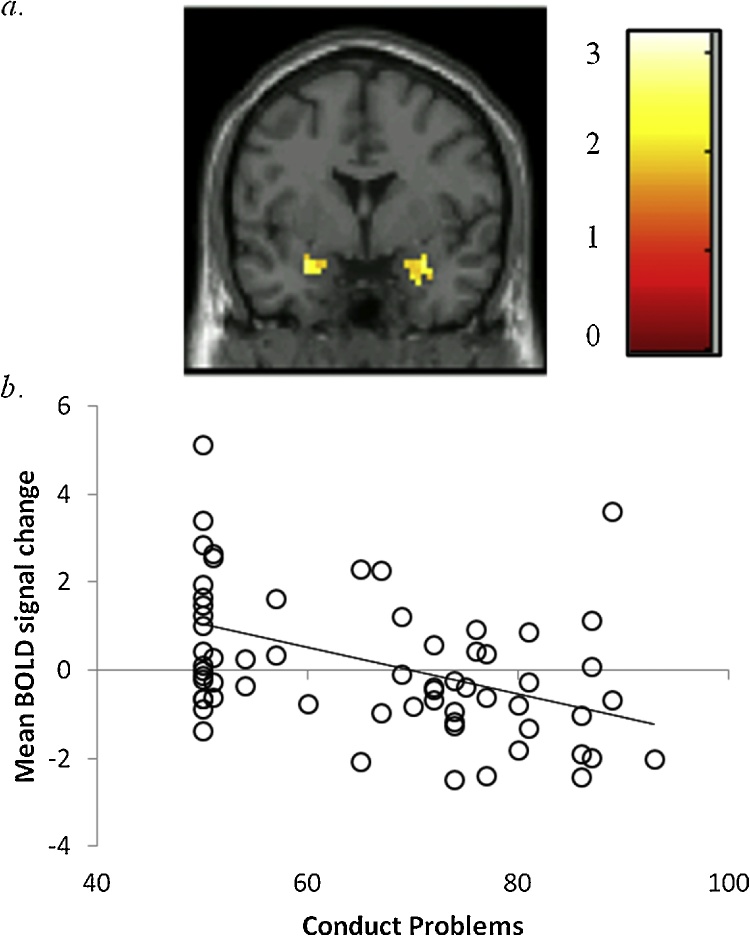
Abnormalities in reward and punishment processing are implicated in the development of conduct problems (CP), particularly among youth with callous-unemotional (CU) traits. However, no studies have examined whether CP children with high versus low CU traits exhibit differences in the neural response to reward and punishment. A clinic-referred sample of CP boys with high versus low CU traits (ages 8-11; n = 37) and healthy controls (HC; n = 27) completed a fMRI task assessing reward and punishment processing. CP boys also completed a randomized control trial examining the effectiveness of an empirically-supported intervention (i.e., Stop-Now-And-Plan; SNAP). Primary analyses examined pre-treatment differences in neural activation to reward and punishment, and exploratory analyses assessed whether these differences predicted treatment outcome. Results demonstrated associations between CP and reduced amygdala activation to punishment independent of age, race, IQ and co-occurring ADHD and internalizing symptoms. CU traits were not associated with reward or punishment processing after accounting for covariates and no differences were found between CP boys with high versus low CU traits. While boys assigned to SNAP showed a greater reduction in CP, differences in neural activation were not associated with treatment response. Findings suggest that reduced sensitivity to punishment is associated with early-onset CP in boys regardless of the level of CU traits.
奖励和惩罚处理异常与行为问题(CP)的发展有关,特别是在具有无情情感(CU)特征的年轻人中。然而,尚无研究探讨具有高 CU 特征与低 CU 特征的 CP 儿童在对奖励和惩罚的神经反应方面是否存在差异。一个由诊所推荐的 CP 男孩高 CU 特征与低 CU 特征(年龄 8-11 岁;n=37)和健康对照组(HC;n=27)完成了一项 fMRI 任务,评估奖励和惩罚处理。CP 男孩还完成了一项随机对照试验,检验了一种经过实证支持的干预措施(即立即停止和计划;SNAP)的有效性。主要分析检验了治疗前对奖励和惩罚的神经激活差异,探索性分析评估了这些差异是否预测了治疗结果。结果表明,CP 与惩罚时杏仁核激活减少有关,与年龄、种族、智商和同时存在的 ADHD 和内化症状无关。在考虑了协变量后,CU 特征与奖励或惩罚处理无关,并且在高 CU 特征与低 CU 特征的 CP 男孩之间没有发现差异。虽然被分配到 SNAP 的男孩表现出 CP 更大的减少,但神经激活的差异与治疗反应无关。研究结果表明,无论 CU 特征的水平如何,对惩罚的敏感性降低都与男孩的早期 CP 有关。