Murtha Kristin, Perlstein Samantha, Paz Yael, Seidlitz Jakob, Raine Adrian, Hawes Samuel, Byrd Amy, Waller Rebecca
Department of Psychology, University of Pennsylvania, Philadelphia, PA, USA.
Department of Psychiatry, University of Pennsylvania, Philadelphia, PA, USA.
J Child Psychol Psychiatry. 2025 Mar;66(3):333-349. doi: 10.1111/jcpp.14062. Epub 2024 Nov 4.
Many studies show that both callous-unemotional (CU) traits (e.g., low empathy, lack of guilt) and cognitive difficulties increase risk for externalizing psychopathology across development. However, other work suggests that some aggression (e.g., relational, proactive) may rely on intact cognitive function, which could vary based on the presence of CU traits. Moreover, no prior research has adequately accounted for common risk factors shared by CU traits, cognitive difficulties, and externalizing problems, which confounds conclusions that can be drawn about their purported relationships. The current study addressed these knowledge gaps by leveraging rigorous propensity matching methods to isolate associations between CU traits and different dimensions of cognitive function and externalizing problems.
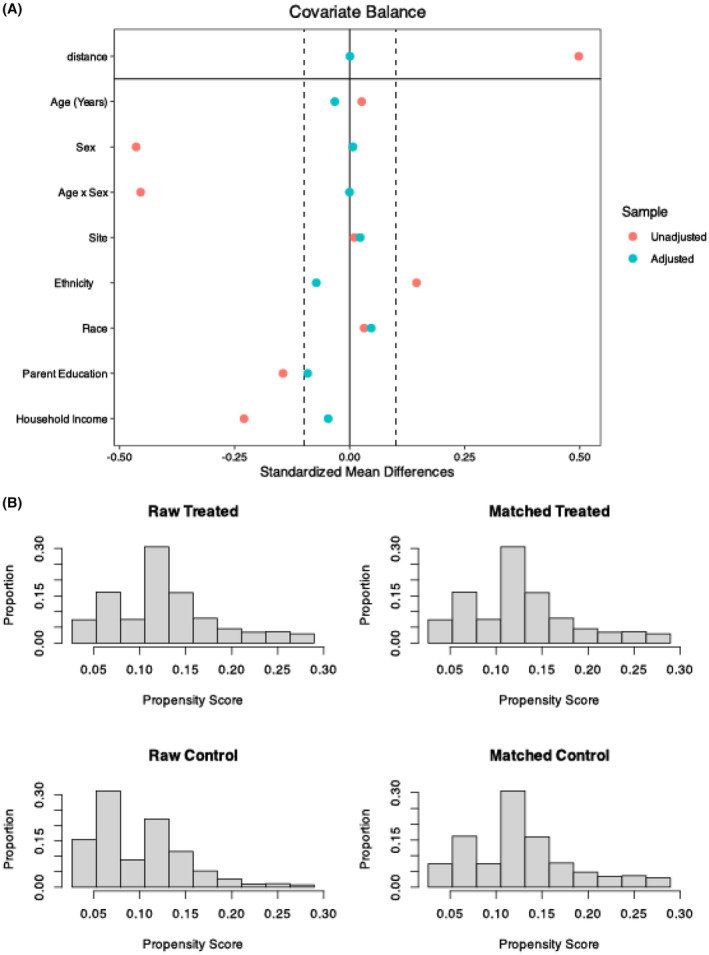
Associations between CU traits, cognitive functioning, and externalizing outcomes were tested within dimensional (n = 11,868) and propensity-matched group-based (n = 1,224) models using data from the Adolescent Brain Cognitive Development Study®, with rigorous statistical control for shared sociodemographic risk factors. Cross-sectional outcomes were parent-reported symptoms of conduct disorder (CD), oppositional defiant disorder (ODD), and attention deficit hyperactivity disorder (ADHD). Longitudinal outcomes were child-reported overt and relational aggression.
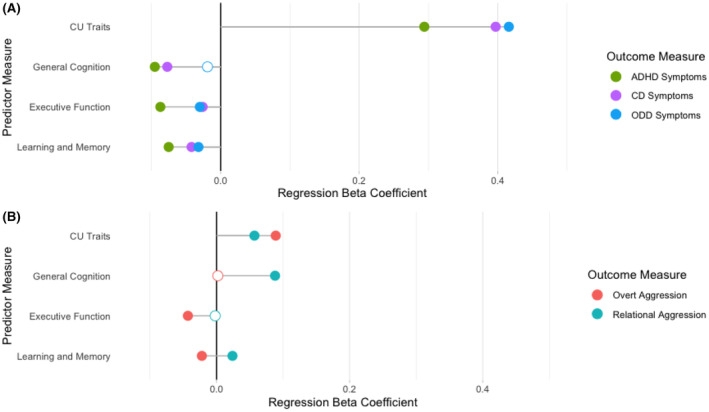
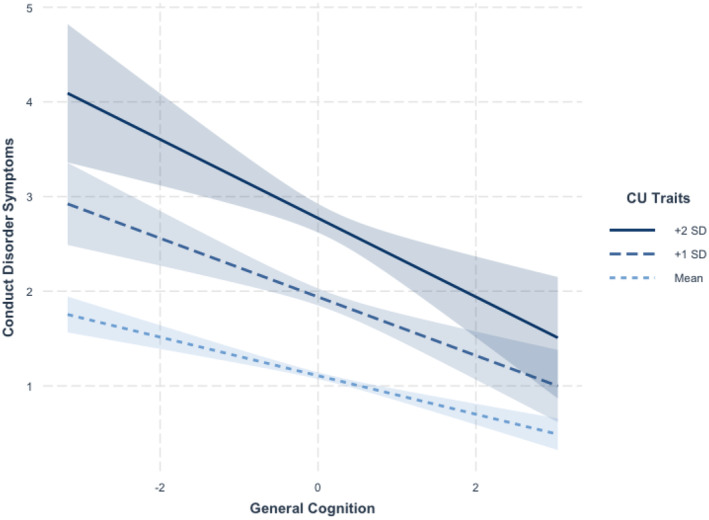
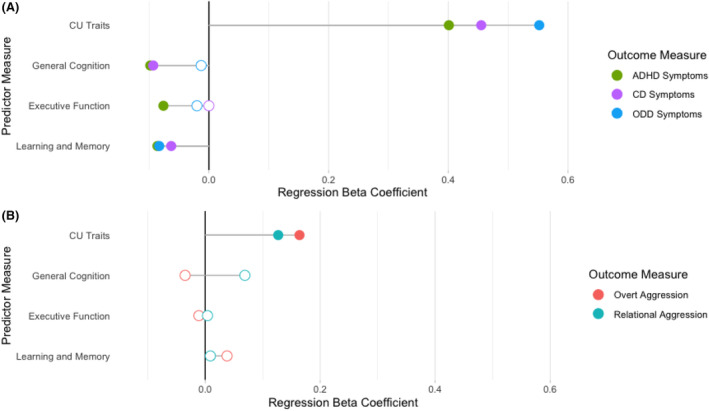
CU traits were uniquely related to more parent-reported CD, ODD, ADHD symptoms, as well as more child-reported aggressive behaviors. Effects of cognitive difficulties were domain specific and were not consistent across dimensional and propensity matched models. There was minimal evidence for divergent associations between CU traits and externalizing outcomes as a function of cognition (i.e., no moderation).
Rigorous control for sociodemographic factors within propensity-matched models establish CU traits as a robust and unique risk factor for externalizing psychopathology, over and above difficulties with cognitive functioning.
许多研究表明,冷酷无情(CU)特质(如低同理心、缺乏内疚感)和认知困难都会增加个体在整个发育过程中出现外化性精神病理学问题的风险。然而,其他研究表明,某些攻击行为(如关系型、主动性攻击)可能依赖于完整的认知功能,而这种认知功能可能会因CU特质的存在而有所不同。此外,之前没有研究充分考虑到CU特质、认知困难和外化性问题所共有的常见风险因素,这使得关于它们之间所谓关系的结论存在混淆。本研究通过运用严格的倾向匹配方法来分离CU特质与认知功能不同维度以及外化性问题之间的关联,从而填补了这些知识空白。
使用青少年大脑认知发展研究(Adolescent Brain Cognitive Development Study®)的数据,在维度模型(n = 11,868)和基于倾向匹配组的模型(n = 1,224)中测试CU特质、认知功能和外化性结果之间的关联,并对共享的社会人口统计学风险因素进行严格的统计控制。横断面结果是家长报告的品行障碍(CD)、对立违抗障碍(ODD)和注意力缺陷多动障碍(ADHD)症状。纵向结果是儿童报告的公开攻击和关系型攻击行为。
CU特质与家长报告的更多CD、ODD、ADHD症状以及儿童报告的更多攻击行为存在独特关联。认知困难的影响具有领域特异性,在维度模型和倾向匹配模型中并不一致。几乎没有证据表明CU特质与外化性结果之间存在因认知而产生的不同关联(即不存在调节作用)。
在倾向匹配模型中对社会人口统计学因素进行严格控制后发现,CU特质是外化性精神病理学的一个强大且独特的风险因素,超越了认知功能方面的困难。